You searched: 238 results

Filter your search results

General feature

  • Plant origin ?
  • Plant type ?
  • Plant shape or form ?
  • Growth habit ?
  • Growth rate ?
  • Height or length ?
  • Lifespan ?
  • Tolerance ?

Flowering feature

  • Flower colour ?
  • Flowering season ?
  • Ornamental flowering ?

Foliage feature

  • Foliage density ?
  • Leaf retention ?
  • Ornamental foliage ?

Fruiting feature

  • Fruit colour at maturity ?
  • Fruiting season ?
  • Fruit size ?
  • Ornamental fruiting ?

Problem feature

  • Hay fever ?
  • Litter ?
  • Poison or irritant ?
  • Sharp parts ?
  • Vigorous growth ?
  • Weed risk ?

Growing environment

Use

  • Art, craft and culture ?
  • Beauty and skin care ?
  • Cleaning ?
  • Construction ?
  • Environmental service ?
  • Food and drink ?
  • Food additive ?
  • Fuel ?
  • Garden (home & public) ?
  • Livestock, bees and fish ?
  • Pest and disease control ?
  • Raw material ?

Health use

  • Mind-body medicine ?
  • Essential fatty acids ?
  • Personal care ?
  • Tonic ?
  • Vitamin and mineral ?

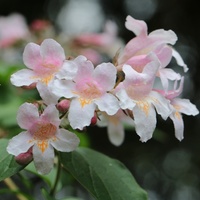
  • Chinese abelia
    Chinese abelia
    Native to southern China, this flowering shrub grows 1 to 2 m (3 to 6 ft) tall and has long, cane-like branches that arch toward the ground, giving it a graceful, weeping, fountain-like shape.The leaves are small and glossy green, remaining on t... more...
  • Okra
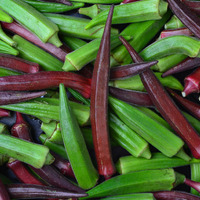
    Okra
    Okra is an annual sub-shrub closely related to cotton and hibiscus. It originates from tropical Africa but is now widely cultivated in many countries for its immature seedpods, which are cooked and eaten as a vegetable.It typically grows 1 to 2 m (3... more...
  • Slippery Cabbage
    Slippery Cabbage
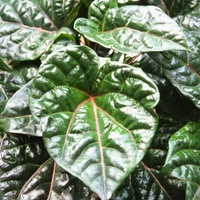
    Slippery Cabbage, or Aibika, is a fast-growing shrub in the Hibiscus family that produces edible leaves and is native to a wide geographic area extending from Southeast Asia to Melanesia, a region in the Pacific encompassing Papua New Guine... more...
  • Ambrette
    Ambrette
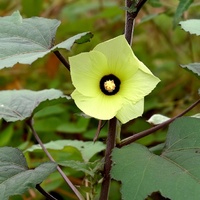
    Ambrette is an Okra (Abelmoschus esculentus) relative that originated in India and is cultivated for its seed, which yields a valuable essential oil.The main centres of cultivation are its native India, the Seychelles, Nosy Be in Madagascar, El Salva... more...
  • Mulga
    Mulga
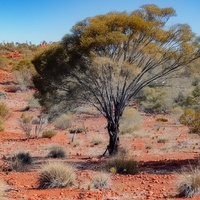
    Mulga is a landscape shrub or small tree native to outback Australia and well suited to dry climates. It has been introduced into Kenya, South Africa and the south-western United States.A highly variable species, it has up to ten naturally evolved va... more...
  • Earleaf Acacia
    Earleaf Acacia
    Earleaf Acacia is a woody legume native to tropical Australia and Papua New Guinea.It varies widely in the wild, from shrubs 2 to 5 m (7 to 16 ft) tall on exposed coastal sites to large timber trees reaching up to 30 m (100 ft) under favourable condi... more...
  • Bailey's Wattle
    Bailey's Wattle
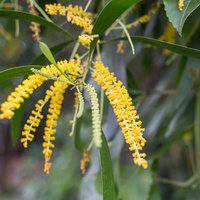
    Native to Australia, this flowering shrub to small tree typically grows 3 to 5 m (10 to 16 ft) tall, occasionally reaching up to 9 m (30 ft). In shrub form, it is multi-trunked and low-branching. Otherwise, it has a single trunk supporting a rounded... more...
  • Formosa Acacia
    Formosa Acacia
    Native to the Philippines, this fast-growing ornamental and forestry tree typically reaches 10 to 15 m (30 to 50 ft) tall, with a single or forked trunk supporting a moderately dense, rounded crown. The bark is grey or grey-brown and u... more...
  • Australian Blackwood
    Australian Blackwood
    Australian Blackwood is a tree species native to Australia. Its native range extends from Tasmania and the southeastern corner of the Australian mainland, north along the eastern seaboard to the subtropics.However, trees adapted to temperate and subt... more...
  • Pink Cedar
    Pink Cedar
    Pink Cedar, or Mundani, is a fast-growing flowering timber tree native to parts of the Indian subcontinent and Southeast Asia. Its natural range extends from the foothills of the Himalayas east to forested highland areas in Myanmar (Burma), Thailand... more...
< Page 1 of 24 >
© All rights reserved Iplantz 2026