

Common name: Formosa Acacia
Other common names: False Koa, Formosan Koa, Fine Leaved Wattle, Taiwan Acacia
Description
Native to the Philippines, this fast-growing ornamental and forestry tree typically reaches 10 to 15 m (30 to 50 ft) tall, with a single or forked trunk supporting a moderately dense, rounded crown. The bark is grey or grey-brown and usually smooth.
The leaves are long and narrow, slightly curved or sickle-shaped, medium green, and remain on the tree year-round.
The flowers are small, bright yellow and round, in the shape of small puff-balls. They bloom in profusion from spring to summer, in clusters at the ends of the branches, creating a showy display. Masses of flat, brown seedpods soon follow and persist on the tree before eventually drying and falling to the ground.
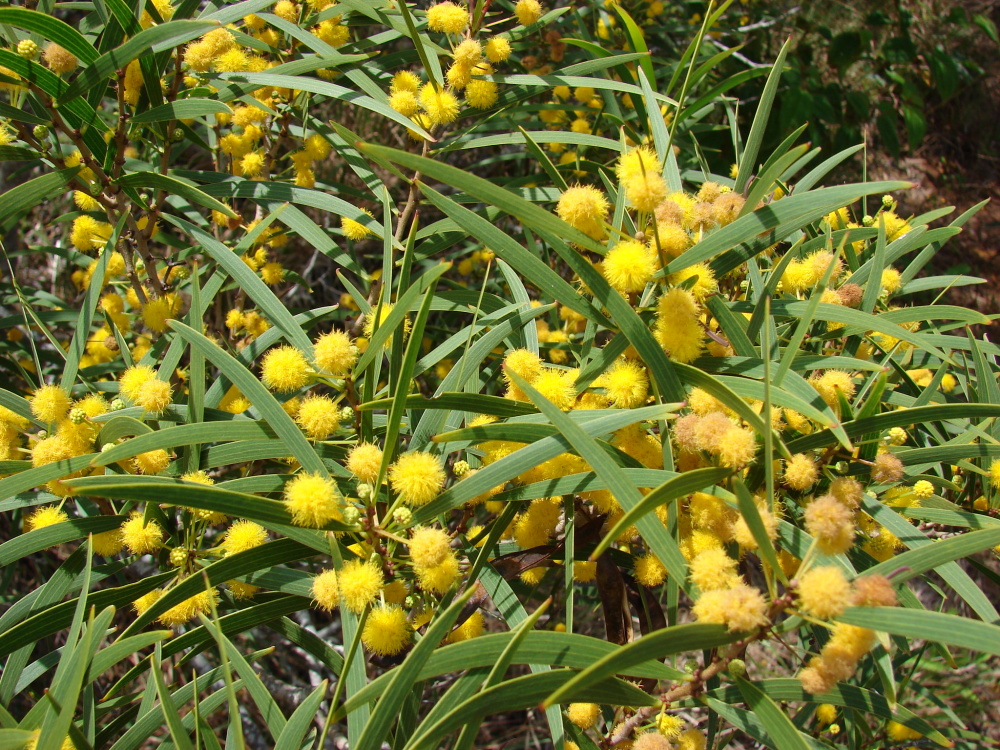
Photo by Kim Starr
Environmental uses
Nitrogen-fixing - A resilient forest tree, it can withstand adverse weather events thanks to its extensive root system, which also has nitrogen-fixing abilities, helping enrich the soil as it grows.
Land rehabilitation - This has led to its widespread use in forest regeneration projects, particularly on degraded soils and sloping land.
Erosion control - To minimise soil erosion.
Watershed protection - And also helps protect watershed areas.
Flowering ornamental - It is also cultivated as a landscape tree in Hawaii, mainly for its showy flowering display. However, the leaves emit an unpleasant odour when brushed or ruffled by the wind.
Material uses
Hardwood - It produces medium- to heavy-weight wood, averaging about 750 kg per cubic metre (47 lb per cubic ft), placing it in the hardwood class. However, many trees develop low branching or forked trunks with small diameters, making them impractical to saw into lumber.
Firewood - The trunk and main branches are often only suitable in roundwood form, to be cut into lengths for firewood.
Charcoal - And charcoal.
Climate
Grows naturally in humid subtropical and tropical lowland to mid-elevation climates, generally areas with annual lows of 16 to 24°C, annual highs of 25 to 33°C, annual rainfall of 1200 to 3000 mm and a dry season of 6 months or less.
Growing
New plants are usually started from seed, which is pre-treated by immersing it in near-boiling water for about a minute.
It performs best on free-draining clay, loam, and sand soils of a moderately acid to slightly alkaline nature, generally with a pH of 5.5 to 7.5, and on sites with full to partial sun exposure. It tolerates strong winds and drought conditions.
Problem features
There do not appear to be any reports of seed dispersal by birds or other animals. However, many seeds that fall to the ground germinate readily, creating dense, impenetrable stands or thickets over time and eventually crowding out other plant species. It is considered a major weed in most areas where it has been introduced. The Hawaii Pacific Weed Risk Assessment (HPWRA) project assessed it as a high weed risk species for Hawaii.
The roots are quite vigorous and wide-spreading, which can damage building foundations, pavements, and sidewalks (footpaths) if the tree is planted too close to these structures.
Where it grows
References
Books
-
Allen, O. N. & Allen, E. K. 1981, The Leguminosae : a source book of characteristics, uses, and nodulation, University of Wisconsin Press, Madison, Wisconsin
-
Barwick, M., et al. 2004, Tropical & subtropical trees : a worldwide encyclopaedic guide, Thames and Hudson, London
-
Holttum, R. E. & Enoch, I. C. 2010, Gardening in the tropics : the definitive guide for gardeners, Marshall Cavendish Editions, Singapore
-
Jim, C.Y. 1990, Trees in Hong Kong: Species for Landscape Planting, Hong Kong University Press, Hong Kong
-
Little, E. L. & Skolmen, R. G. 1989, Common forest trees of Hawaii (native and introduced), Agricultuural Handbook No. 679, Forest Service, U.S. Department of Agriculture, Washington, D.C.
-
Randall, R. P. 2002, A global compendium of weeds, R.G. and F.J. Richardson Press, Melbourne
-
Rauch, F. D. & Weissich, P. R. 2000, Plants for tropical landscapes : a gardener's guide, University of Hawaii Press, Honolulu
-
Reyes, G. 1992, Wood densities of tropical tree species, U.S. Department of Agriculture, Forest Service, Southern Forest Experiment Station, New Orleans, Louisiana