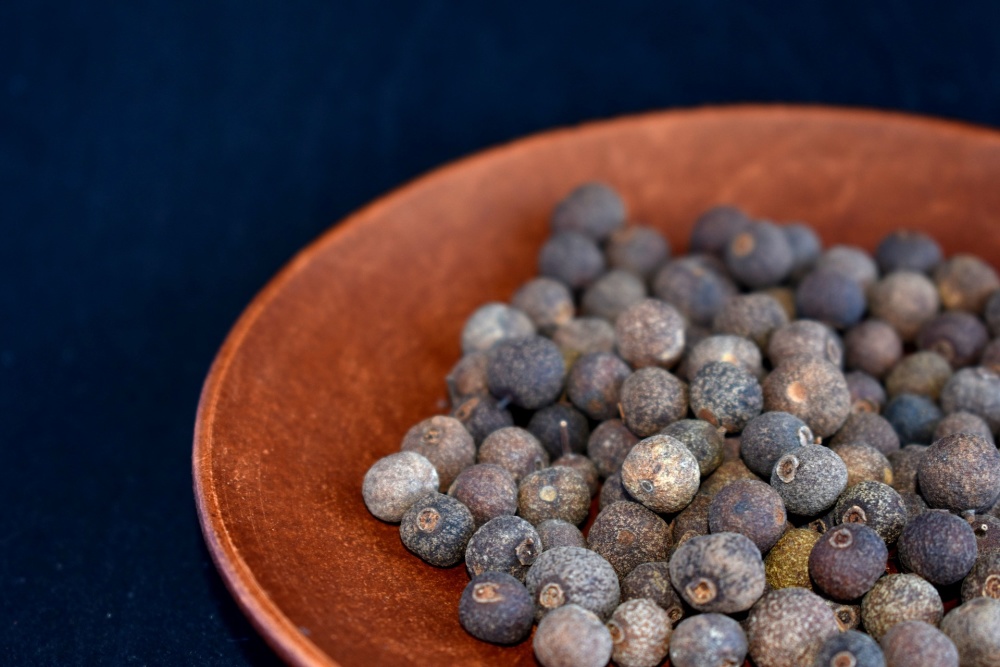


Common name: Allspice
Other common names: Clover Pepper, Jamaica Pepper, Pimento
Description
Allspice, or Pimento, is a spice and essential oil-yielding tree originating in the Caribbean and Central America. Its natural range extends from the islands of Jamaica and Cuba to the Caribbean side of Central America, including Belize, El Salvador, Guatemala, Honduras, Nicaragua and the east coast of the Yucatan Peninsula in Mexico.
It is a slow-growing tree, typically reaching 10 to 15 m (30 to 50 ft) tall, though it can reach up to 18 m (60 ft), with a stout trunk and a densely branched, rounded crown. The bark is creamy brown and peeling, exposing smooth, creamy white underbark.
Leaves are oval, up to 20 cm (8 in) long, dark glossy green above, light green underneath and dotted with numerous oil-filled pores. They release a strong, spicy aroma when crushed, reminiscent of clove, nutmeg, and cinnamon, and remain on the tree year-round in a dense arrangement that casts deep shade.
Flowers are creamy-white, small, up to 0.5 cm (0.2 in) in diameter, and sweetly fragrant, releasing a spicy, air-filling aroma. Female and male flowers are on separate trees, in domed- or pyramidal-shaped clusters that bloom in mid-summer in its native range.
Fertilised flowers are followed by small, round, green berries that turn purple to near black when ripe, usually from late summer to autumn, with one or occasionally two large seeds.
Edible uses
Spice - When dried, the green, unripe berries are known as Allspice and are widely utilised, either whole or in powdered form, to flavour both sweet and savoury dishes. They flavour sausage meats, stews, soups, steamed fish, salty pickling brines for meats such as corned beef, and vinegar brines for pickling fish and vegetables.
It is also a common ingredient in sauces, including tomato ketchup, barbecue sauces, and marinades, and in sweet dishes as a substitute for other spices, such as Nutmeg (Myristica fragrans). The dried berries contain about 4% volatile oil, the main constituent of which is Eugenol, a compound also found in Cloves (Syzygium aromaticum).
Alcoholic drink - The French liqueurs 'Benedictine' and 'Chartreuse' derive flavour from the berries, as does 'Pimento-Dram', a Caribbean liquor made by soaking the ripe berries in alcohol, mainly white rum.
Culinary herb - Fresh leaves can also substitute for Bay leaves (from Laurus nobilis).
Natural flavouring - Pimento leaf oil, steam-distilled from the tree's leftover leaves and twigs, is also used as a flavouring agent in food and pharmaceutical products.
Food smoke - The pruned limbs are also used as smoke wood for barbecuing, particularly 'Jerk' barbecuing in Jamaica.
Material uses
Essential oil - The leftover leaves and small twigs are steam-distilled to extract an essential oil, traded as 'Pimento leaf oil'.
Natural fragrance - The oil is also sometimes used as a substitute for 'Bay oil', extracted from the leaves of the closely related Bay Rum Tree (Pimenta racemosa), the primary source of oil for making 'Bay rum', a popular men's cologne and after-shave esteemed for its spicy fragrance.
Wood craft - The wood is heavy and durable, with pinkish heartwood, though the tree is not usually felled for its timber, given its economic importance as a spice crop. The pruned limbs are instead used in woodcraft.
Tool handles - Also used for tool handles.
Firewood - Also used as general-purpose firewood.
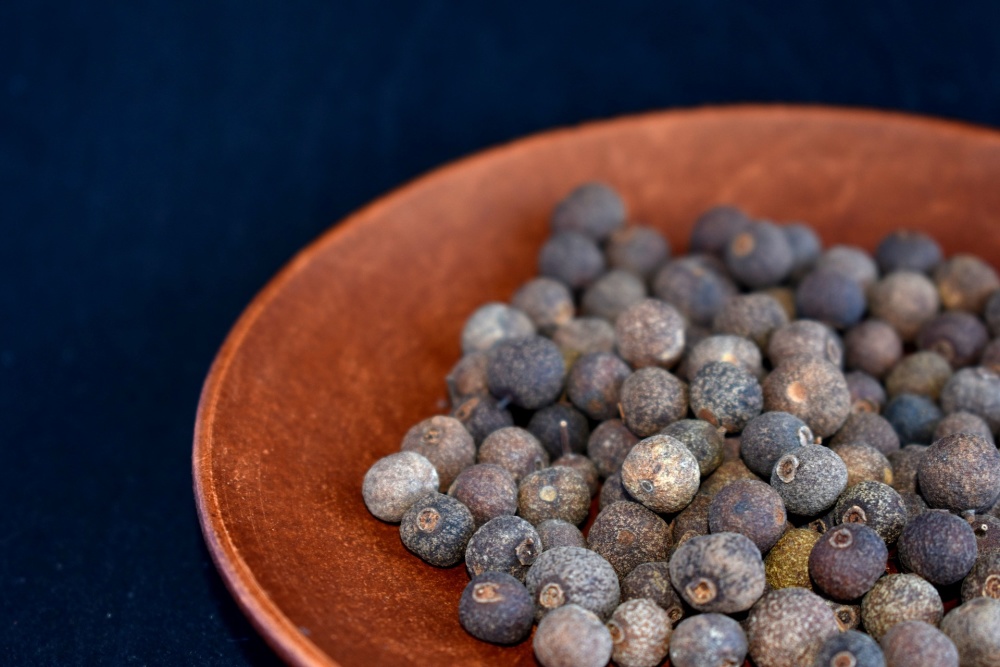
Dried Allspice berries
Climate
Grows and fruits naturally in moderately humid to humid tropical lowland to mid-elevation climates, generally in frost-free areas with annual lows of 17 to 25°C, annual highs of 25 to 35°C, annual rainfall of 1200 to 3200 mm and a dry season of 5 months or less, extending to 7 months with irrigation or groundwater.
Growing
New plants usually start from seed, which loses its viability quickly and should be sown soon after the ripe berries are harvested. Some success is reported with cuttings of one-year-old wood dipped in a rooting hormone, which would allow better control over the ratio of male to female plants.
Volunteer seedlings sprouted from bird droppings are another source of propagation material.
Performs best on free-draining clay and loam soils of a moderately acid to alkaline nature, generally with a pH of 5.5 to 8.0, and on sites with full to partial sun exposure.
To harvest the green berries, berry-bearing limbs and twigs are pruned from the tree. The berry clusters are then rubbed between the hands until they fall, after which they are collected, dried and bagged. Average yields range from 10 to 25 kg (22 to 55 lbs) of berries per tree per year, and many factors influence this yield.
Problem features
Allspice plants have been introduced into regions outside of their native range. It is recorded as naturalised in India and in Hawaii, where it is listed as an invasive species, having spread with the help of birds to native forests on the islands of O'ahu, Maui and Kaua'i. It is assessed as a high weed risk species for Hawaii by the Hawaii Pacific Weed Risk Assessment (HPWRA) project.
Where it grows
References
Books
-
Adams, C. D. 1972, Flowering plants of Jamaica, University of the West Indies, Mona, Greater Kingston
-
Alexiades, M.N. & Shanley, P. 2005, Forest products, livelihoods and conservation: case studies of non-timber forest product systems, volume 3 (Latin America), Bogor, Indonesia
-
Attokaran, M. 2011, Natural food flavors and colorants, Institute of Food Technologists, Wiley-Blackwell Publishing, Oxfordshire
-
Barwick, M., et al. 2004, Tropical & subtropical trees : a worldwide encyclopaedic guide, Thames and Hudson, London
-
Chevallier, A. 2000, Encyclopedia of herbal medicine, 2nd American ed., Dorling Kindersley, New York
-
Culbreth, D. M. R. 1927, A manual of materia medica and pharmacology : comprising the organic and inorganic drugs which are or have been recognized by the United States pharmacopeia, 7th ed., Febiger, Philadelphia
-
Fawcett, W. 1891, Economic plants, An index to economic products of the vegetable kingdom in Jamaica, Jamaica Government Printing Establishment, Kingston
-
Khan, I. A. & Abourashed, E. A. 2010, Leung's encyclopedia of common natural ingredients : used in food, drugs and cosmetics, 3rd edition, Wiley Publishing, Hoboken, New Jersey
-
Lopez, C., et al. 2004, Riches of the forest: fruits, remedies and handicrafts in Latin America, Center for International Forestry Research (CIFOR), Bogor, Indonesia
-
Randall, R. P. 2002, A global compendium of weeds, R.G. and F.J. Richardson Press, Melbourne
-
Randall, R. P. 2007, The introduced flora of Australia and its weed status, Cooperative Research Centre for Australian Weed Management, Glen Osmond, South Australia
-
Seidemann, J. 2005, World spice plants: economic usage botany taxonomy, Springer-Verlag, Berlin
-
Stewart, A. 2013, The drunken botanist : the plants that create the world's great drinks, 1st ed., Algonquin Books, Chapel Hill, North Carolina
-
Vázquez, Y. C. 1999, Potentially valuable Mexican trees for ecological restoration and reforestation, Institute of Ecology, Database SNIB-REMIB-CONABIO, Project J084, Mexico
-
Weiss, E. A 2002, Spice crops, CABI Publishing, Wallingford, United Kingdom
Articles, Journals, Reports and Working Papers
-
Douglas M. & Heyes J. & Smallfield B. 2005, Herbs, Spices and Essential Oils Post-Harvest Operations in Developing Countries, Food and Agriculture Organization of the United Nations (FAO), Rome