

Common name: Indian Butter Tree
Other common names: Bassia, Butter Nut Tree, Illipe Nut, Illupai, Ippe, Mabua Butter Tree, Moatree, Moah Tree, Mowra Butter Tree, South Indian Mahua
Description
Mahua, or Indian Butter Tree, is one of India's most important trees, with its flowers and seeds providing food and a livelihood for countless people across the subcontinent.
Two varieties are known: var. longifolia, which occurs in southern India and parts of Sri Lanka, and var. latifolia, which is more widely distributed in India. Only the latter variety is described here, with a natural range extending across northern India, from Punjab to West Bengal, and from Central India to Tamil Nadu.
It grows relatively slowly to heights of up to 18 m (60 ft), though it is more commonly 10 to 15 m (33 to 50 ft) tall, with a stout trunk supporting a wide-spreading, rounded crown. The bark is grey, cracked and flakes off in thin pieces. When wounded, it exudes thick, milky sap.
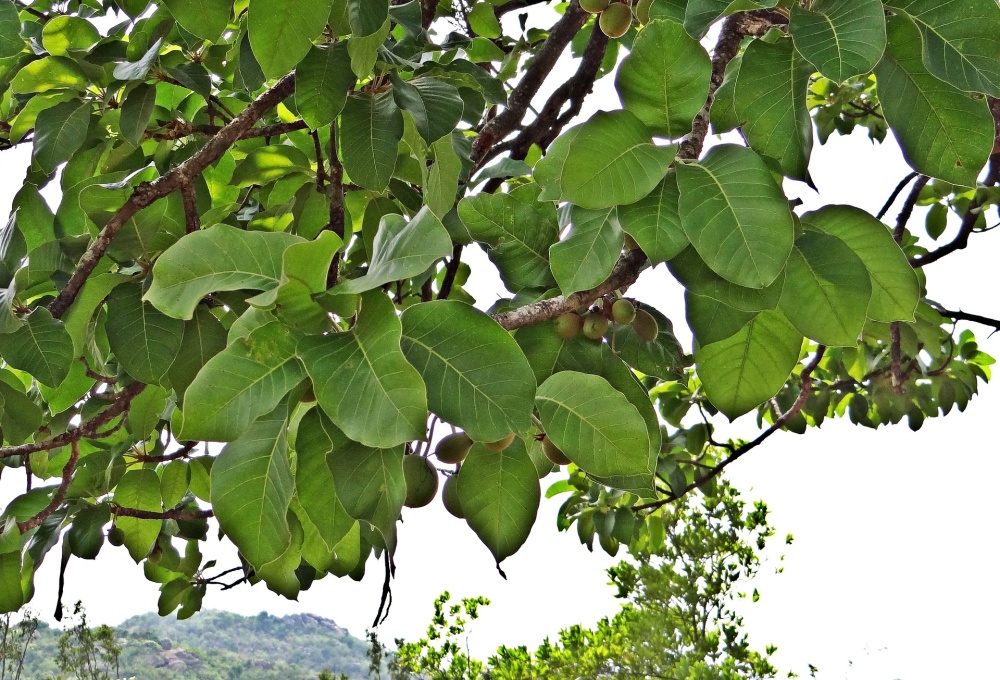
The leaves are oval and pointed, up to 23 cm (9 in) long, crimson-red when they emerge, and become dark green with age; they are prominently veined, thick, and leathery. They form in clusters at the ends of the branches and, in the dry season, turn yellow and fall off the tree to conserve water, leaving the branches exposed.
Flowering follows soon after leaf fall with the formation of dense clusters of hairy, rust-coloured flower buds at the tips of the branches. The buds develop into creamy-white, oval flowers up to 1.5 cm (0.6 in) long with fused, fleshy petals that do not open. They are believed to be wind-pollinated and number in the thousands on mature trees. Each morning, they fall to the ground, where people, livestock, and other animals eagerly seek them.
Fertilised flowers are followed by fleshy oval fruit up to 5 cm (2 in) long, which are green when young, becoming reddish-yellow or orange when ripe, and have up to four glossy, dark brown seeds inside.
Edible uses
Dried fruit - The flowers fall to the ground naturally in great numbers. Mature trees produce up to 100 kgs (220 lbs) of flowers in a season. They are collected, sun-dried, and eaten, much like dried fruit.
Syrup or cordial - Sugar syrup is made by immersing and macerating the flowers in hot water, straining off the liquid, filtering it through activated charcoal and reducing it to a syrupy consistency under a slight vacuum. The resulting syrup is honey coloured with a floral aroma.
Plant-based alcohol- Natural yeast fermentation occurs quickly in the sugar-rich flowers. Alcohol is made by steeping them in first boiled, then cooled water, allowing them to ferment, then distilling the resulting liquid. One tonne (1000 kgs; 2200 lbs) of flowers yields about 400 litres (106 gallons) of 95% ethanol, which is double distilled to remove any foetid odour.
Plant-based vinegar - The fermenting flowers are also processed into vinegar.
Edible oil or fat - Mechanical pressing of the seed yields up to 60% oil, known as 'Mowrah butter' or 'Illipe butter'. Mowrah or Illipe butter is used as a cacao butter equivalent (CBE) to replace expensive cacao butter (from Theobroma cacao) in confectionery.
Material uses
Non-drying oil - 'Mowrah butter' or 'Illipe butter' is a viscous, pale yellow or green non-drying oil that, on refinement, has little or no colour. Non-drying oils remain liquid and do not harden when exposed to air, making them ideal for lubrication and moisturising skin.
Natural soap - Considerable quantities of the seed were once exported to Europe, particularly Germany, where the oil was extracted, refined and used to make soap and candles.
Livestock forage - Not all of the flowers that fall to the ground are collected. They fall in such great numbers that some are left for livestock to browse.
Livestock feed - And the mash left over after alcohol and syrup production is fed to livestock. Dairy cows fed a mixed diet supplemented with the flowers produce milk with an agreeable, nutty flavour.
Hardwood - Mahua trees produce a medium-weight, reddish-brown wood, averaging about 740 kgs per cubic metre (46 lbs per cubic ft).
Decay- and rot-resistant wood - The wood has high natural resistance to rot and decay, placing it in the durable hardwood class and making it suitable for indoor and outdoor construction, including heavy and light construction, particularly furniture and cabinets. However, the tree is rarely felled for its wood, as its flowers and seed are more economically important.
Environmental uses
Green manure - The leftover seed-cake has a high saponin content, making it unsuitable for livestock feed, but it makes an excellent organic fertiliser.
Health uses
In its native range, the seed oil is used as a laxative, and the flowers as a demulcent and expectorant, prescribed as a decoction to treat coughs, colds, and general respiratory complaints.
Calcium - The flowers and their nectar are rich in energy-giving sugars, calcium and trace elements.
Climate
Grows naturally in sub-humid to moderately humid subtropical and tropical climates, generally areas with annual lows of 17 to 25°C, annual highs of 28 to 35°C, annual rainfall of 600 to 1800 mm and a dry season of 6 to 8 months.
Growing
Performs best on rich, free-draining loam and sand soils (less well on clay soils) of a moderately acid to slightly alkaline nature, generally with a pH of 5.0 to 7.5, and on sites with full to partial sun exposure. It has poor tolerance for slow-draining or waterlogged soils and shade.
Problem features
There appears to be no record of it as a weed or invasive species.
The wood is known to cause dermatitis in woodworkers.
Where it grows
References
Books
-
Asouti, E. & Fuller, D. Q. 2008, Trees and woodlands of South India : archaeological perspective, Left Coast Press, Walnut Creek, California
-
Bradbear, N. 2009, Bees and their role in forest livelihoods : a guide to the services provided by bees and the sustainable harvesting, processing and marketing of their products, Food and Agriculture Organization of the United Nations (FAO), Rome
-
Brady, G. S. & Clauser, H. R & Vaccari, J. A. 2002, Materials handbook : an encyclopedia for managers, technical professionals, purchasing and production managers, technicians and supervisors, 15th ed., McGraw-Hill, New York
-
Champion, H. G. & Seth, S. K. 1968, A revised survey of the forest types of India, Natraj Publishers, Dehradun, India
-
Chevallier, A. 2000, Encyclopedia of herbal medicine, 2nd American ed., Dorling Kindersley, New York
-
Colfer, C. J. et. al 2006, Forests and human health : assessing the evidence, Center for International Forestry Research (CIFOR), Bogor Barat, Indonesia
-
Crane, E., Walker, P. & Day, R. 1984, Directory of important world honey sources, International Bee Research Association, London, United Kingdom
-
Dey, S.C. 1996, Fragrant flowers for homes and gardens, trade and industry, Abhinav Publications, New Delhi, India
-
Gohl, B. 1981, Tropical Feeds : feed information summaries and nutritive values (Revised edition), Food and Agriculture Organization of the United Nations (FAO), Rome
-
Hocking, D. 1993, Trees for drylands, International Science Publisher, New York
-
Jamieson, G. S. 1943, Vegetable fats and oils : their chemistry, production, and utilization for edible, medicinal and technical purposes, 2d ed, Reinhold, New York
-
Krishen, P. 2006, Trees of Delhi : a field guide, Dorling Kindersley Publishers, Delhi
-
Luna, R. K 1996, Plantation trees, International Book Distributors, Dehradun, Uttarakhand
-
Macmillan, H. F. 1943, Tropical planting and gardening : with special reference to Ceylon, 5th ed, Macmillan Publishing, London
-
Martin, F. M., et al. 1987, Perennial edible fruits of the tropics : an inventory, U.S. Dept. of Agriculture (USDA), Agricultural Research Service, U.S. Government Printing Office (GPO), Washington, D.C.
-
Mollison, B. 1993, The permaculture book of ferment and human nutrition (Duplicate), Tagari Publications, Tyalgum, New South Wales
-
Parrotta, J. A. 2001, Healing plants of peninsular India, CABI Publishing, Wallingford, Oxfordshire
-
Reyes, G. 1992, Wood densities of tropical tree species, U.S. Department of Agriculture, Forest Service, Southern Forest Experiment Station, New Orleans, Louisiana
-
Scheffer, T. C & Morrell, J. J. 1998, Natural durability of wood : a worldwide checklist of species, Forest Research Laboratory, Oregon State University, Corvallis, Oregon
-
Singh, R. V. 1982, Fodder trees of India, Oxford & IBH Publishing Company, New Delhi
-
Tatken, R. L., & C. A. Browning 1987, Health effects of exposure to wood dust: A summary of the literature. No. PB-87-218251/XAB, National Institute for Occupational Safety and Health, Cincinnati, Ohio
-
Wickens, G. E 1995, Edible nuts, Food and Agriculture Organization of the United Nations (FAO), Rome