

Common name: Atemoya
Description
Atemoya is a type of custard apple that does not grow wild. It is a hybrid created by crossing Cherimoya (Annona cherimola) with Sugar Apple (Annona squamosa). Like other Annona plants, it is native to tropical America. Today, it is grown in backyards around the world and farmed commercially in Australia, Israel, and South Africa.
This small tree usually grows between 3 and 7 meters (10 to 23 feet) tall, but can reach up to 10 meters (33 feet). Its branches spread widely and start low to the ground, creating a dense, rounded crown of leaves. The bark is smooth and ranges from grey to grey-brown.
The leaves are long and oval, reaching up to 15 cm (6 inches) in length. They are medium green, have smooth edges, and feel leathery. Leaves grow alternately along the stems near the ends of the branches. They fall off briefly just before new buds appear.
Atemoya flowers look like those of other Annona plants. They are oblong and tubular, up to 6 cm (2.4 inches) long, and have two sets of three petals. The inner petals are pale yellow, while the outer ones are yellow-green and leathery. Neither set opens fully. The flowers have both male and female parts and grow alone or in small clusters that hang down from the branches, attracting pollinating insects.
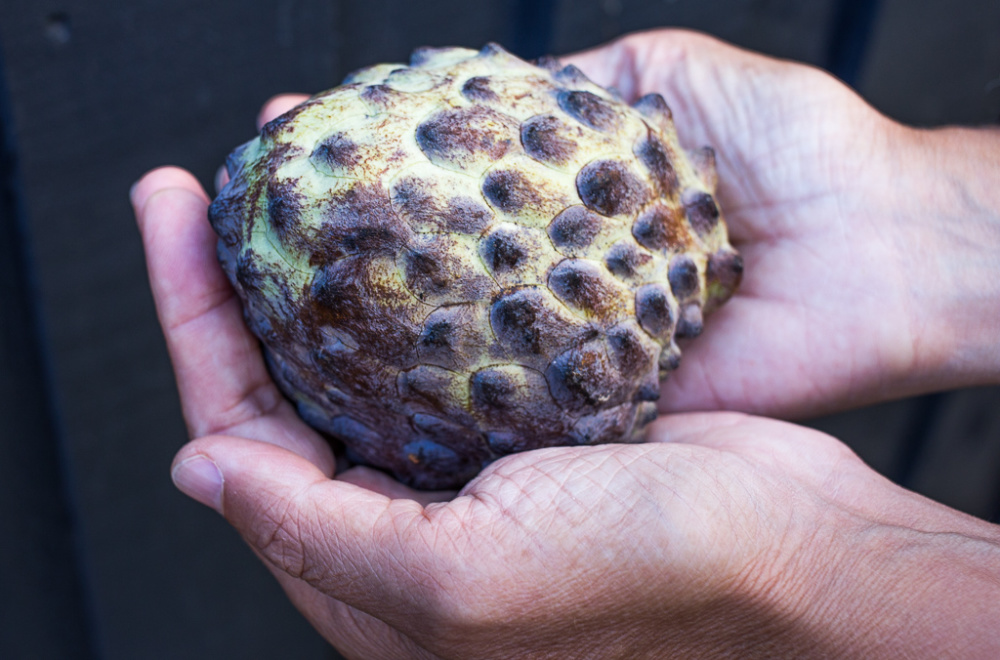
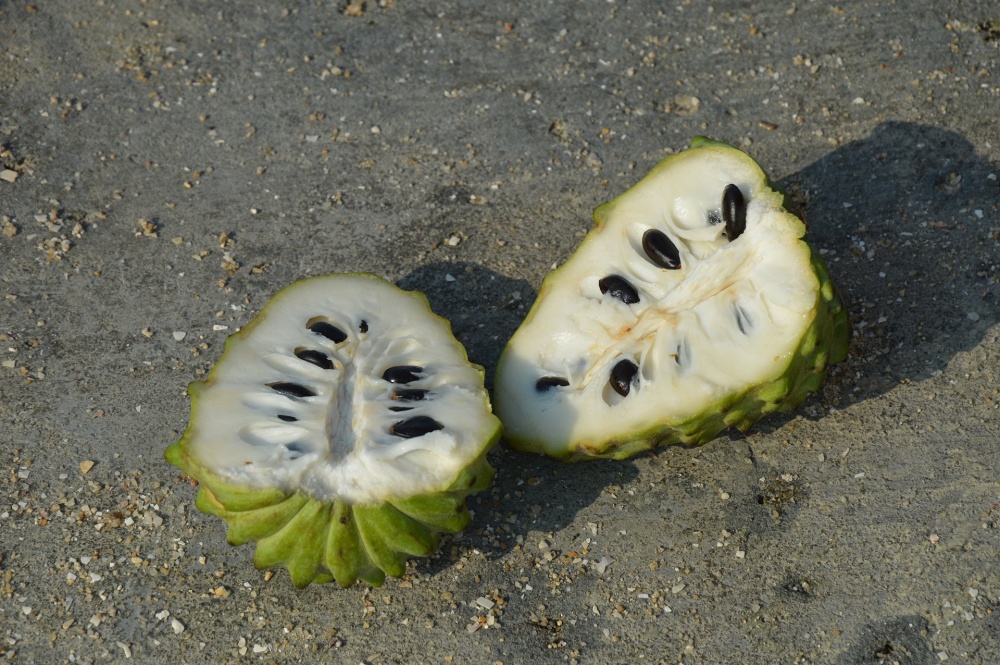
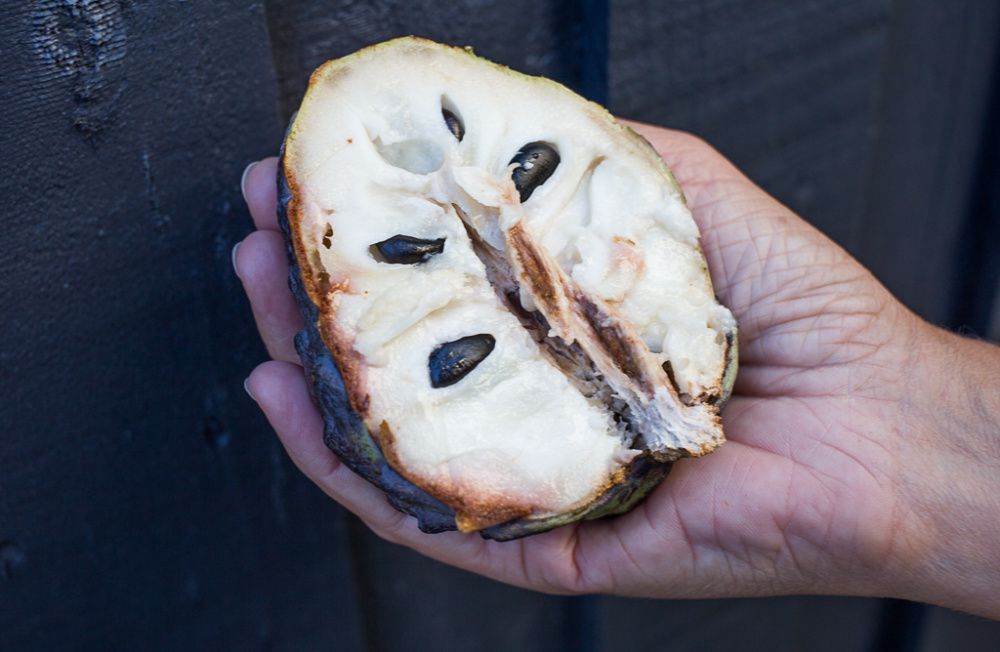
Once pollinated, the flowers develop into medium- to large-sized heart-shaped fruits, measuring 8 to 15 cm (3 to 6 inches) across and weighing between 0.3 and 1.0 kg (0.7 to 2.2 lbs), depending on the variety. The fruit has a thick, leathery green rind with a bumpy surface. Inside, there is soft white pulp with large, smooth, dark brown oblong seeds.
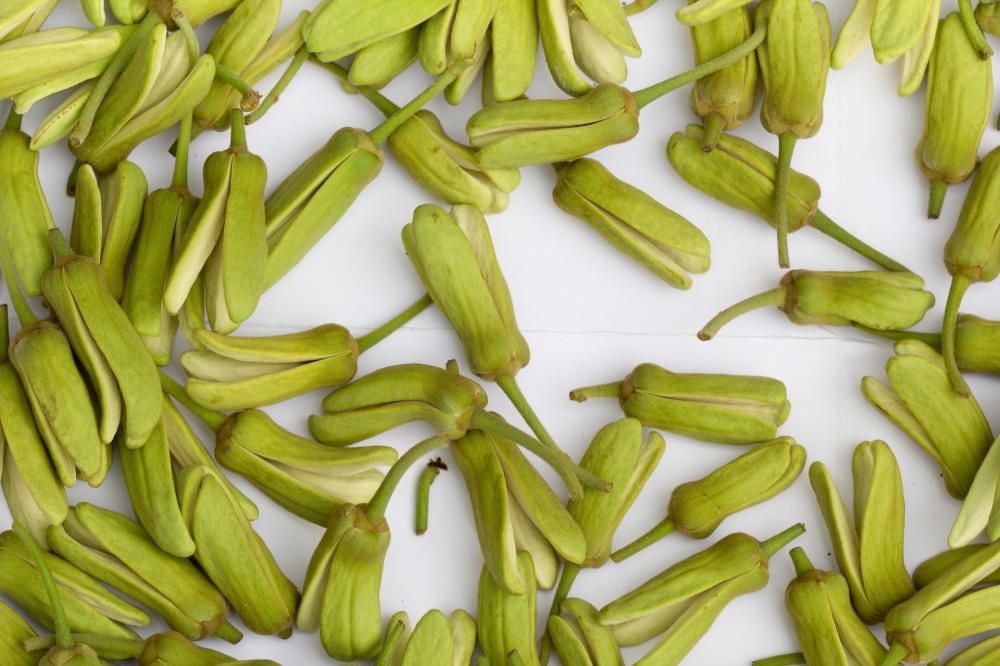
Flowers (Photo by Antonio Jose Cespedes from Pixabay)
Edible uses
Fresh fruit People usually eat ripe Atemoya fresh and enjoy its smooth, aromatic pulp, which is sweet or slightly tangy, much like Cherimoya (Annona cherimola). After removing the seeds, the fruit can also be blended into drinks or used to flavour cold desserts, such as ice cream.
Climate
Atemoya grows best and produces well in humid subtropical areas where yearly temperatures range from 13 to 33°C, rainfall is between 1000 and 3500 mm, and the dry season lasts five months or less. In humid tropical climates, it is better to plant heat-tolerant varieties like 'Genfer'.
Atemoya can also be grown in places with a dry season of up to eight months if irrigation is used. In dry areas, trees do better when misted from above their canopy to create a more humid microclimate.
Growing
New Atemoya plants are usually grown from cuttings or grafts because trees grown from seed often produce small or inedible fruit.
Common ways to propagate Atemoya include air-layering and grafting. Grafting works best when using rootstock from Atemoya, Cherimoya (Annona cherimola), or Sugar Apple (Annona squamosa) seedlings. Trees grown on Sugar Apple rootstock are usually smaller than those grown on other types.
Performs best on rich, free-draining loam and sand soils of a moderately acid to neutral pH (5.0 to 7.0), and on sites with full sun exposure. It has poor tolerance to clayey, slow-draining and waterlogged soils.
Commonly cultivated varieties include:
'Africa pride' - from South Africa, good flavour, average weight 300 to 500 g (0.67 to 1.1 lbs), much-seeded, benefits from hand pollination, moderately heat-tolerant;
'Gefner' - from Israel, good flavour, average weight 300 to 400 g (0.67 to 0.89 lbs), moderately seeded, self-pollinating, heat-tolerant;
'Pink Mammoth' - from Australia, good flavour, average weight 500 to 1000 g (1.1 to 2.2 lbs), moderately seeded, benefits from hand pollination;
'Dwarf Tropic Sun' - from Australia, good flavour, average fruit weight 300 to 400 g (0.67 to 0.89 lbs), moderately seeded.
Problem features
Atemoya produces fruit with seeds that can grow into new plants, and it has been introduced in many countries, but it is not considered a weed anywhere. There are no reports of it being a weed or an invasive species.
The seeds are poisonous and can irritate, so they should not be swallowed or allowed to come into contact with the eyes.
Where it grows
References
Books
-
George, A. et al. 1998, Custard Apple Information Kit, your growing guide to better farming, Agrilink Series QAL9904. Queensland Department of Primary Industries (QLD DPI), Brisbane
-
Janick, J., & Paull, R. E. 2008, The encyclopedia of fruit & nuts, CABI Publishing, Wallingford, Oxfordshire
-
Martin, F. M., et al. 1987, Perennial edible fruits of the tropics : an inventory, U.S. Dept. of Agriculture (USDA), Agricultural Research Service, U.S. Government Printing Office (GPO), Washington, D.C.
-
Morton, J. F. & Dowling, C. F. 1987, Fruits of warm climates, Creative Resources Systems, Winterville, North Carolina
-
Page, P. E. 1984, Tropical tree fruits for Australia, Queensland Department of Primary Industries (QLD DPI), Brisbane
-
Randall, R. P. 2002, A global compendium of weeds, R.G. and F.J. Richardson Press, Melbourne
-
Randall, R. P. 2007, The introduced flora of Australia and its weed status, Cooperative Research Centre for Australian Weed Management, Glen Osmond, South Australia
Articles, Journals, Reports and Working Papers
-
P. Padmanabhan, G. Paliyath, Annonaceous Fruits, Editor(s): Benjamin Caballero, Paul M. Finglas, Fidel Toldrá, Encyclopedia of Food and Health, Academic Press, 2016, Pages 169-173
-
Watson, B.J., & Moncur, M. 1985, Guideline criteria for determining survival, commercial and best mean minimum July temperatures for various tropical fruit in Australia (Southern Hemisphere), Department of Primary Industries Queensland (DPI QLD), Wet Tropics Regional Publication, Queensland