

Description
Achacha, or Achachairu, is a fruiting tree and a relative of Mangosteen (Garcinia mangostana), native to South America, with a range extending from southern Bolivia to neighbouring south-eastern Brazil.
However, considerable uncertainty remains about the different types or forms that occur there, including the extent of their distribution, their climate adaptation, and whether they should remain a single species or be divided into separate species. Because of this uncertainty, this description is limited to the types that occur within the area of the Department of Santa Cruz, in southern Bolivia, extending to as far south as the state of Mato Grosso do Sol, in Brazil.
It is a small- to medium-sized tree, 7 to 15 m (23 to 50 ft) tall, with a straight trunk up to 40 cm (1.3 ft) in diameter supporting a densely leafy pyramidal crown. The bark is dark brown and lightly flaking, and when wounded, it exudes sticky yellow latex.
The leaves are lance-shaped, 10 to 20 cm (4 to 8 in) long, pinkish-bronze or reddish when they emerge, ageing to lime green, then dark glossy green, and leathery. They are arranged in pairs at the ends of the branches and remain on the tree year-round.
The flowers are small, four-petaled, and white, with erect stamens; they are either perfect (with both female and male parts) or male. They are borne singly or in groups of up to twenty, arising at nodes along the branches, and come into bloom from winter to spring, coinciding with the dry season in its native range.
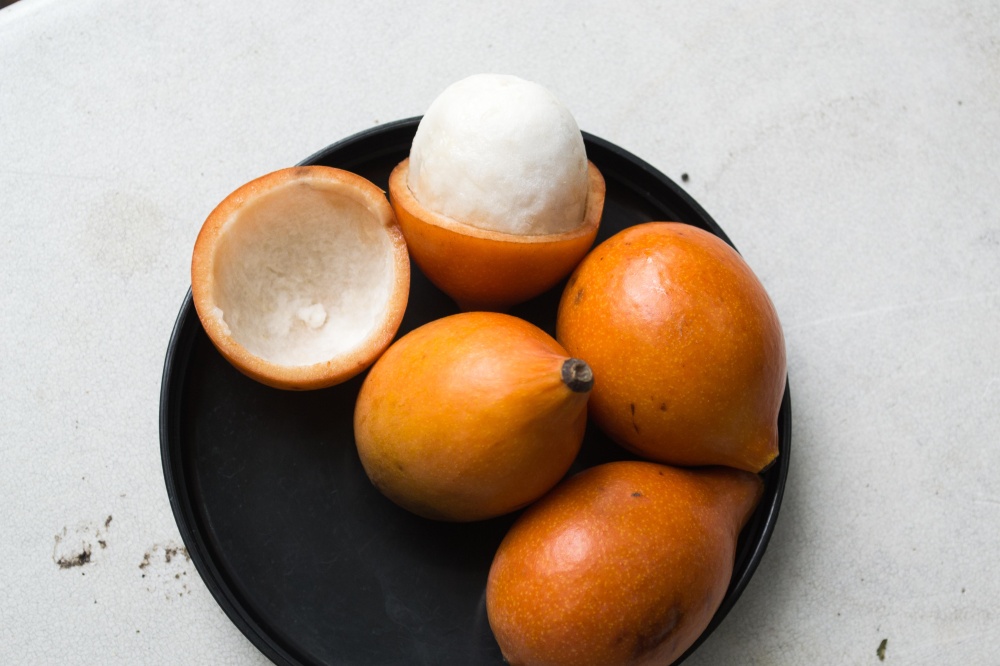
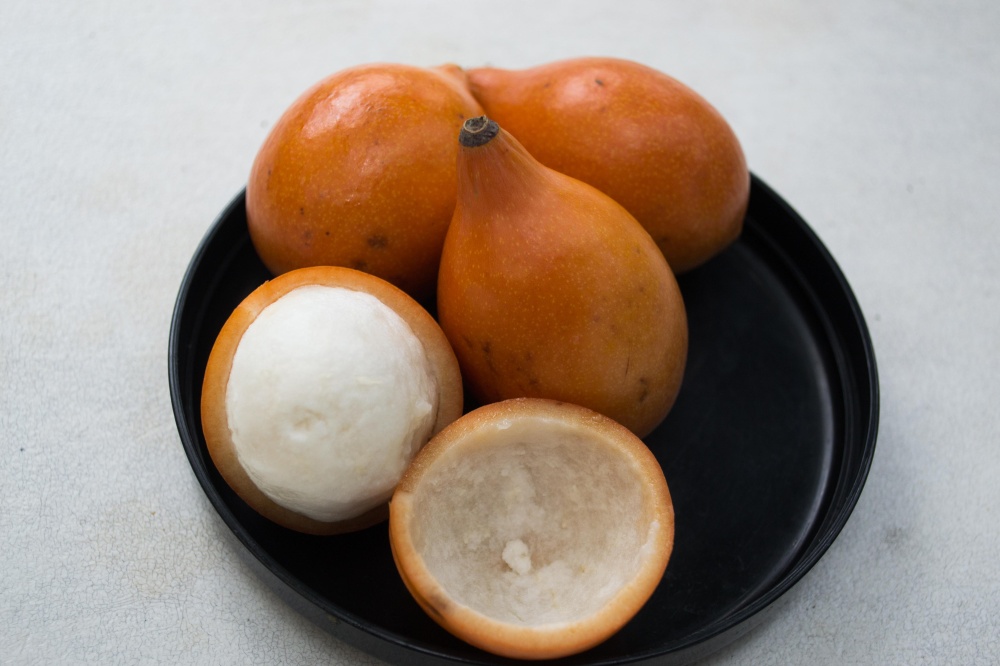
The fertilised flowers are followed by oval fruit up to 5 cm (2 in) long, nippled at the stem end, green when young, becoming bright orange when ripe. They ripen in summer, around four to five months after fruit-set, and have a leathery rind enclosing juicy, white, aromatic pulp that clings to a large, occasionally two, brown seed.
Edible uses
Fresh fruit - The fruit is eaten fresh out-of-hand by cracking the leathery rind with the fingernail, then peeling it to access the pulp, which is usually sucked away from the seed in the mouth. The texture is meltingly juicy, and the flavour is pleasingly sour to mildly sweet, reminiscent of a tropical fruit cocktail with passion fruit, pineapple, and mango.
Natural flavouring - Achachairu pulp is used to flavour ice cream, popsicles, jam, and even liquor when it is in season and abundant.
Non-alcoholic drink - The rind also has a fruity flavour. It can be made into a refreshing drink or granita base by blending it with cold water, letting it infuse overnight, then straining and sweetening the remaining liquid, which takes on the rind's orange colour. Some low-calorie recipes suggest using Stevia (Stevia rebaudiana) instead of sugar and adding fresh mint or ginger for extra zing.
General interest
The name Achachairu comes from the indigenous Guarani language and means 'honey kiss'. Each year in December, in Santa Cruz de la Sierra, Bolivia, at the height of Achachairu season, a festival honours the fruit harvest, with markets and streets packed with vendors selling the fruit.
Climate
Grows naturally in humid subtropical and tropical climates, generally frost-free areas with annual lows of 16 to 25°C, annual highs of 26 to 35°C, annual rainfall of 1200 to 4500 mm and a dry season of 4 months or less, extending to 7 months with irrigation.
Growing
New plants are usually started from seed, which remain viable for only a short time and are best sown fresh in a free-draining potting mix, soon after removal from the fruit. Plants need tending in a nursery under 50% shade until they are ready to be planted out, when they are about 50 to 80 cm (1.6 to 2.6 ft) tall.
Performs best on organically rich, free-draining clay-loam, loam, sandy-loam and loamy-sand soils of a moderately acid to neutral nature, generally with a pH of 5.5 to 7.5.
Newly planted seedlings need light shade for the first few years to prevent sun-scorching, and it is common practice to plant them under a fast-growing, short-lived perennial such as Banana (Musa acuminata). Seedling trees start bearing fruit when about five to ten years old, and mature trees produce from five hundred to a few thousand fruits per year, depending on the size of the tree and the growing conditions.
Large Achachairu plantations have been established in Australia, near the town of Giru in the continent's tropical north. The trees there are irrigated during the dry season, which can last up to six months.
Problem features
No invasive or other problem features appear to be associated with this plant.
Where it grows
References
Books
-
Janick, J., & Paull, R. E. 2008, The encyclopedia of fruit & nuts, CABI Publishing, Wallingford, Oxfordshire
-
Lorenzi, H. 2002, Brazilian trees : a guide to the identification and cultivation of Brazilian native trees. Vol. 1, 4. ed, Instituto Plantarum de Estudos da Flora, Nova Odessa, Sao Paulo
-
Lorenzi, H. 2006, Brazilian fruits & cultivated exotics (for consuming in natura), Instituto Plantarum de Estudos da Flora, Nova Odessa, San Paulo
-
Macmillan, H. F. 1943, Tropical planting and gardening : with special reference to Ceylon, 5th ed, Macmillan Publishing, London
-
Shanley, P. 2012, Fruit trees and useful plants in Amazonian life (Rev. eng. ed), the Center for International Forestry Research (CIFOR), and People and Plants International, and the Food and Agriculture Organization of the United Nations (FAO), Rome