

Common name: Stevia
Other common names: Candy Leaf, Sugar Leaf, Sweetleaf, Sweet Honey Leaf, Sweet Herb of Paraguay
Description
Stevia is a short-lived perennial herb with leaves used as a natural sweetener. Originating in South America, in moist hilly areas in eastern Paraguay, it is now cultivated worldwide, including Brazil, Taiwan, India, and the United States.
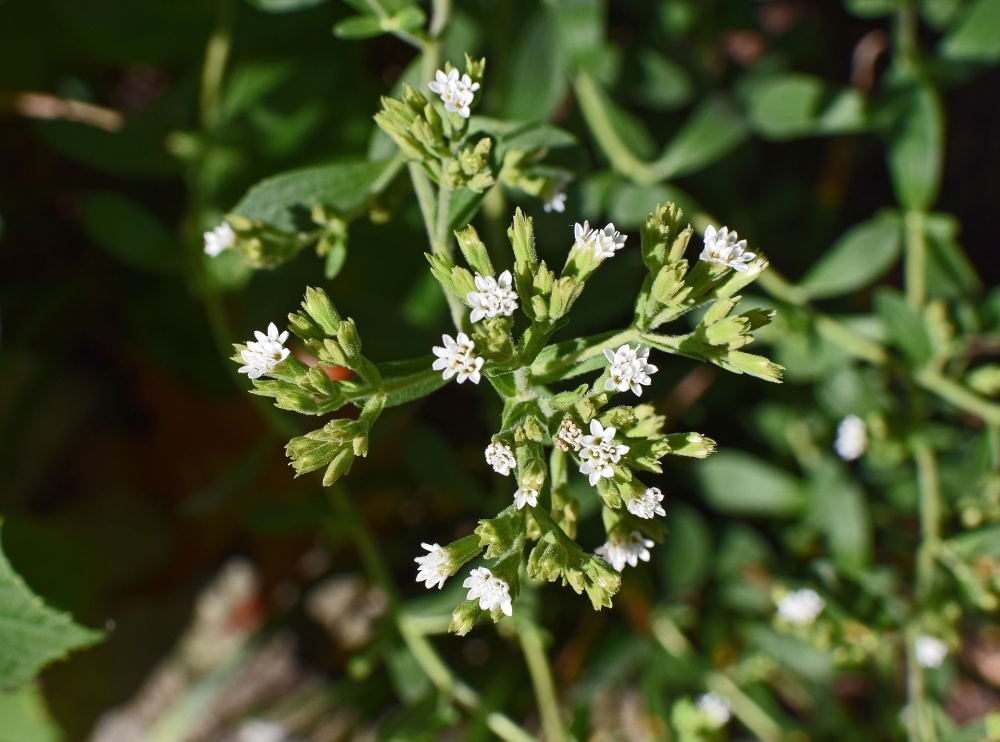
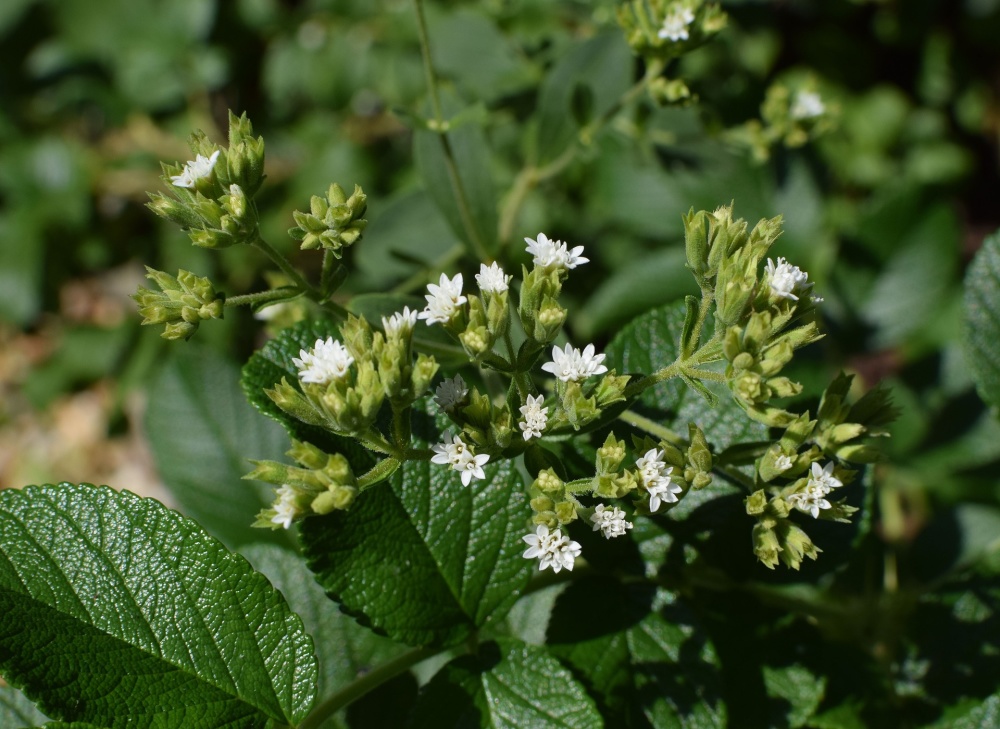
A small shrub with a bushy appearance, it reaches up to 80 cm (2.6 ft) tall and consists of semi-woody stems, on top of which grow pairs of short-stalked, green, elongated oval leaves toothed around the top half.
The flowers are small, white and five-petaled. They are encouraged to bloom by shortening day lengths from autumn to winter and are followed by tiny, tufted seeds designed for wind dispersal.
Due to selective breeding, there are wide variations in plant height, leaf size, leaf shape, and sweetness.
Edible uses
Natural sweetener - The leaves have been used for hundreds of years in native areas to sweeten teas and medicines, and have more recently gained popularity as a low-calorie, natural alternative to artificial sweeteners such as saccharin. The sweetness comes from two leaf compounds, stevioside and rebaudioside, which are many times sweeter than sugar by weight once extracted and crystallised; their ratio varies by variety and determines the degree of liquorice or bitter aftertaste, with the best-tasting, least bitter varieties carrying more rebaudioside relative to stevioside.
Commercial extraction involves soaking the leaves in hot water to dissolve the sweet compounds, then filtering and evaporating the solution to obtain a white powder or fine crystals. Used commercially as a non-caloric sweetening agent, particularly in Japan, Brazil, and Paraguay - in Japan it appears in confectionery, chewing gum, mints, non-alcoholic drinks, pickles, dried seafood, soy sauce, and miso-based products - and its non-fermenting, non-browning properties and stability under heat and acid also suit it to baked goods.
Natural food colouring - The leaves are also a rich source of chlorophyll, which serves as a natural green colouring agent in foods that don't require heat treatment, such as chilled desserts.
Material uses
Natural cosmetic - Chlorophyll extracted from the leaves is also used in cosmetics and toiletries such as toothpaste.
Natural skin care - Wetted leaves placed in a leaf bag over the eyes are reportedly effective in tightening the skin and smoothing out wrinkles.
Health uses
Vitamin K - Chlorophyll, present in the leaves, is high in Vitamin K.
Natural blood tonic - For this reason, it is widely promoted as a blood tonic.
Natural liver tonic - And, likewise, as a liver tonic.
Natural sugar substitute - As a non-caloric sweetener, Stevia is suitable for people with diabetes.
Natural slimming aid - And for those on weight-loss diets.

Climate
Short day lengths and lack of moisture induce flowering in Stevia, usually at the expense of leaf production. For this reason, subtropical and temperate areas with long summer days are better suited than tropical areas for cultivating Stevia, as are areas with adequate moisture during the growing period. Stevia is grown as a perennial in temperate to warm climates but as an annual in colder regions.
Grows naturally and is productive in moderately humid subtropical and tropical mid- to high-elevation climates, generally frost-free areas with annual lows of 9 to 20°C, annual highs of 19 to 32°C, annual rainfall of 800 to 2200 mm and a dry season of 6 months or less.
Stevia can also be grown with irrigation in areas with low rainfall and a long dry season, and is cultivated with irrigation in the Indian states of Gujarat and Punjab, where annual rainfall is less than 1000 mm and the dry season lasts up to 8 months.
Growing
New plants are started from seed or cuttings, but seedlings do not come true to type, so cuttings are preferred. Cuttings are best taken from known varieties with desirable characteristics, such as a reduced tendency to flower and a high rebaudioside-to-stevioside ratio.
Planting is done in subtropical regions in spring and early summer, and in tropical regions when soil moisture is sufficient. It is also well suited for growing in a container.
Performs best on rich, moist, free-draining loam and sand soils of a moderately acid to neutral nature, generally with a pH of 6.0 to 7.5, and on sites with full to partial sun exposure. It has poor tolerance to drought.
Problem features
It is recorded as having naturalised in Japan. Still, there does not appear to be any record of it anywhere as a serious weed or invasive species.
Where it grows
References
Books
-
Byrne, T. & Bourke, M. & Salvin, S. 2004, The new crop industries handbook, Rural Industries Research and Development Corporation (RIRDC), Canberra, Australia
-
Farooqi, A. A. & Sreeramu, B. S. 2004, Cultivation of medicinal and aromatic crops, Hyderabad University Press, Hyderabad
-
Khan, I. A. & Abourashed, E. A. 2010, Leung's encyclopedia of common natural ingredients : used in food, drugs and cosmetics, 3rd edition, Wiley Publishing, Hoboken, New Jersey
-
Randall, R. P. 2002, A global compendium of weeds, R.G. and F.J. Richardson Press, Melbourne
-
Randall, R. P. 2007, The introduced flora of Australia and its weed status, Cooperative Research Centre for Australian Weed Management, Glen Osmond, South Australia
-
Van Wyk, B. E. 2005, Food plants of the world: an illustrated guide, 1st ed., Timber Press, Portland, Oregon