

Common name: Australian Blackwood
Other common names: Blackwood
Description
Australian Blackwood is a tree species native to Australia. Its native range extends from Tasmania and the southeastern corner of the Australian mainland, north along the eastern seaboard to the subtropics.
However, trees adapted to temperate and subtropical climates are treated as distinct varieties because of variation in their form, climate adaptation and tolerances. This description includes only varieties adapted to subtropical climates.
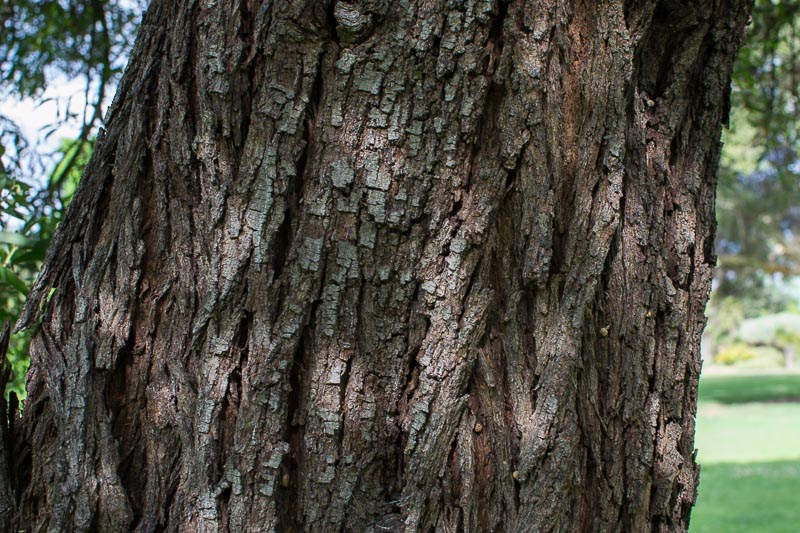
In natural forests, it may reach up to 24 m (80 ft). However, on open sites, it is typically 10 to 20 m (30 to 65 ft) tall. It grows at a slow to moderate rate, depending on growing conditions, forming a straight trunk supporting a densely branched pyramidal or rounded crown. The bark is dark grey, rough and fissured.
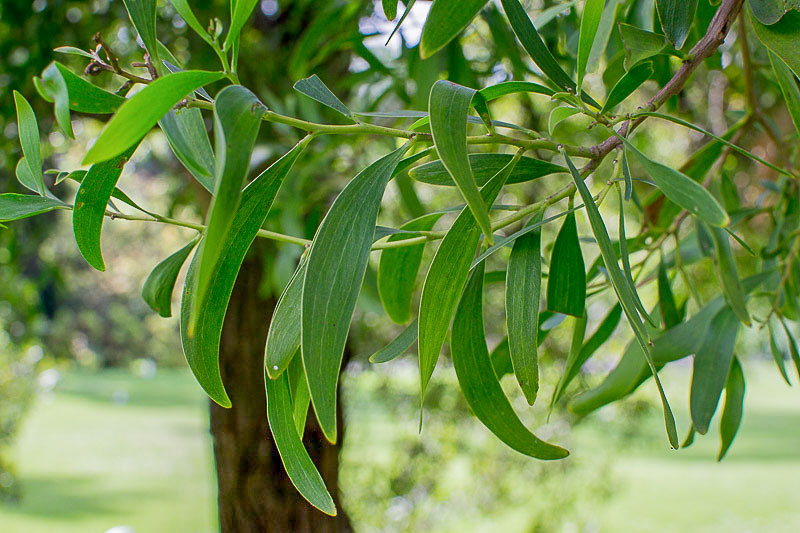
The leaves on young trees are delicate and showy, composed of numerous small blue-green leaflets arranged in a feathery pattern. They are replaced as the tree ages by less striking, dull-green, sickle- or lance-shaped leaves.
The flowers are creamy-white to pale yellow puffballs that bloom from late winter to spring, sometimes with light blooms on and off throughout the year. They give off a sweet, honey-like fragrance and are followed by numerous small, flat, twisted, or tightly coiled seedpods that turn brown when mature, usually from summer to autumn.
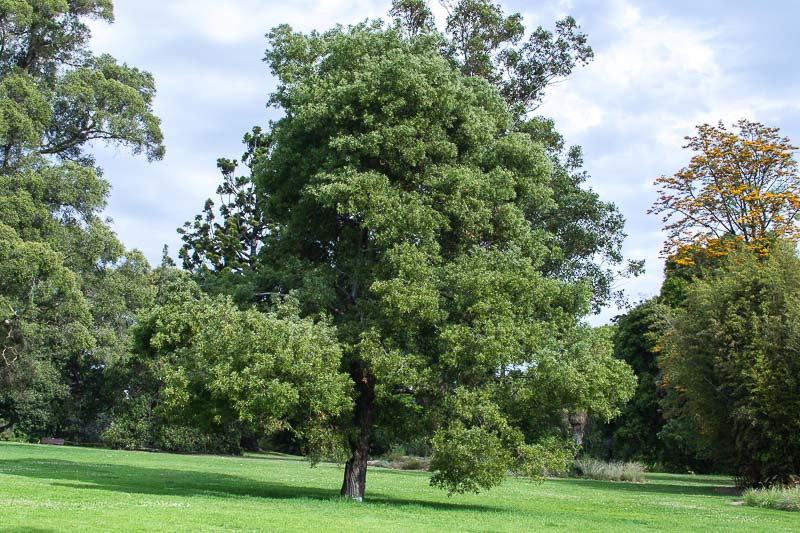
Melbourne, Australia
Material uses
Timber and lumber - Australian Blackwood is a major timber tree, much valued for its golden-brown to dark-brown heartwood, enhanced by reddish streaks and occasional dark bands. Because of this, it is cultivated extensively in plantations worldwide.
Hardwood - The wood is medium- to heavy-weight, averaging 600 to 700 kilograms per cubic meter (37 to 44 lbs per cubic ft), placing it in the hardwood class. However, it is only moderately resistant to rot and decay and is susceptible to wood-boring insects, limiting its outdoor use.
Furniture and cabinets - It is used in light construction to make high-end furniture and cabinets, as well as for other types of interior joinery.
Musical instruments - Its natural resonance makes it ideal for making stringed musical instruments.
Decorative veneer - Selected roundwood lengths are sliced for decorative veneer.
Manufactured wood - Also pulped to make composite woods such as plywood.
Poles and posts - Cut for poles and posts.
Firewood - Or for firewood
Charcoal - And for making charcoal.
Environmental uses
Shade tree - Australian Blackwood is widely cultivated in Australia as an ornamental tree for its shapely form, showy juvenile foliage, sweetly fragrant flowers, and ability to provide shade.
Climate
Grows naturally in sub-humid to moderately humid subtropical and tropical mid- to high-elevation climates, generally areas with annual lows of 10 to 19°C, annual highs of 22 to 30°C, annual rainfall of 800 to 1500 mm and a dry season of 6 months or less. However, it has been successfully grown in areas with up to 2700 mm of annual rainfall.
Growing
New plants are usually started from seed. Scaring or boiling the seed in water for about a minute improves germination. Most seed germinate within a week of planting.
Performs best on rich, free-draining clay and loam soils of a moderately acid to neutral nature, generally with a pH of 5.0 to 7.5, and on sites with full to partial sun exposure.
Established trees are generally unaffected by low salinity, or the equivalent of up to 2.5 grams of dissolved salt per litre of water (around one-fourteenth of the salinity of seawater).
Problem features
The tree produces abundant seed that germinates readily. It is listed as a weed in multiple reference publications, and the Hawaii Pacific Weed Risk Assessment (HPWRA) project assesses it as a high weed-risk species for Hawaii.
The roots are moderately vigorous, and a minimum planting distance of six meters away from any underground pipes is recommended. Root suckering is another problem feature of this tree species.
Where it grows
References
Books
-
Allen, O. N. & Allen, E. K. 1981, The Leguminosae : a source book of characteristics, uses, and nodulation, University of Wisconsin Press, Madison, Wisconsin
-
Boland, D. & Brooker, I. & McDonald, M. W. 2006, Forest trees of Australia, 5th ed., CSIRO Publishing (Ensis), Melbourne
-
Bristow, M. & Bragg, A. & Annandale. M. 2005, Growing rainforest timber trees: a farm forestry manual for north Queensland, Research and Development Corporation (RIRDC), Barton, A.C.T, Australia
-
C.A.B. International 2013, The CABI encyclopedia of forest trees, CABI Publishing, Wallingford, Oxfordshire
-
Chudnoff, M. 1984, Tropical timbers of the world, Forest Service, U.S. Department of Agriculture (USDA), Washington, D.C.
-
Church, G. & Greenfield, P. 2002, Trees and shrubs for fragrance, David Bateman, Auckland, New Zealand
-
Doran, J. C & Turnbull, J. W. 1997, Australian trees and shrubs : species for land rehabilitation and farm planting in the tropics, 2nd ed, Australian Centre for International Agricultural Research (ACIAR), Canberra, Australian Capital Territory
-
Holliday, I. 2002, A field guide to Australian trees, 3rd revised editon, New Holland Publishers, Frenchs Forest, New South Wales
-
Lake, M. 2015, Australian rainforest woods : characteristics, uses and identification, CSIRO Publishing, Collingwood, Victoria
-
Lemmens, R.H.M.J., Louppe, D. & Oteng-Amoako, A.A. (eds). PROTA, Plant Resources of Tropical Africa, Volume 7(1) : Timbers 1, PROTA Foundation, Backhuys Publishers, Leiden
-
Little, E. L. & Skolmen, R. G. 1989, Common forest trees of Hawaii (native and introduced), Agricultuural Handbook No. 679, Forest Service, U.S. Department of Agriculture, Washington, D.C.
-
Luna, R. K 1996, Plantation trees, International Book Distributors, Dehradun, Uttarakhand
-
Macmillan, H. F. 1943, Tropical planting and gardening : with special reference to Ceylon, 5th ed, Macmillan Publishing, London
-
Marcar, N. E. 1995, Trees for saltland : a guide to selecting native species for Australia, Division of Forestry, Commonwealth Scientific and Industrial Research Organisation (CSIRO) Australia, Canberra
-
Porter, T. 2012, Wood : identification & use, Compact edition, Guild of Master Craftsman Publications, Lewes, East Sussex
-
Scheffer, T. C & Morrell, J. J. 1998, Natural durability of wood : a worldwide checklist of species, Forest Research Laboratory, Oregon State University, Corvallis, Oregon
-
Streets, R. J. & Troup, R. S. 1962, Exotic forest trees in the British Commonwealth, Oxford University Press, Oxford, England
-
Webb, D. B. 1984, A Guide to species selection for tropical and sub-tropical plantations, 2nd ed., Unit of Tropical Silviculture, Commonwealth Forestry Institute, University of Oxford, Oxfordshire
Articles, Journals, Reports and Working Papers
-
South East Water Company 1999, Tree roots : a growing problem, South East Water, Moorabbin, Victoria