

Common name: Lemon Verbena
Other common names: Lemon Beebrush
Description
Lemon Verbena is an aromatic shrub native to subtropical South America, its native range extending across parts of Argentina, Brazil, and Chile. Introduced long ago to other parts of the Americas, Europe, and Africa, it is now grown commercially in many countries for its leaves, which yield a lemon-scented essential oil. Producing countries include its native Argentina, Brazil, Chile, and Mexico, as well as Venezuela, Bolivia, Peru, Uruguay, southern France, and Algeria.
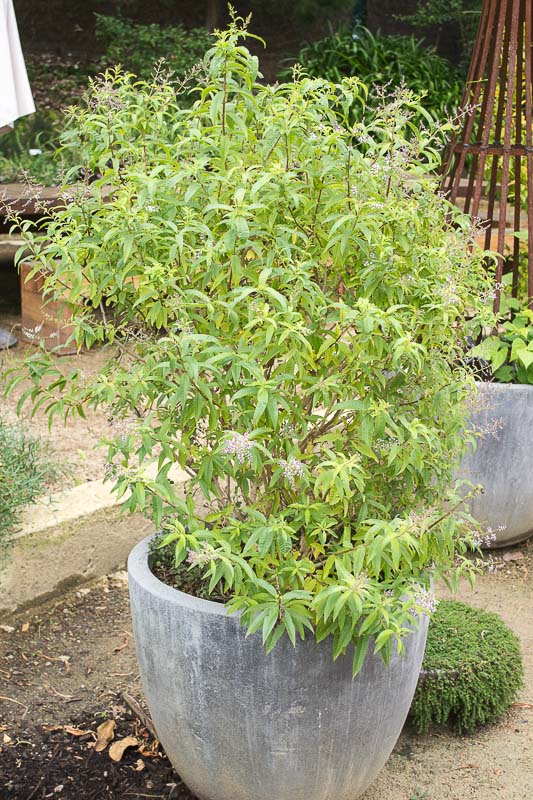
It is typically a leggy shrub 1 to 3 m (3 to 10 ft) tall. However, in tropical climates, it can grow into a small tree up to 6 m (20 ft) tall, especially if unpruned and allowed to grow naturally.
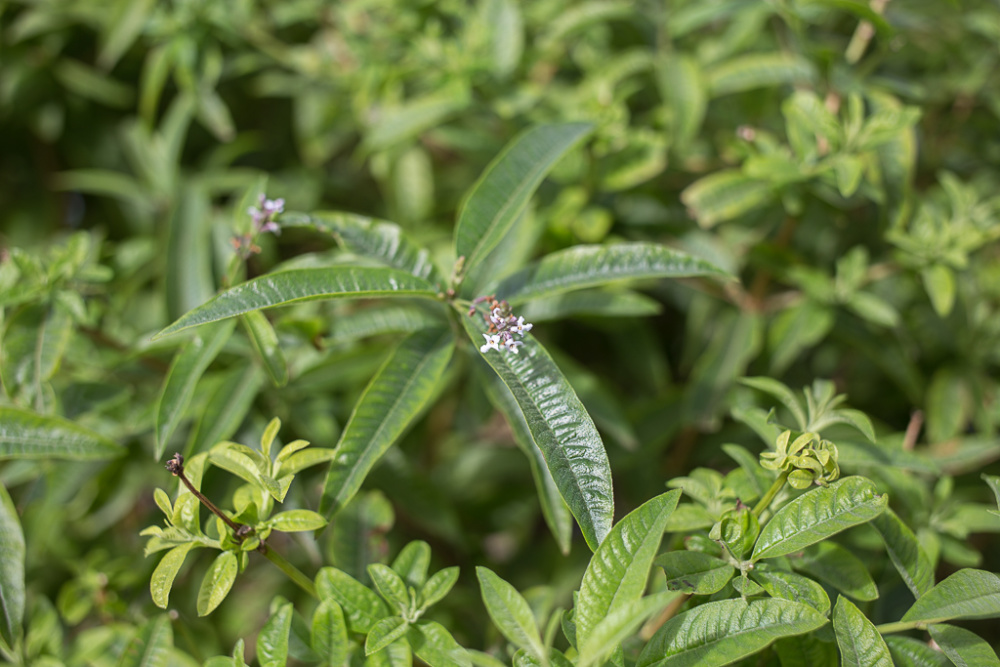
Leaves are sword-shaped, light green and arranged in propeller-like clusters of three to four, borne at nodes along the branches. When crushed, they release a strong lemon fragrance, considered the truest to Lemon (Citrus limon) of all the lemon-scented plants. Although deciduous in cold climates, it is semi-evergreen to evergreen in the tropics, with most leaves remaining year-round.
Flowers are tiny, white to lavender and borne on flower spikes arising at the end of branches. They bloom from summer to autumn and, like the leaves, have a delightful lemon-scented fragrance. Although functionally hermaphroditic, with both female and male parts, they are seldom pollinated. As a result, they produce few to no seeds.
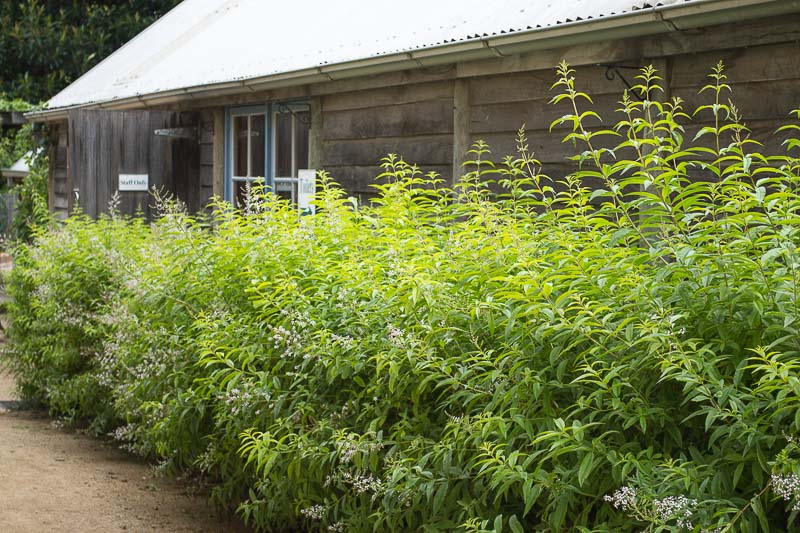
Dromana, Victoria, Australia
Material uses
Essential oil - Steam distillation of the leaves yields a lemon-scented essential oil known as 'Verbena oil', with its fragrance resulting from high Citral content - the same chemical compound that gives lemons their lemony aroma. Its aroma and flavour are considered one of the closest to Lemon (Citrus limon) of all lemon-scented plants.
Commercial plantations harvest around 4,000 to 6,000 kg (9,000 to 13,000 lb) of fresh leaves per hectare per year; with an oil content of 0.1 to 0.7%, the average yield is 20 kg of oil per acre (18 lb per acre). Because oil yields are so low, the leaves are steam-distilled as soon as possible after harvest to minimise vaporisation.
Natural fragrance - The pale yellow oil has wide application in scenting medicines, soaps, and household cleaning products; the leaves and essential oil are also added to potpourri mixtures and air fresheners to scent homes and cars. However, perfumery has discontinued its use because of its skin-sensitising and phototoxic properties.
Deodoriser - The same potpourri mixtures and air fresheners also deodorise rooms.
Edible uses
Tea - The leaves are also used fresh or dried for tea.
Culinary herb - Fresh or dried leaves add lemon fragrance and flavour to poultry, seafood, vegetable dishes, desserts, and drinks, both alcoholic and non-alcoholic.
Natural flavouring - The essential oil is also used to flavour food.
Environmental uses
Lemon Verbena is a popular plant in home gardens wherever the climate is suitable.
Fragrant plant - Grown both as a herb and a fragrant plant for its aromatic leaves.
Container plant - Commonly grown in large containers.
Hedge plant - Or planted as an informal hedge.
Health uses
Lemon Verbena has digestive and calming properties.
Natural digestive aid - The leaves are made into a tea to relieve intestinal gas and bloating.
Natural stress relaxant - The tea also acts as a gentle sedative, reportedly similar to Lemon Balm (Melissa officinalis) but less potent.
Climate
Grows naturally and is productive in sub-humid to moderately humid subtropical and tropical mid-elevation climates, generally areas with annual lows of 8 to 20°C, annual highs of 19 to 32°C, annual rainfall of 600 to 2000 mm and a dry season of 3 to 6 months, extending to 12 months with irrigation. Commercial essential oil plantations are mostly located in subtropical areas receiving 1200 mm or less annual rainfall.
Growing
New plants are grown from cuttings, as seeds are not always readily available. It performs best in free-draining loam and sandy soils of a mildly acid to mildly alkaline nature, generally with a pH of 6.0 to 7.5, and on sites with partial sun exposure. Full sun exposure in warm climates, especially during the sun-intense afternoon hours, may bleach the leaves, resulting in some flavour loss.
It forms a straggly or untidy canopy that benefits from pruning or frequent leaf harvesting to maintain an attractive shape, particularly for the home garden.
Lemon Verbena is highly susceptible to fungal disease in hot, humid conditions.
Problem features
Lemon Verbena is recorded as having escaped cultivation. However, it does not appear to be recorded as a serious weed anywhere, despite its widespread introduction and cultivation. This may be due, in part, to its shy-seeding habit, producing seed in small amounts, infrequently, or not at all. The Hawaii Pacific Weed Risk Assessment (HPWRA) project assesses it as a low weed-risk species for Hawaii.
Where it grows
References
Books
-
Chevallier, A. 2000, Encyclopedia of herbal medicine, 2nd American ed., Dorling Kindersley, New York
-
Church, G. & Greenfield, P. 2002, Trees and shrubs for fragrance, David Bateman, Auckland, New Zealand
-
Editors of Sunset Magazine 2012, The New Western Garden Book: The Ultimate Gardening Guide, 9th edition, Sunset Publishing Corporation, California
-
Groom, N. 1997, The new perfume handbook, 2nd ed., Blackie Academic & Professional, London
-
Guenther, E. & Althausen, D. 1948 to 1952, The essential oils (6 volumes), Van Nostrand Publishing, New York
-
Macmillan, H. F. 1943, Tropical planting and gardening : with special reference to Ceylon, 5th ed, Macmillan Publishing, London
-
Randall, R. P. 2007, The introduced flora of Australia and its weed status, Cooperative Research Centre for Australian Weed Management, Glen Osmond, South Australia
-
Seidemann, J. 2005, World spice plants: economic usage botany taxonomy, Springer-Verlag, Berlin
-
Stewart, A. 2013, The drunken botanist : the plants that create the world's great drinks, 1st ed., Algonquin Books, Chapel Hill, North Carolina
-
Van Wyk, B. E. 2005, Food plants of the world: an illustrated guide, 1st ed., Timber Press, Portland, Oregon