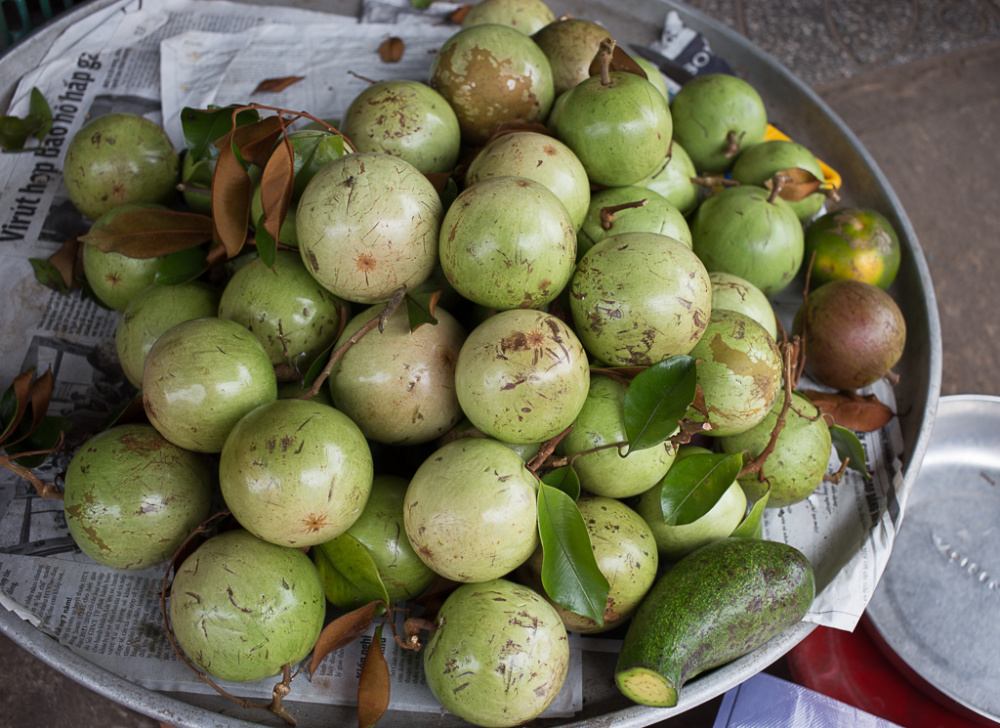


Common name: Star Apple
Other common names: Star Plum
Description
Star Apple is a fruit tree native to the Caribbean. It grows naturally in places like Jamaica, the Cayman Islands, Cuba, Hispaniola, and Puerto Rico.
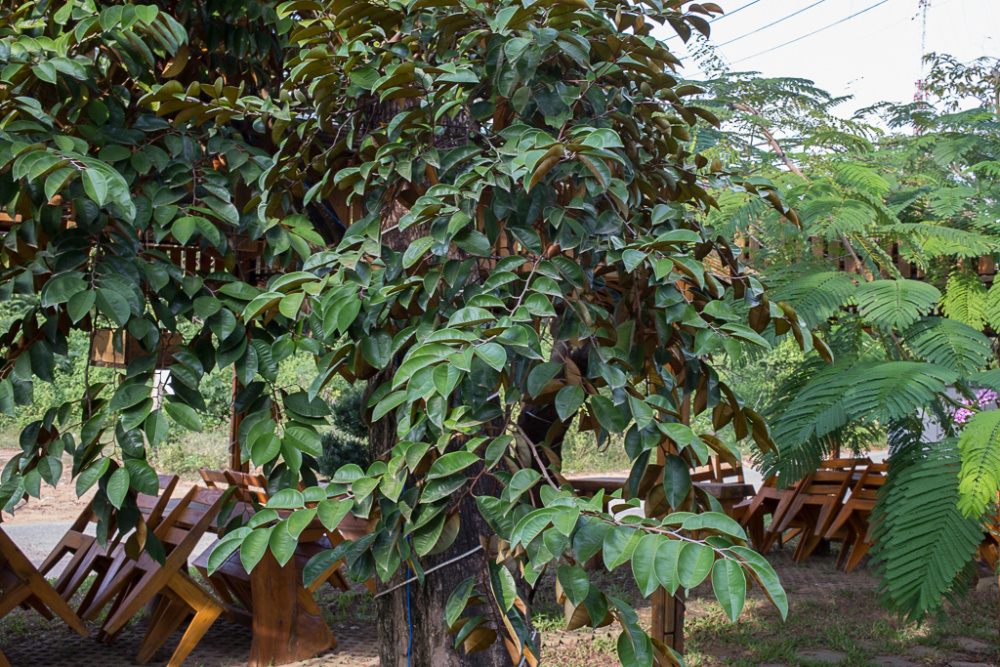
In forests, this medium-sized tree can grow up to 30 meters (100 feet) tall, but it usually reaches 15 to 20 meters (50 to 65 feet). When grown in open areas, it has a short trunk and a thick, rounded top with wide, drooping branches. The bark is dark brown, rough, and cracked.
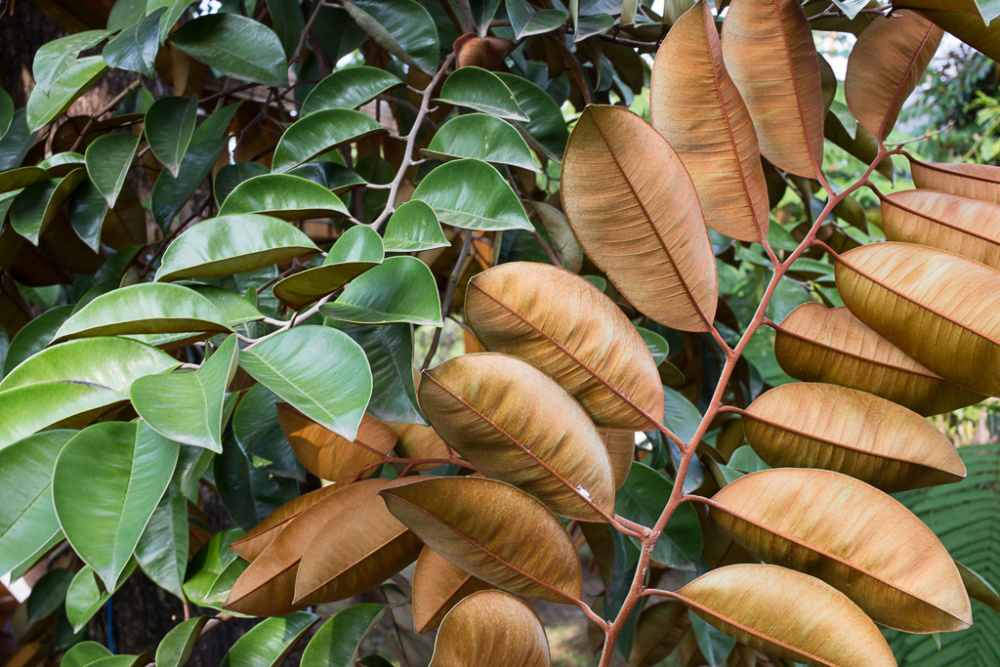
The leaves are oval or elliptical, dark green above and copper-brown below. This colour contrast makes the tree easy to notice. If the dry season is short, the leaves stay on the tree; during longer dry periods, they fall off.
The flowers are small and can be purplish or greenish. Each flower has both female and male parts. They usually bloom as the days get shorter, from late summer through late autumn or early winter.
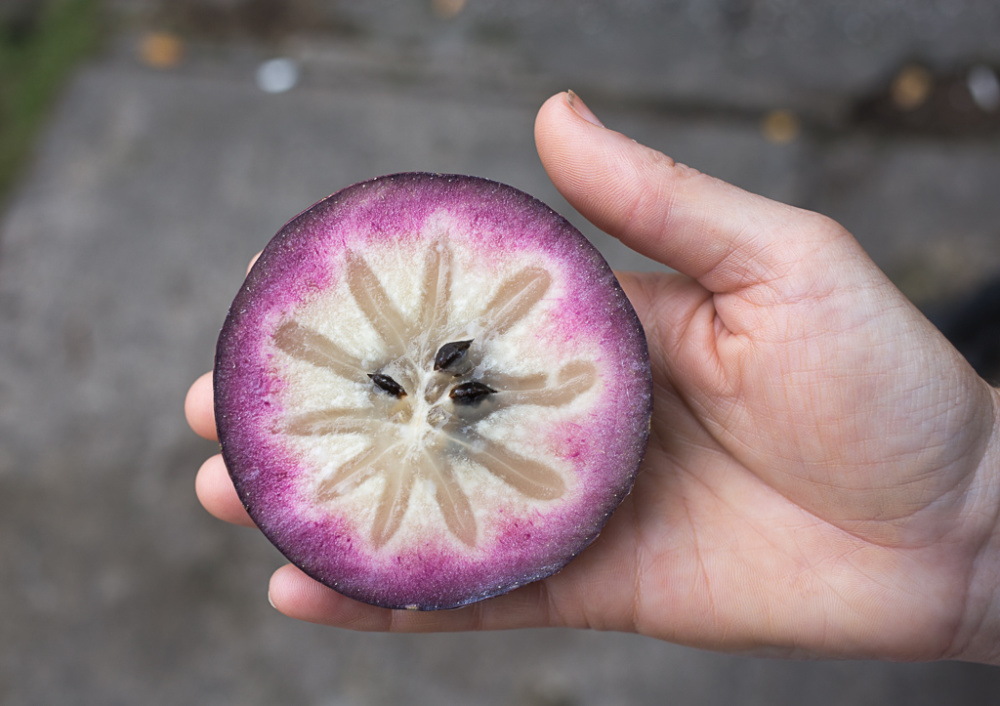
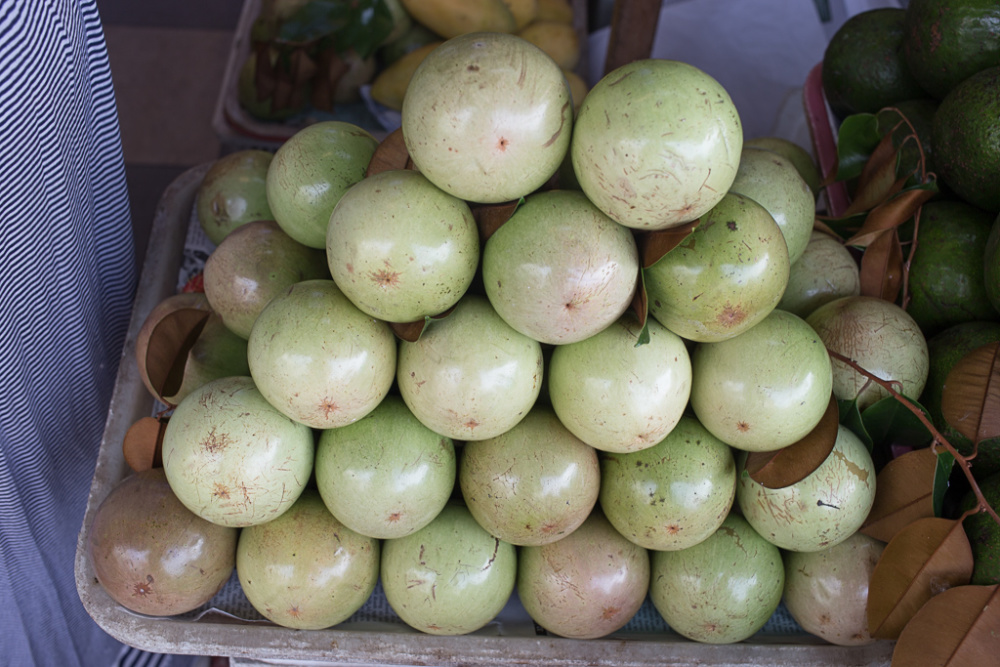
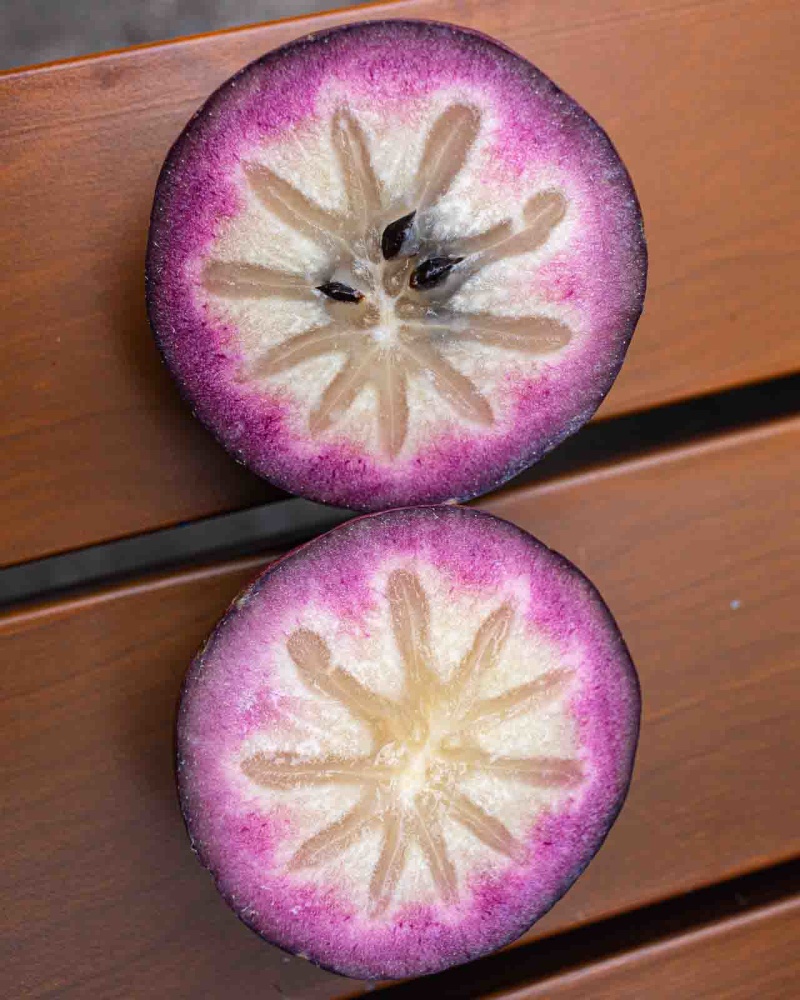
The fruit takes about three to four months to ripen after it starts growing, usually from winter to late spring or early summer in its native regions. The fruit is round, about the size of a baseball or bigger, with smooth purple or green skin. When you cut it in half, you can see a star-shaped pattern inside, which is how the tree got its name. The seeds are oval, fairly large, and shiny, ranging from dark brown to almost black.
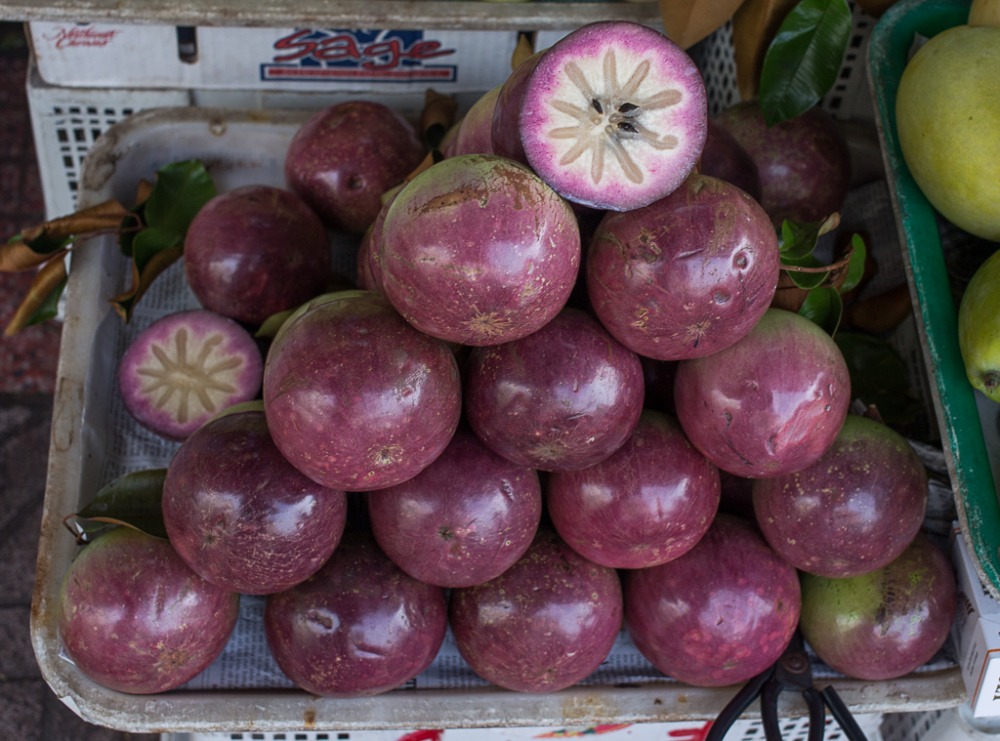
Star Apples for sale (Ho Chi Minh, Vietnam)
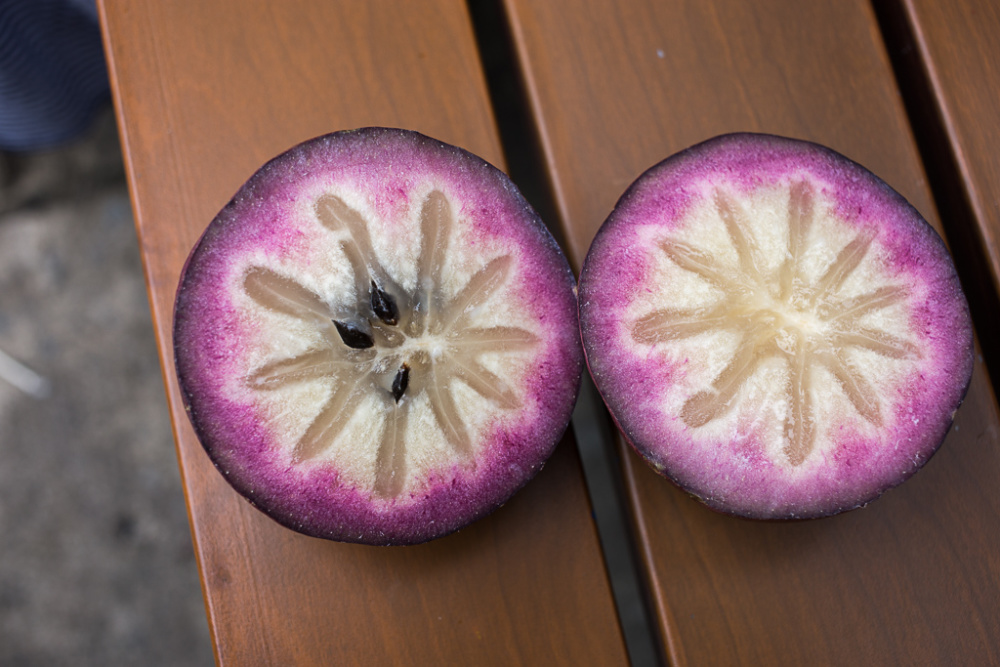
Star Apple cut in half
Use
Most people grow this tree for its fruit, which is usually eaten fresh or added to fruit salads. The fruit is often cut in half, and the soft, sweet, jelly-like flesh is scooped out with a spoon. It's best to avoid the pulp near the skin, as it contains sticky sap, especially if the fruit isn't fully ripe. Since the fruit doesn't ripen after being picked, it's important to leave it on the tree until it's fully ripe.
The leaves, with their contrasting colours, make the tree look attractive in gardens. The dense growth also provides good shade on hot afternoons.
Star Apple trees have medium-weight wood, about 700 kg per cubic meter (44 lbs per cubic foot), but it doesn't resist decay well. Because of this, the wood isn't very durable and isn't good for outdoor or ground-level construction. When available, it's used to make turned objects, furniture, and cabinets.
Climate
Star Apple grows and produces fruit naturally in moderately humid subtropical and tropical climates. It does best in places without frost, where annual low temperatures are between 15 and 25°C, highs are between 26 and 35°C, rainfall is between 900 and 3000 mm, and the winter dry season lasts 3 to 6 months.
Star Apple trees can also grow in wetter climates that don't have a dry season, but they often have poor flowering because of fungal problems, which leads to less fruit. The trees may also not produce tasty fruit in places where the average low temperature of the warmest month is below 20°C (68°F).
Growing
New trees are usually grown from seed, which stays viable for up to six months and sprouts easily. However, trees grown from seed can take up to ten years to produce fruit, so people often use other methods. Cuttings and air-layering are the most common, and trees grown this way start to flower and bear fruit in about three to five years.
Mature trees in South Florida can produce up to 68 kg (150 lbs) of fruit in a season, but trees in warmer, tropical areas may produce even more.
Star Apple grows best in well-drained loam, sandy-loam, or loamy-sand soils that are moderately acidic to alkaline, with a pH between 5.0 and 8.0. It also prefers places with full or partial sun.
Problem features
Star Apple is listed as a weed in at least one source, but there are no reports of it causing serious problems, even though it is widely grown in the tropics.
Where it grows
References
Books
-
Adams, C. D. 1972, Flowering plants of Jamaica, University of the West Indies, Mona, Greater Kingston
-
Allen, B. M. 1967, Malayan fruits : an introduction to the cultivated species, Donald Moore Press, Singapore
-
Chudnoff, M. 1984, Tropical timbers of the world, Forest Service, U.S. Department of Agriculture (USDA), Washington, D.C.
-
Gargiullo, M. B & Magnuson, B. L. & Kimball, Larry D. 2008, A field guide to plants of Costa Rica, Oxford University Press, Oxford
-
Janick, J., & Paull, R. E. 2008, The encyclopedia of fruit & nuts, CABI Publishing, Wallingford, Oxfordshire
-
Jensen, M. 1999, Trees commonly cultivated in Southeast Asia : an illustrated field guide, 2nd ed., Food and Agricultural Organisation of the United Nations (FAO) Regional Office for Asia and the Pacific (RAP), Bangkok
-
Little, E. L. et al. 1964 and 1974, Common trees of Puerto Rico and the Virgin Islands (2 volumes), Forest Service, U.S. Department of Agriculture (USDA), Washington D.C.
-
Macmillan, H. F. 1943, Tropical planting and gardening : with special reference to Ceylon, 5th ed, Macmillan Publishing, London
-
Martin, F. M., et al. 1987, Perennial edible fruits of the tropics : an inventory, U.S. Dept. of Agriculture (USDA), Agricultural Research Service, U.S. Government Printing Office (GPO), Washington, D.C.
-
Morton, J. F. & Dowling, C. F. 1987, Fruits of warm climates, Creative Resources Systems, Winterville, North Carolina
-
Page, P. E. 1984, Tropical tree fruits for Australia, Queensland Department of Primary Industries (QLD DPI), Brisbane
-
Queensland Department of Primary Industries and Fisheries (QLD DPI) 2008, Queensland tropical fruit : the healthy flavours of North Queensland, Brisbane
-
Randall, R. P. 2002, A global compendium of weeds, R.G. and F.J. Richardson Press, Melbourne
-
Randall, R. P. 2007, The introduced flora of Australia and its weed status, Cooperative Research Centre for Australian Weed Management, Glen Osmond, South Australia
-
Scheffer, T. C & Morrell, J. J. 1998, Natural durability of wood : a worldwide checklist of species, Forest Research Laboratory, Oregon State University, Corvallis, Oregon
-
Schubert, T. H. 1979, Trees for urban use in Puerto Rico and the Virgin Islands. U.S. Department of Agriculture, Forest Service, Southern Forest Experiment Station, New Orleans
-
Wilder, G. P. 1911, Fruits of the Hawaiian Islands rev. ed, Honolulu: The Hawaiian gazette co. ltd.
Articles, Journals, Reports and Working Papers
-
Subhadrabandhu, S. 2001, Under-utilized tropical fruits of Thailand, Food and Agriculture Organisation of the United Nations (FAO), Regional Office for Asia and the Pacific (RAPA), Bangkok
-
Walkar, Tad, et al. Dispersal modes of woody species from the northern Western Ghats, India. Tropical Ecology 53.1 (2012).
-
Watson, B.J., & Moncur, M. 1985, Guideline criteria for determining survival, commercial and best mean minimum July temperatures for various tropical fruit in Australia (Southern Hemisphere), Department of Primary Industries Queensland (DPI QLD), Wet Tropics Regional Publication, Queensland