



Common name: Kauri Pine
Other common names: Dundathu Pine, Queensland Kauri, Smooth Bark Kauri
Description
Kauri Pine is a large conifer from Australia and Papua New Guinea, producing valuable timber. There are two known varieties, one originating in each of the native countries.
The native range of the Australian variety is limited to subtropical forest areas along the continent's east coast and elevated parts of the tropical north. In contrast, the Papua New Guinean variety is found only in upland areas in the country's east.
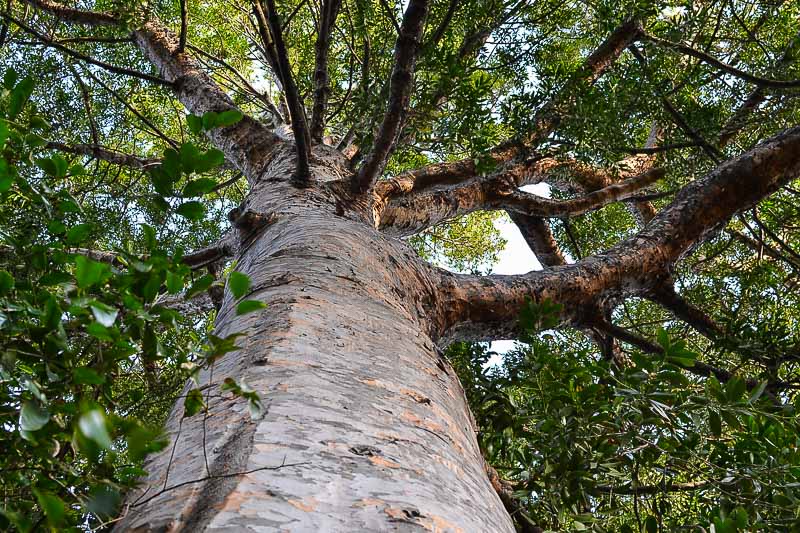
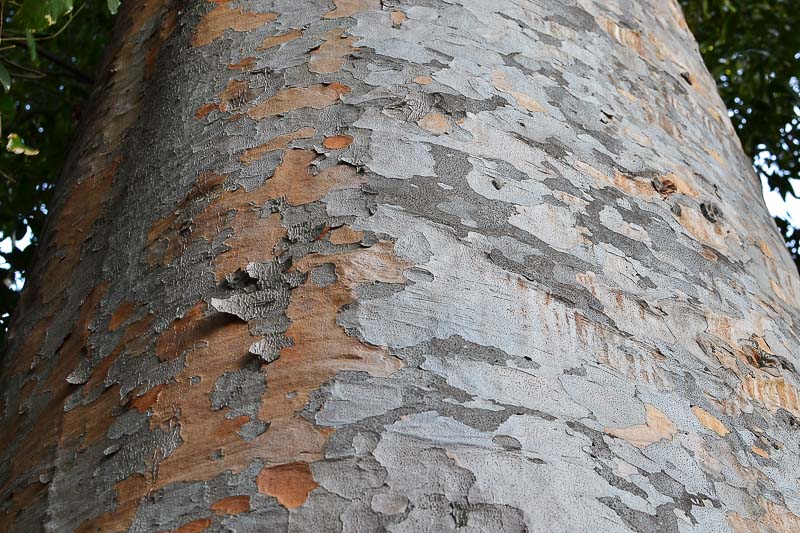
In its natural habitat, it may reach heights of up to 40 m (130 ft), with a straight, uniform trunk approaching 2.5 m (8.2 ft) in diameter, lacking buttresses at the base. The bark is grey and smooth, flaking off in small patches that expose orange-brown underbark, leaving a mottled surface.
Branching starts near the ground on young trees, with branches ascending steeply and close to the trunk, resulting in a columnar shape. The lower branches naturally prune off as the tree grows, leaving a mostly branch-free trunk topped with a narrow crown.
The leaves come in juvenile and adult forms, though they are generally oval, pale yellow-green when young, becoming dark green, thick and leathery with age and arranged in pairs along the branches. They resemble the leaves of a tropical hardwood rather than a conifer.
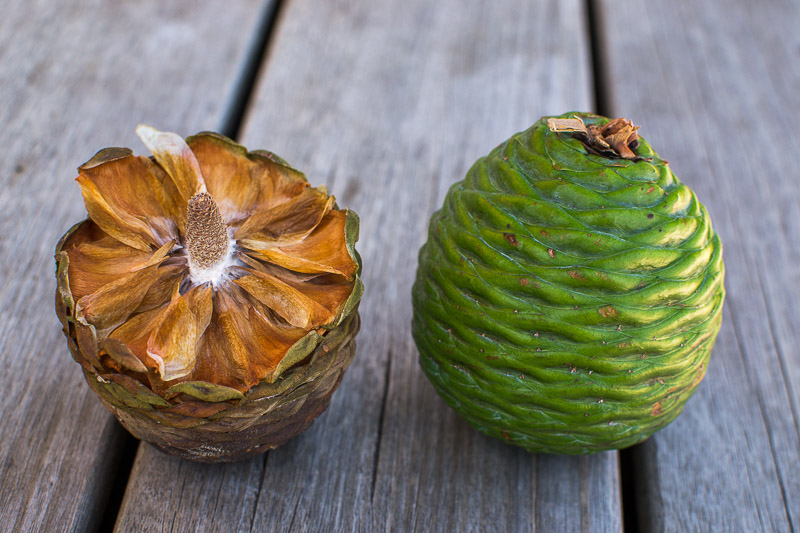
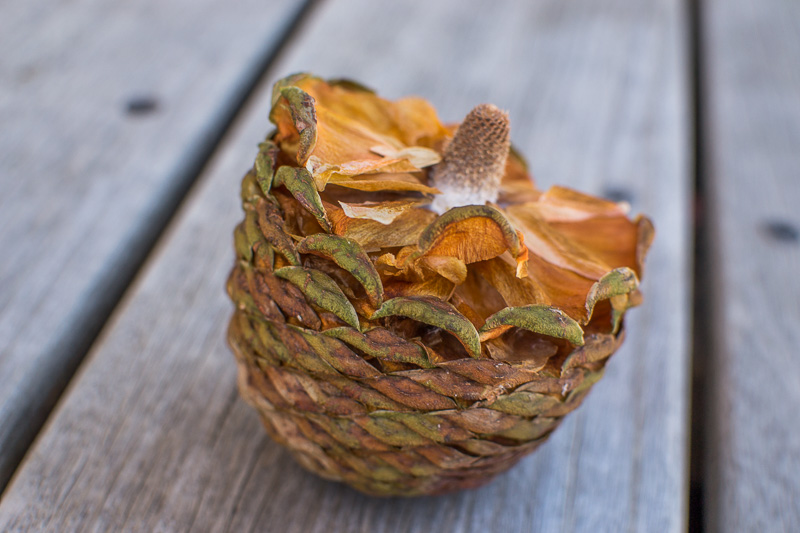
Fruit are a round to egg-shaped cone, comparable to an orange in size, and are either female or male on the same tree. Only female cones produce seed and release it when mature, around sixteen months after pollination and while still on the tree. The seeds, being winged, get carried on the wind a fair distance.
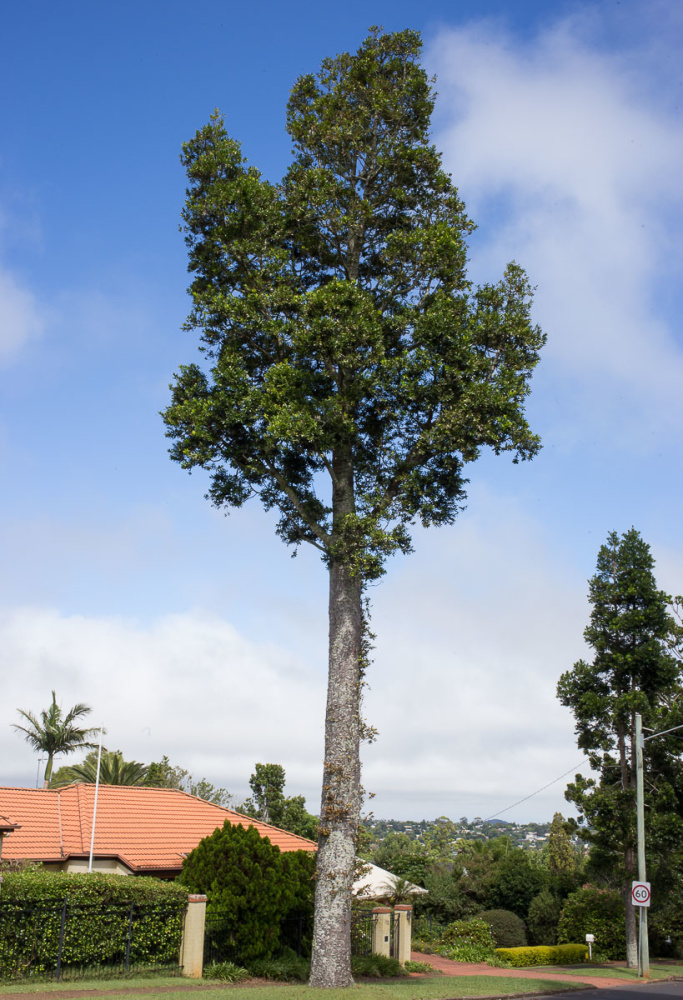
Toowoomba, Queensland, Australia
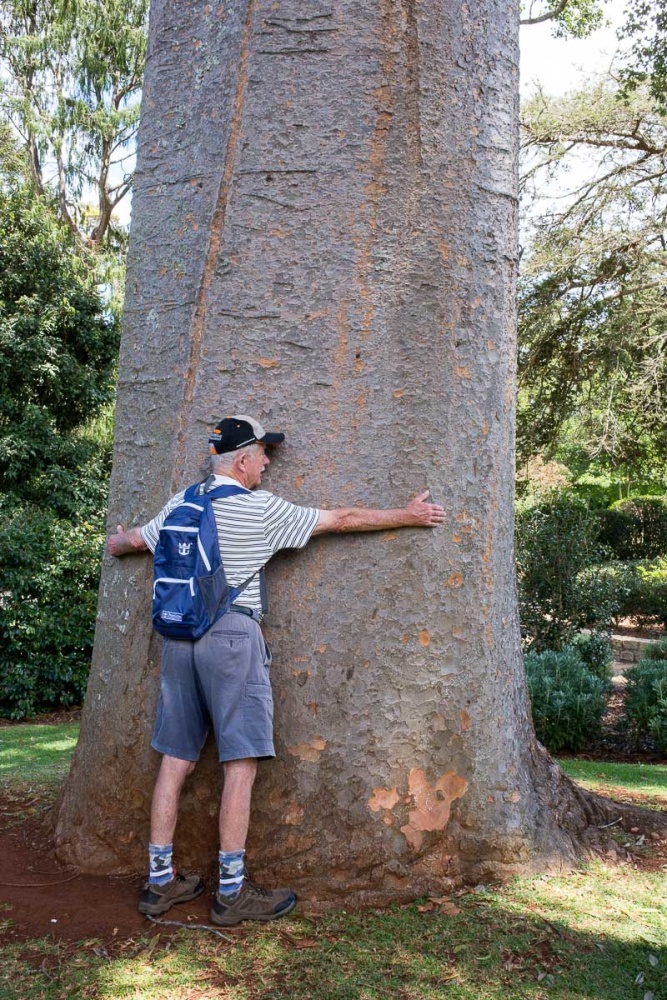
Large specimen (Toowoomba, Australia)
Material uses
Softwood - Kauri Pine produces a light- to medium-weight wood, averaging 400 to 500 kg per cubic meter (25 to 31 lb per cubic ft), with low natural resistance to rot and decay, making it a non-durable softwood suited only for indoor construction.
Furniture and cabinets - Well-formed logs are sawn into planks for making light furniture and cabinets.
Joinery and millwork - Also used for interior joinery.
Boxes and crates - Also made into wooden boxes and crates.
Paper pulp - Small-diameter logs are processed into wood pulp for making paper and related products.
Natural resin - The inner bark exudes a clear, white resin that slowly hardens upon exposure to air. Once hardened, it can be harvested and, similar to other Agathis resins, has turpentine-like properties.
Natural varnish - In the past, it was used in the manufacture of paints and varnishes.
Environmental uses
Public garden tree - An impressive tree that stands out from its surroundings with its large size, handsome uniform shape, and eye-catching bark and foliage, but due to its massive size, it is unsuited for residential gardens. It is best restricted to large public gardens, wide arboretums, and open parks.
Climate
Kauri Pine grows naturally in humid warm-temperate, subtropical and tropical climates, generally areas with annual lows of 9 to 20°C, annual highs of 17 to 32°C, annual rainfall of 600 to 5000 mm and a summer or winter dry season of 6 months or less, extending to 8 months with irrigation or groundwater. However, trees achieve their best development at the wetter end of the climate range, with high rainfall and/or a short dry season.
Growing
New plants are usually started from seed, which the female cone releases when mature.
Performs best on deep, free-draining clay-loam, loam, sandy-loam and loamy-sand soils of a moderately acid to alkaline nature, generally with a pH of 5.0 to 8.0, and on sites with full to partial sun exposure. It has good tolerance to light salt spray and strong winds.
Problem features
There does not appear to be any record of it as a serious weed anywhere in the world. The Hawaii Pacific Weed Risk Assessment project (HPWRA) assessed it as a low weed risk species for Hawaii.
Where it grows
References
Books
-
Barwick, M., et al. 2004, Tropical & subtropical trees : a worldwide encyclopaedic guide, Thames and Hudson, London
-
Boland, D. & Brooker, I. & McDonald, M. W. 2006, Forest trees of Australia, 5th ed., CSIRO Publishing (Ensis), Melbourne
-
C.A.B. International 2013, The CABI encyclopedia of forest trees, CABI Publishing, Wallingford, Oxfordshire
-
Chudnoff, M. 1984, Tropical timbers of the world, Forest Service, U.S. Department of Agriculture (USDA), Washington, D.C.
-
Francis, J. K. 1998, Tree species for planting in forest, rural, and urban areas of Puerto Rico, U.S. Department of Agriculture, Forest Service, International Institute of Tropical Forestry, Río Piedras, Puerto Rico
-
Francis, J. K. and Liogier, H. A. 1991, Naturalized exotic tree species in Puerto Rico, General technical report SO-82, USDA Forest Service, Southern Forest Experiment Station, New Orleans
-
Francis, J. K. et al. 2000, Silvics of Native and Exotic Trees of Puerto Rico and the Caribbean Islands, Technical Report IITF-15, USDA Forest Service, Rio Piedras, Puerto Rico
-
Howes, F. N. 1949, Vegetable gums and resins, Chronica Botanica Company, Waltham, Massachusetts
-
Krishen, P. 2006, Trees of Delhi : a field guide, Dorling Kindersley Publishers, Delhi
-
Little, E. L. 1974, Trees of Puerto Rico and the Virgin Islands, Vol. 2, United States Department of Agriculture (USDA), Washington D.C.
-
Luna, R. K 1996, Plantation trees, International Book Distributors, Dehradun, Uttarakhand
-
Macmillan, H. F. 1943, Tropical planting and gardening : with special reference to Ceylon, 5th ed, Macmillan Publishing, London
-
Peate, N. & Macdonald, G. & Talbot, A. 2006, Grow what where : over 3,000 Australian native plants for every situation, special use and problem area, 3rd ed., Bloomings Books, Richmond, Victoria, Australia
-
Porter, T. 2012, Wood : identification & use, Compact edition, Guild of Master Craftsman Publications, Lewes, East Sussex
-
Randall, R. P. 2002, A global compendium of weeds, R.G. and F.J. Richardson Press, Melbourne
-
Rauch, F. D. & Weissich, P. R. 2000, Plants for tropical landscapes : a gardener's guide, University of Hawaii Press, Honolulu
-
Rowell, R. J. 1996, Ornamental conifers for Australian gardens, New South Wales University Press, Kensington, New South Wales
-
Streets, R. J. & Troup, R. S. 1962, Exotic forest trees in the British Commonwealth, Oxford University Press, Oxford, England
-
West, A. P. & Brown, W. H. 1920, Philippine resins, gums, seed oils, and essential oils, Bureau of printing, Department of Agriculture and Natural Resources, Manila