



Common name: Okra
Other common names: Lady Fingers, Gumbo
Description
Okra is an annual sub-shrub closely related to cotton and hibiscus. It originates from tropical Africa but is now widely cultivated in many countries for its immature seedpods, which are cooked and eaten as a vegetable.
It typically grows 1 to 2 m (3 to 6 ft) tall with a single unbranched stem bearing large green, deeply lobed heart-shaped leaves.
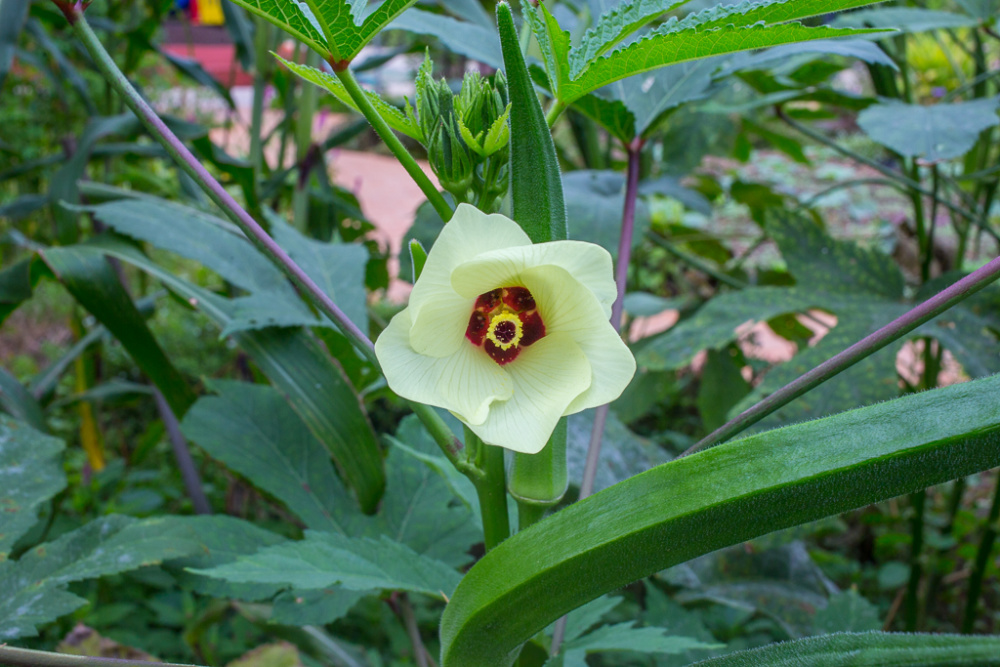
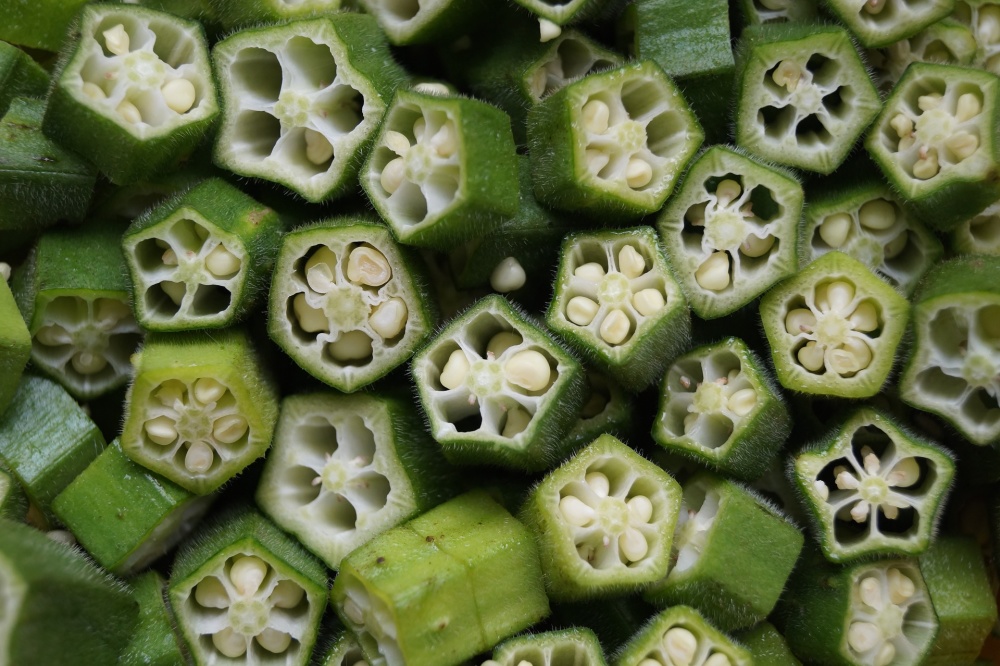
Flowers are hibiscus-like with pale yellow petals and purple centres. These are followed by long, ribbed green seedpods, less commonly wine-red, that become dry and brown when mature and contain several small, round seeds.
Edible uses
Cooked vegetable - The seedpods are harvested young, when the tips can be easily pinched off without resistance, then steamed, boiled, or fried. In New Orleans, it is the central ingredient in Jambalaya, a Creole dish of okra, rice, freshwater crayfish, and various meats.
Chip or crisp - Also made into chips. In India and Southeast Asia, young seedpods are fried or dried, then packaged and sold as chips or crisps.
Pickled vegetable - Also preserved by pickling.
Natural thickening agent - Valued for their mucilage, they are used to thicken sauces, curries, soups, and stews, including the famous Gumbo stews of Louisiana in the southern United States - and are also an essential ingredient in steamed seafood dishes in the West Indies.
Edible oil - An edible oil can be pressed from mature, dried seeds, with oil content ranging from 15 to 22% of the seed's dry weight. The expressed oil is greenish-yellow with an agreeable flavour and aroma.
Flour - Mature, dried seeds can also be ground into a flour rich in fibre, fats, and protein, at around 22% of the seed dry weight.
Material uses
Bird or poultry feed - The mature seed also makes an excellent feed for poultry.
Dried flowers and foliage - The stems with the seedpods intact, as well as singular seedpods, are sometimes dried for use in floral arrangements.
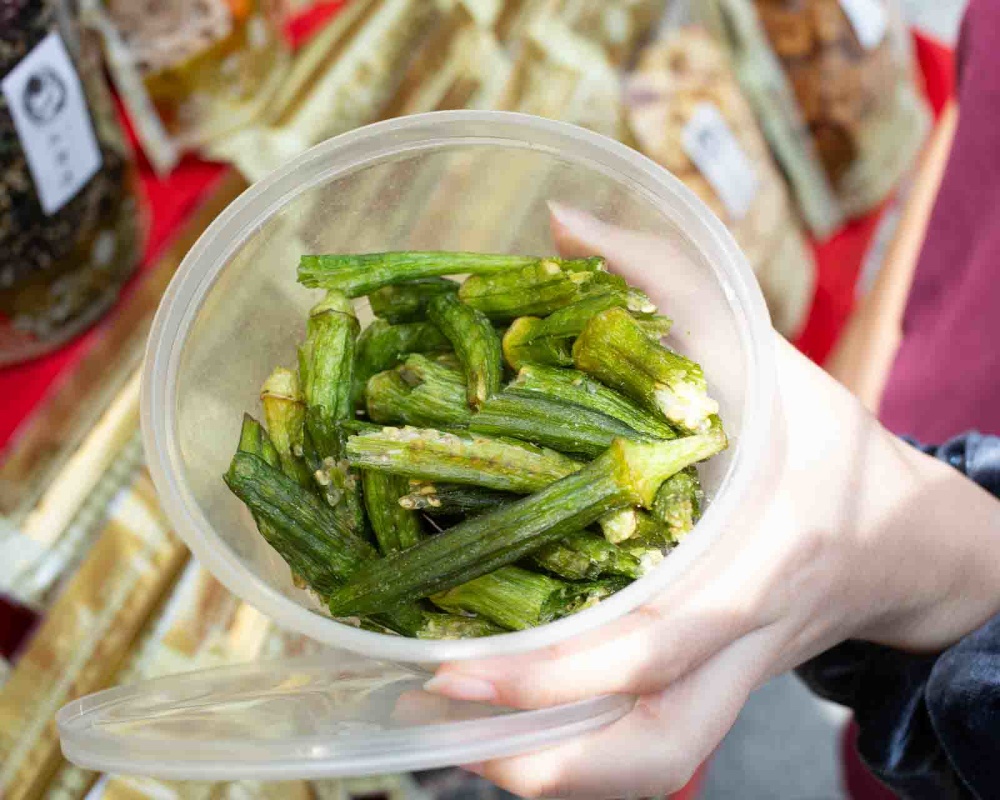
Dried okra chips or crisps (Singapore)
Health uses
Young seedpods are also high in fibre.
Vitamin C - Present at good levels, as ascorbic acid.
Folate - Also present, in smaller amounts.
Climate
Okra is grown as an annual in warm temperate, subtropical, and tropical climates, generally in areas with annual lows of 9 to 25°C, annual highs of 20 to 37°C, and annual rainfall of 500 to 3000 mm.
Okra plants may fail to flower and fruit, or do so poorly, in areas where the average low of the warmest month is below 16°C (61°F), such as in tropical highland areas above 1000 m (3300 ft) elevation.
Growing
The seeds are best sown in spring to early summer in subtropical areas and toward the end of the rainy season in tropical areas (leading into the drier, cooler months), when there is sufficient soil moisture for good germination and growth.
The planting site should have full to partial sun exposure, and the soil in which the seed is sown should be a free-draining clay, loam or sand that has been enriched with organic matter and adjusted to have a moderately acid to neutral pH, generally in the 5.5 to 7.5 range.
Problem features
Okra is listed in one or more reference publications as having escaped cultivation and as a weed of agriculture. Still, there does not appear to be any record of it as a serious weed anywhere in the world.
The fine hairs on the stems and seedpods are an irritant for some people and may cause them dermatitis on contact.
Where it grows
References
Books
-
Editors of Sunset Magazine 2012, The New Western Garden Book: The Ultimate Gardening Guide, 9th edition, Sunset Publishing Corporation, California
-
Gohl, B. 1981, Tropical Feeds : feed information summaries and nutritive values (Revised edition), Food and Agriculture Organization of the United Nations (FAO), Rome
-
Grubben, G.J.H. & Denton, O.A. (Editors) 2004, Plant Resources of Tropical Africa, Volume 2 : Vegetables, PROTA Foundation, Backhuys Publishers, Leiden
-
Jamieson, G. S. 1943, Vegetable fats and oils : their chemistry, production, and utilization for edible, medicinal and technical purposes, 2d ed, Reinhold, New York
-
National Research Council (Board on Science and Technology for International Development) 2006, Lost Crops of Africa: Volume II: Vegetables, The National Academies Press, Washington D.C.
-
Norrington, L. & Campbell, C. 2001, Tropical food gardens : a guide to growing fruit, herbs and vegetables in tropical and sub-tropical climates, Bloomings Books, Hawthorn, Victoria
-
Parrotta, J. A. 2001, Healing plants of peninsular India, CABI Publishing, Wallingford, Oxfordshire
-
Perkins, K. D. & Payne, W. 1981, Guide to the poisonous and irritant plants of Florida, Florida Cooperative Extension Service, Gainesville, Florida
-
Van Wyk, B. E. 2005, Food plants of the world: an illustrated guide, 1st ed., Timber Press, Portland, Oregon
-
Winters, H. F & Miskimen, G. W. 1967, Vegetable gardening in the Caribbean area, U.S. Dept of Agriculture, Washington D.C.
Articles, Journals, Reports and Working Papers
-
Morton, J.F. 1964, Honeybee Plants of South Florida, Proceedings of the Florida State Horticultural Society, Vol 77:415-436.