

Common name: Hoop Pine
Other common names: Colonial Pine, Moreton Bay Pine, Richmond River Pine
Description
Hoop Pine is an Australian and Papua New Guinean conifer producing commercially valuable timber.
It is a large tree and may reach up to 50 m (165 ft) under favourable conditions, though it is typically 20 to 30 m ( 66 to 98 ft) tall with a straight, uniform trunk. The bark is grey-brown and peeling. The lower branches are naturally pruned as the tree ages, leaving older trees mostly branch-free. This habit gradually reduces the crown's size over time; the crown is usually pyramid-shaped.
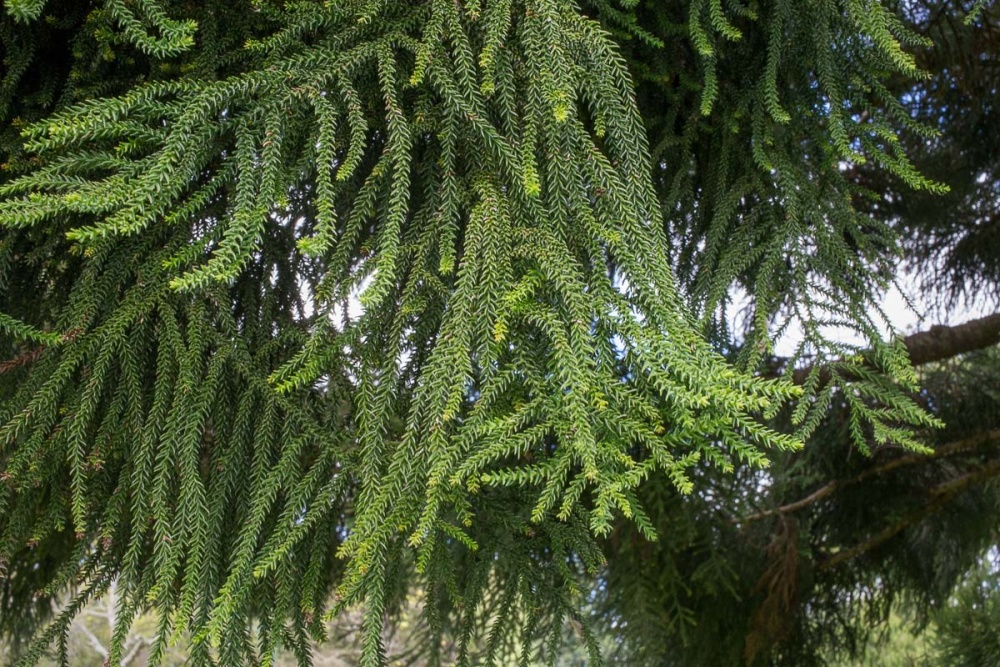
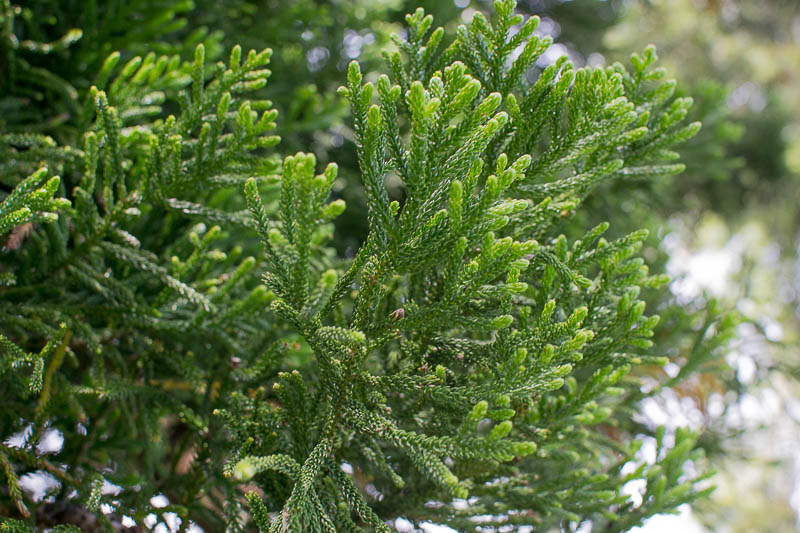
The leaves differ markedly on juvenile and adult trees. Juvenile leaves are dark green, needle-like with a sharp point, and spirally arranged on branched twigs. By contrast, the mature leaves are much smaller and closely packed in whorls on pencil-sized twigs, these grouped in an antler-like arrangement at the ends of the branches.
The cones are either male or female on the same tree but borne on separate branches, and the female cones only first appear when the tree is fifteen to twenty-five years old.
Female cones are egg-shaped, green, spiky when young, and up to 10 cm (4 in) in diameter when mature. They take up to two years to reach maturity, at which time they release winged seeds for wind dispersal.
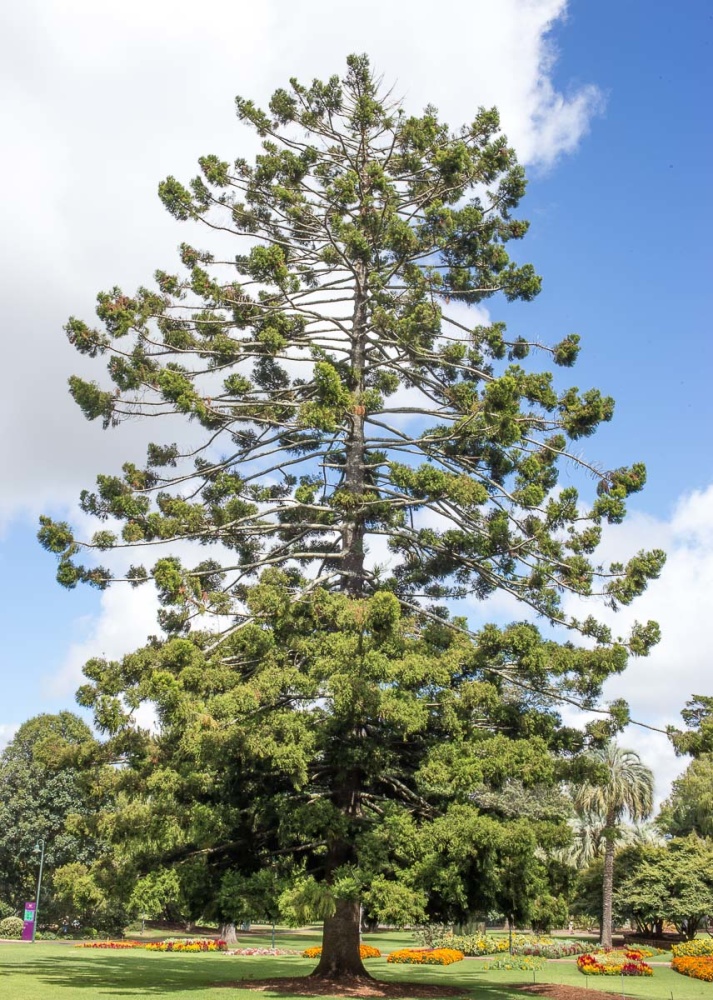
Queens Park, Toowoomba, Australia
Environmental uses
Public garden tree - Hoop Pine is cultivated as an ornamental tree for its attractive form and imposing stature, particularly suited to large gardens and parks.
Material uses
Softwood - The wood is medium-weight, averaging around 550 kilograms per cubic metre (34 lb per cubic ft), classified as a non-durable softwood. It has low natural resistance to rot, decay and wood-boring insects, and is used mostly in indoor construction and for manufacturing light articles. The heartwood ranges in colour from white to pale yellow-brown.
Timber and lumber - It is mostly grown in commercial plantations for its timber. Suitable logs are sawn into planks, and the uniform appearance of the sawn product is a prime commercial attribute of Hoop Pine.
Flooring and decking - Used for indoor flooring.
Joinery and millwork - Also used for joinery.
Furniture and cabinets - Also used for cabinets.
Boxes and crates - Also used for boxes and crates.
Poles and posts - Small-diameter logs are cut into lengths for fence posts and transmission poles, used for carrying electricity and communication cables.
Manufactured wood - Also used to manufacture engineered wood products such as particleboard, plywood, and veneer, for which it is well suited.
Climate
Two native varieties are recognised within the species, with somewhat different rainfall requirements. The Australian variety is adapted to moderately humid subtropical climates with annual rainfall of 700 to 2000 mm and a dry season of 4 months or less, while the Papua New Guinean variety is adapted to humid, elevated tropical climates with annual rainfall of 2000 to 3000 mm and a dry season of 2 months or less.
However, their temperature requirements differ less, with both varieties reported to grow well and produce valuable timber in areas with annual lows of 10 to 21°C and annual highs of 20 to 29°C.
Growing
New plants are usually started from seed collected from mature female cones. The seed remains viable only for a relatively short time but can be kept viable longer, for months, stored under cool, dry, air-tight conditions. They are usually pretreated by soaking them in water for about 4 hours to stimulate germination. Then sow them in individual containers with a free-draining potting mix.
Established trees perform best on deep, fertile, moist, free-draining, clay and loam soils of an acid to neutral nature, generally with a pH of 5.0 to 7.0, and on sites with full to partial sun exposure.
Problem features
There appear to be no records of it naturalising or being a serious weed anywhere in the world, despite its widespread cultivation and introduction into areas outside its native range.
The leaves have sharp points or edges that can cause pain when handled or touched.
Where it grows
References
Books
-
Boland, D. & Brooker, I. & McDonald, M. W. 2006, Forest trees of Australia, 5th ed., CSIRO Publishing (Ensis), Melbourne
-
Clarke, B. & McLeod, I. & Vercoe, T. 2009, Trees for farm Forestry : 22 Promising Species, Rural Industries Research and Development Corporation (RIRDC), Wagga Wagga, New South Wales
-
Food and Agriculture Organization of the United Nations (FAO) 1986, Databook on endangered tree and shrub species and provenances, FAO Forestry Paper 77, Forest Resources Division, Rome
-
Food and Agriculture Organization of the United Nations (FAO). 1993. Timber Plantations in the Humid Tropics of Africa. Forestry Paper 98.
-
Francis, J. K. 1998, Tree species for planting in forest, rural, and urban areas of Puerto Rico, U.S. Department of Agriculture, Forest Service, International Institute of Tropical Forestry, Río Piedras, Puerto Rico
-
Hall, N. 1972, The use of trees and shrubs in the dry country of Australia, Australian Government Publishing Service, Canberra, Australian Capital Territory
-
Holliday, I. 2002, A field guide to Australian trees, 3rd revised editon, New Holland Publishers, Frenchs Forest, New South Wales
-
Howes, F. N. 1949, Vegetable gums and resins, Chronica Botanica Company, Waltham, Massachusetts
-
Jensen, M. 1999, Trees commonly cultivated in Southeast Asia : an illustrated field guide, 2nd ed., Food and Agricultural Organisation of the United Nations (FAO) Regional Office for Asia and the Pacific (RAP), Bangkok
-
Lemmens, R.H.M.J., Louppe, D. & Oteng-Amoako, A.A. (eds). PROTA, Plant Resources of Tropical Africa, Volume 7(1) : Timbers 1, PROTA Foundation, Backhuys Publishers, Leiden
-
Liegel, L. H. 1987. A technical guide for forest nursery management in the Caribbean and Latin America, U.S. Dept. of Agriculture, Forest Service, Southern Forest Experiment Station, New Orleans
-
Little, E. L. & Skolmen, R. G. 1989, Common forest trees of Hawaii (native and introduced), Agricultuural Handbook No. 679, Forest Service, U.S. Department of Agriculture, Washington, D.C.
-
Luna, R. K 1996, Plantation trees, International Book Distributors, Dehradun, Uttarakhand
-
Ntima, O. O. 1968, The araucarias, Commonwealth Forestry Institute, University of Oxford, Oxfordshire
-
Porter, T. 2012, Wood : identification & use, Compact edition, Guild of Master Craftsman Publications, Lewes, East Sussex
-
Rowell, R. J. 1996, Ornamental conifers for Australian gardens, New South Wales University Press, Kensington, New South Wales
-
Webb, D. B. 1984, A Guide to species selection for tropical and sub-tropical plantations, 2nd ed., Unit of Tropical Silviculture, Commonwealth Forestry Institute, University of Oxford, Oxfordshire