

Common name: June Plum
Other common names: Golden Apple, Great Hog Plum, Hog Plum, Jew Plum, Otaheite Apple, Polynesian Plum, Tahitian Quince, Yellow Ylum
Description
June Plum or Ambarella is a fruit-bearing tree from the Society Islands in the South Pacific. Nowadays, it can be found in gardens and orchards in many subtropical and tropical regions of the world.
Under favourable conditions, the tree may attain a height of up to 30 m (100 ft). However, it is more typically a medium-sized tree 10 to 20 m (30 to 60 ft) tall, with a stout trunk supporting a wide-spreading, leafy crown. The bark is grey, smooth, and, on wounding, exudes a sticky, resinous gum.
The leaves are up to 50 m (1.6 ft) long and feathery, consisting of up to twenty-four leaflets arranged in pairs along the length and with a single leaflet at the tip. Individual leaflets are lance-shaped, about 4 cm (1.5 in) long, finely toothed on the margins and dark green. Those at the leaf middle are slightly larger than the rest. Most remain on the tree during the short dry season, but when it is long and pronounced, they change from green to bright yellow and fall to the ground.
Flowers are small and inconspicuous, greenish-white, and either female or male in the same cluster, which are large, branched and arise at the ends of the branches. In seasonally dry areas, flowering usually occurs in the dry season but may be intermittent or year-round where the dry season is short or humid conditions prevail. However, constantly humid conditions make the flowers susceptible to fungal attack, resulting in only a few fruits, most of which are usually diseased or of poor quality.
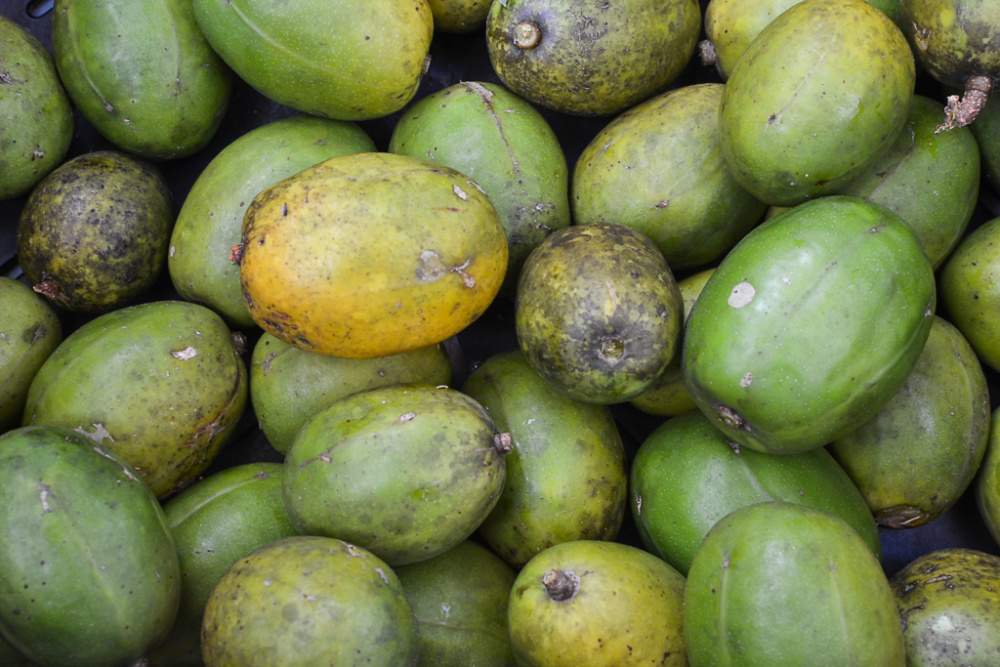
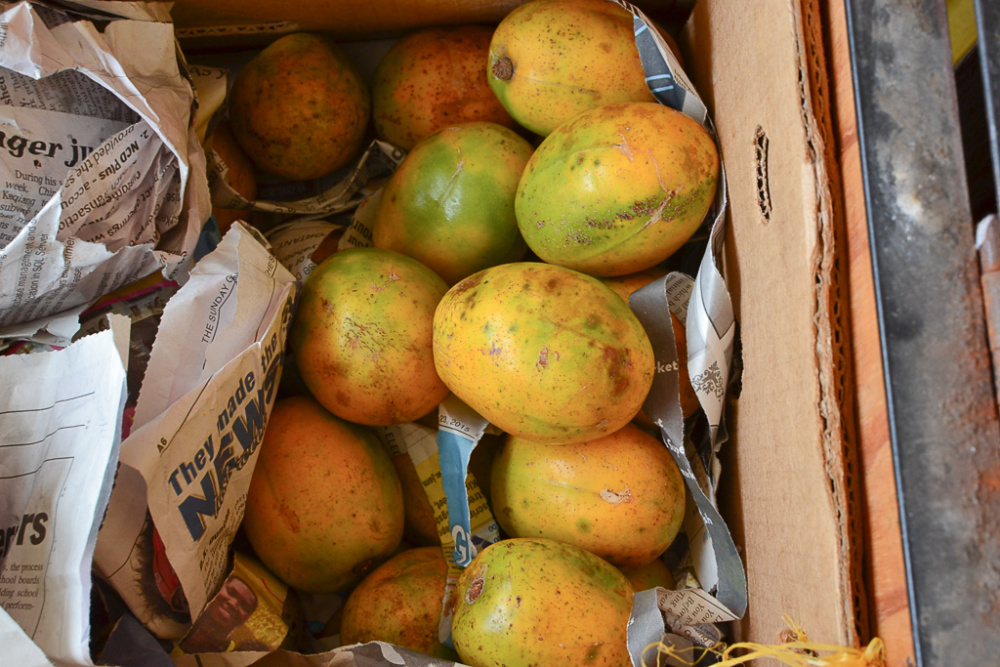
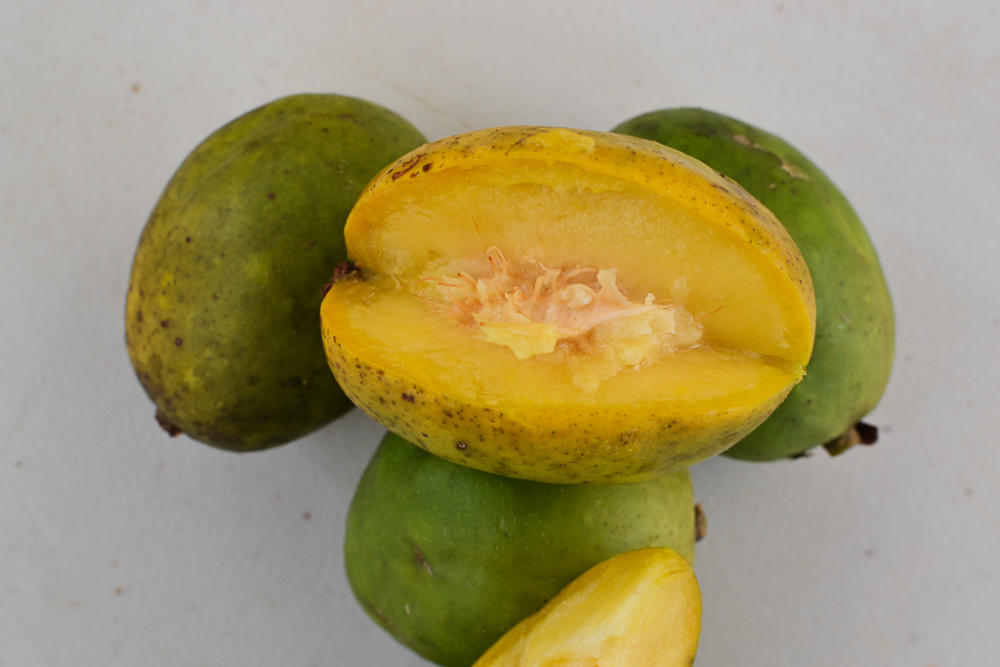
Fertilised flowers develop into oblong fruit 5 to 8 cm (2 to 3 in) long. Green when young, they become yellow when ripe, about six months after fruit-set. They have firm, juicy pulp surrounding a large seed armed with protruding spines.
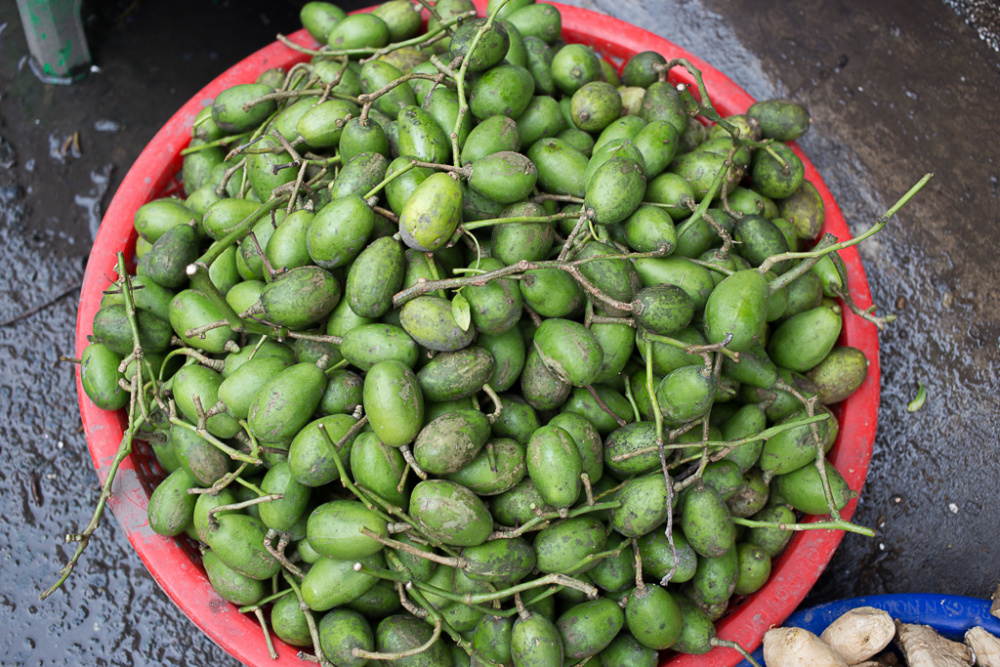
Unripe fruit on sale (Vietnam)
Edible uses
Fresh fruit - The ripe fruit can be eaten fresh out of hand, or the firm, crisp pulp can be sliced into pieces; it may be sour or sweet, with a distinctly tropical flavour, though resinous and disagreeable in inferior varieties.
Stewed fruit - More commonly stewed than eaten fresh.
Jam or marmalade - Also made into jams.
Fruit chutney - And into chutneys.
Fruit puree - Or turned into fruit sauces to accompany desserts such as cheesecake, cake, ice cream, and yoghurt.
Juice - The ripe fruit is also juiced to make a refreshing cold drink, while the unripe fruit yields a very sour green juice that is a popular thirst-quencher in Vietnam, usually sweetened with sugar syrup.
Material uses
Natural gum - The trunk exudes a yellowish gum that turns reddish-brown on exposure to air and, when immersed in water, forms a viscous gel that is not wholly soluble; its application is unclear.
Environmental uses
Bee forage - Honeybees are observed working the flowers vigorously, though the tree's value as a honey source is unknown.
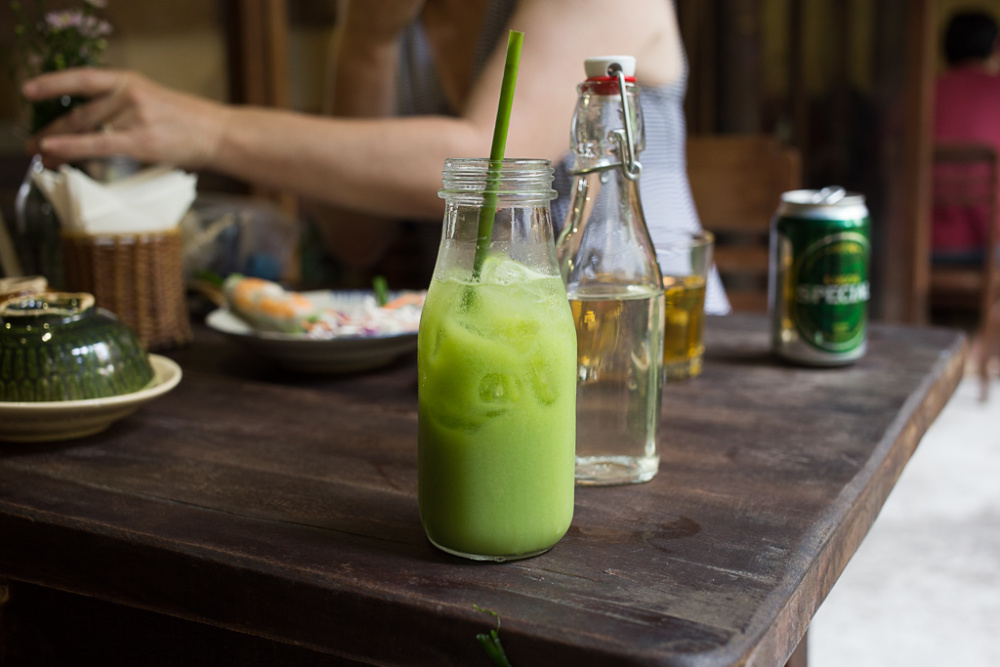
Juice sweetened with sugar syrup (Vietnam)
Climate
June Plum is closely related to the Mango (Mangifera indica) and Cashew (Anacardium occidentale). Like the Mango and Cashew, it flowers and fruits best in areas with a distinct dry season. It is most productive in humid subtropical and tropical climates, generally frost-free areas with annual lows of 13 to 25°C, annual highs of 22 to 35°C, annual rainfall of 1000 to 4500 mm, and a dry season of 3 to 7 months, as well as in drier areas with irrigation or groundwater.
In Jamaica, June plum is cultivated at elevations from near sea level up to 600 m (2000 ft), generally in areas where the average low of the warmest month is 19°C (66°F) or above. At higher elevations, where air temperatures are cooler, the tree may fail to produce flavoursome fruit.
Growing
New plants can be grown from seed, but fruit quality is highly variable among the different varieties, with unpredictable results from seedling-derived trees. Vegetative propagation is usually practised to give more predictable results, with cuttings, air-layering (circumposing) and grafting techniques all showing promising results.
Performs best on deep, rich, free-draining loam, sandy loam, and loamy sand soils of a moderately acid to slightly alkaline nature, generally with a pH of 6.0 to 7.5, and on sites with full sun exposure. Although the tree is also known to grow and fruit on limestone or alkaline soils (with a pH of 8.0 or higher), it is more likely to suffer from nutritional disorders.
Vegetatively propagated trees start to flower and fruit at around 4 to 6 years old and produce heavy crops when mature. Mature trees in South Florida produce more than 317 kg (700 lbs) of fruit in a season.
Problem features
June Plum is assessed as a low weed risk species for Hawaii and Florida by the Hawaii Pacific Weed Risk Assessment (HPWRA) project and the IFAS Assessment of Non-Native Plants in Florida's Natural Areas, respectively.
June plum is assessed as a low weed risk species for Hawaii and Florida, respectively, by the Hawaii Pacific Weed Risk Assessment (HPWRA) project and the IFAS Assessment of Non-Native Plants in Florida's Natural Areas.
The seed has sharp, protruding spines that can cause pain to the lips and gums when eating the fruit.
Where it grows
References
Books
-
Adams, C. D. 1972, Flowering plants of Jamaica, University of the West Indies, Mona, Greater Kingston
-
Allen, B. M. 1967, Malayan fruits : an introduction to the cultivated species, Donald Moore Press, Singapore
-
Barwick, M., et al. 2004, Tropical & subtropical trees : a worldwide encyclopaedic guide, Thames and Hudson, London
-
Francis, J. K. and Liogier, H. A. 1991, Naturalized exotic tree species in Puerto Rico, General technical report SO-82, USDA Forest Service, Southern Forest Experiment Station, New Orleans
-
Howes, F. N. 1949, Vegetable gums and resins, Chronica Botanica Company, Waltham, Massachusetts
-
Jensen, M. 1999, Trees commonly cultivated in Southeast Asia : an illustrated field guide, 2nd ed., Food and Agricultural Organisation of the United Nations (FAO) Regional Office for Asia and the Pacific (RAP), Bangkok
-
Kennard, W. C. & Winters, H. F. 1960, Some fruits and nuts for the tropics, Miscellaneous Publication No. 801, U.S. Department of Agriculture, Federal Experimental Station, Mayaguez, Puerto Rico
-
Macmillan, H. F. 1943, Tropical planting and gardening : with special reference to Ceylon, 5th ed, Macmillan Publishing, London
-
Martin, F. M., et al. 1987, Perennial edible fruits of the tropics : an inventory, U.S. Dept. of Agriculture (USDA), Agricultural Research Service, U.S. Government Printing Office (GPO), Washington, D.C.
-
Nussinovitch, A. 2010, Plant gum exudates of the world : sources, distribution, properties, and applications, CRC Press / Taylor & Francis, Boca Raton, Florida
-
Page, P. E. 1984, Tropical tree fruits for Australia, Queensland Department of Primary Industries (QLD DPI), Brisbane
-
Randall, R. P. 2002, A global compendium of weeds, R.G. and F.J. Richardson Press, Melbourne
-
Troup, R.S. & Joshi, H. B. 1975 to 1981, Silviculture of Indian Trees (3 volumes), Government of India Publications, New Delhi
Articles, Journals, Reports and Working Papers
-
Subhadrabandhu, S. 2001, Under-utilized tropical fruits of Thailand, Food and Agriculture Organisation of the United Nations (FAO), Regional Office for Asia and the Pacific (RAPA), Bangkok
-
Watson, B.J., & Moncur, M. 1985, Guideline criteria for determining survival, commercial and best mean minimum July temperatures for various tropical fruit in Australia (Southern Hemisphere), Department of Primary Industries Queensland (DPI QLD), Wet Tropics Regional Publication, Queensland