

Common name: Moringa
Other common names: Ben Tree, Behn Tree, Behen Tree, Benzolive Tree, Drumstick Tree, Horseradish Tree, West Indian Ben
Description
Moringa is one of the world's most valuable plants, producing edible leaves and seedpods, oil-rich seeds, and flowers with enough nectar for bees to make honey.
Native to India and Pakistan, it ranges across much of the Indian subcontinent, from the Himalayan foothills through Central India to Kerala and Tamil Nadu. Nowadays, it is cultivated in most warm-climate regions of the world, including parts of Australia, Africa, Southeast Asia, the Pacific, tropical America and the Caribbean.
It is a fast-growing, small to medium-sized tree that attains heights of up to 15 m (50 ft). However, it is typically 5 to 10 m (16 to 33 ft) tall, with a short trunk 20 to 40 cm (0.7 to 1.3 ft) in diameter that supports a wide-spreading, rounded crown. Mature trees have light brown, thickly corky, deeply fissured bark.
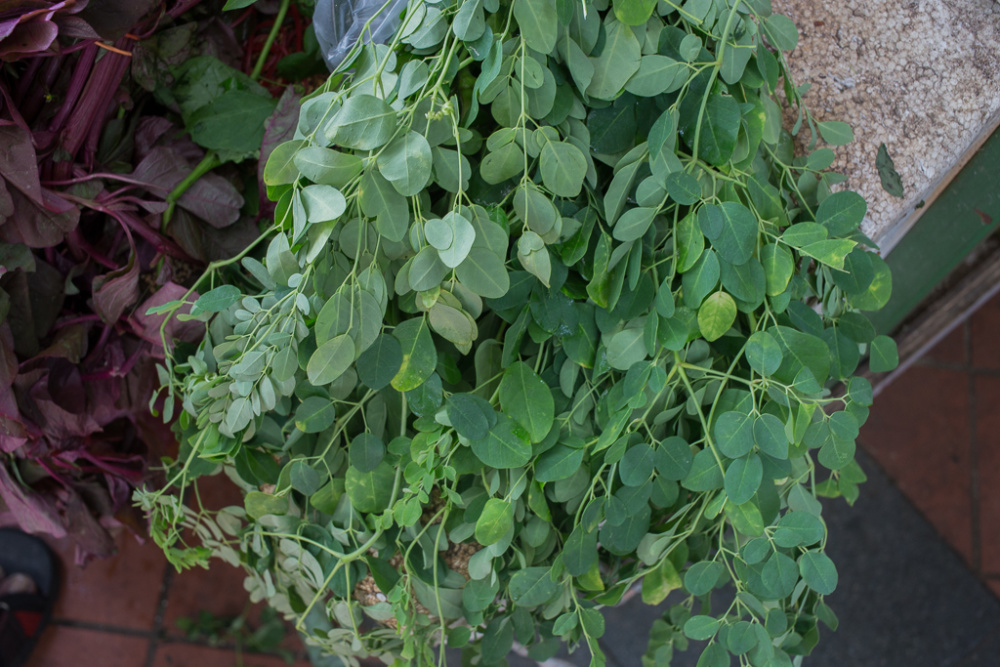
The leaves are large, 30 to 90 cm (1 to 3 ft) long and twice-feathered with up to six pairs of side branches along the length, on which grow small dark green oval leaflets arranged in pairs, and with an extra leaflet at the tip. In the dry season, the leaflets turn yellow and fall to the ground, helping the tree conserve water.
The flowers bloom around the same time as the new leaves emerge. They are five-petaled, creamy-white, fragrant, perfect (with both female and male parts) and borne on pendant clusters at the ends of the branches. Watering encourages more blooms, with on-and-off flowering not uncommon in regularly watered gardens.
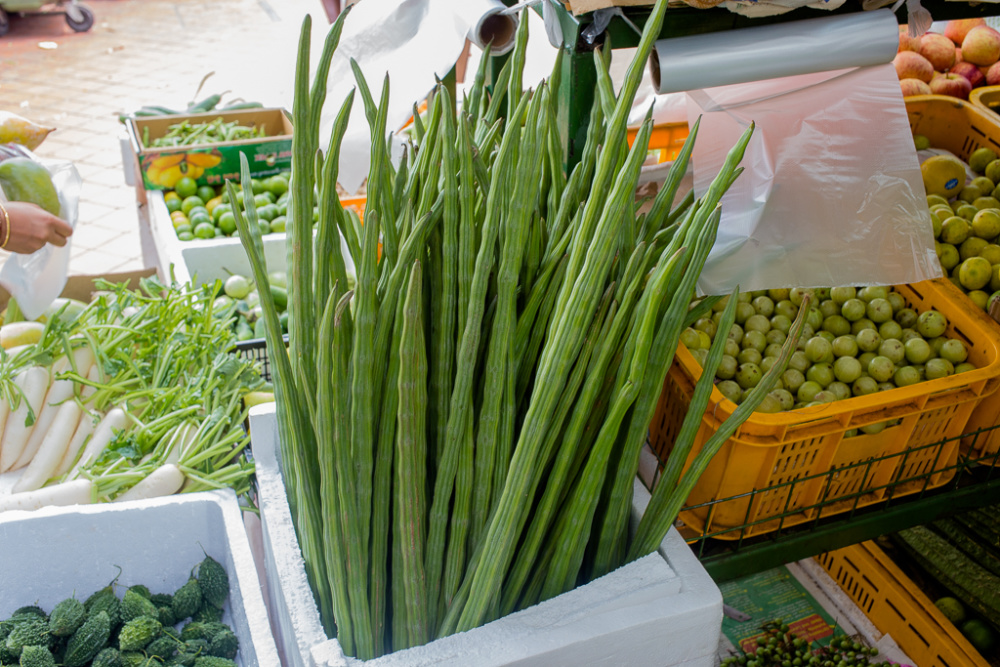
Fertilised flowers are followed by slender, triangular and ribbed seedpods varying in length from 25 to 60 cm (10 to 24 in), depending on the variety, and with up to twenty largish, three-angled, papery-winged seeds inside. The seedpods are green when young and become brown and dry when mature.
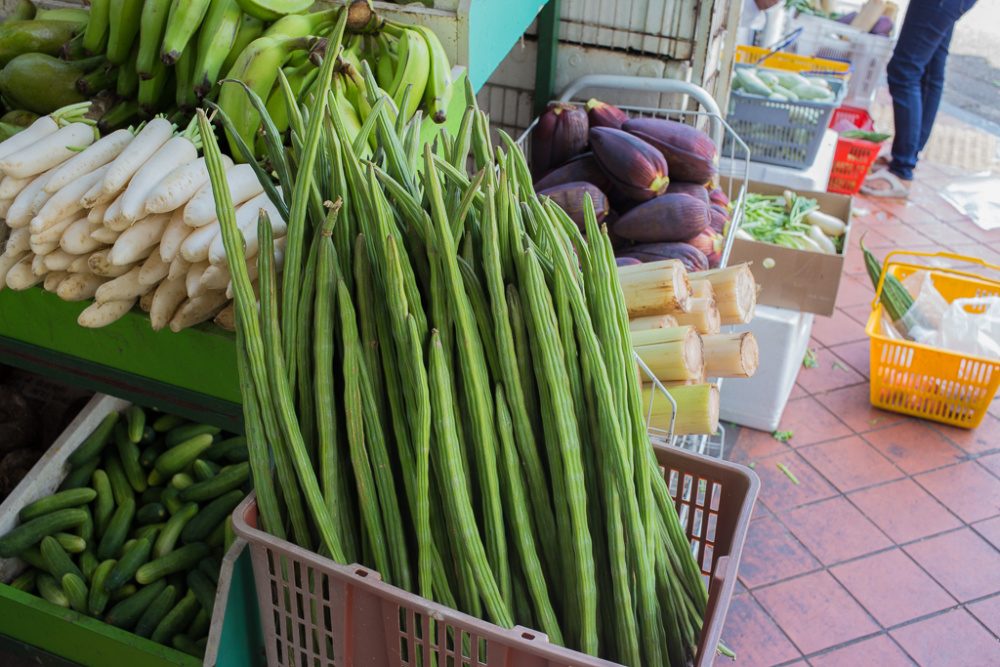
Moringa seedpods (Singapore)
Edible uses
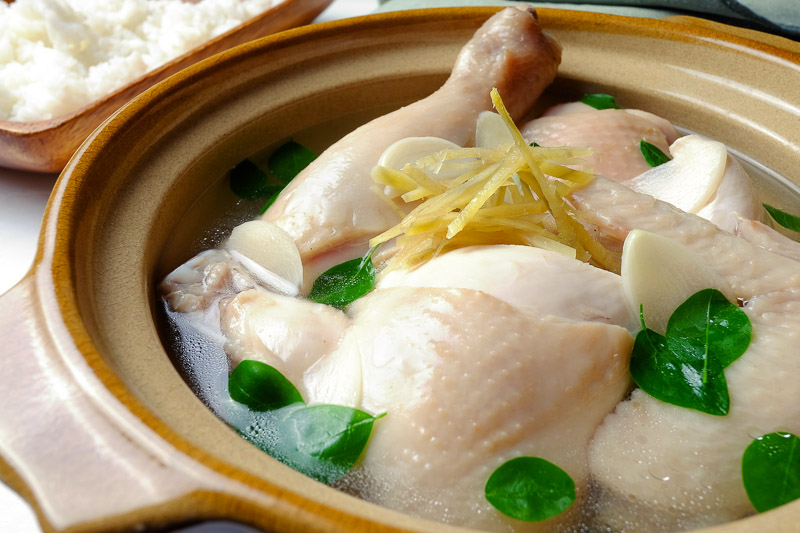
Cooked vegetable - The young leaflets are stripped from the leaf stalks and substituted for other leafy greens in steamed dishes, soups, and stir-fries. When very young, the seedpods are fibreless and can be prepared like string beans; in its native range, people add the tender pods to stews, curries, and other sauced dishes.
People also eat the very young seeds, prepared like green peas.
Pickled vegetable - The tender pods are also pickled.
Edible nut - The mature seeds are fried or roasted and eaten as a nut.
Honey - Honeybees convert the flowers' abundant nectar into a dark amber honey; it is reported as a major honey plant in Haiti and the Indian state of Bihar.
Edible oil - Seed from mature pods contains up to 35% edible oil, extracted by mechanical pressing. Known as 'Ben oil', it is a clear, yellow, odourless oil that does not go rancid and may be used as a cooking or salad oil.
Material uses
Natural carrier base - Ben oil's odourless qualities make it an excellent base for perfumes and for extracting delicate fragrances from flowers, which steam distillation or other high-temperature extraction processes might otherwise destroy.
Natural soap - Also used to make soap.
Natural lubricant - Used as a lubricant for fine machinery, such as watch movements.
Livestock feed - The fresh leaves are palatable to livestock and have a dry-weight crude protein content of 15-20%. The branches are also lopped for feeding goats and other small livestock.
Environmental uses
Green manure - The seedcake left after oil extraction is bitter and unpalatable to livestock and is mostly used as a fertiliser.
Wastewater treatment - When dried and powdered, the seedcake has also shown good wastewater-filtering (flocculation) abilities, leading to its testing as a biodegradable substitute for aluminium sulphate, a chemical widely used in wastewater treatment.
Bee forage - The flowers provide abundant nectar, supporting honey production.
Health uses
The leaflets and tender pods are high in protein. The leaflets especially contain reasonable amounts of the following:
Vitamin A
Vitamin C
When wounded, the bark yields a white gum that darkens on exposure to air, becoming reddish-brown or brownish-black. Its properties are reportedly similar to those of Karaya Gum (from Sterculia urens), as it is partly soluble in water and swells to a jelly-like consistency. It is reportedly used in traditional medicine against earache and intestinal complaints.
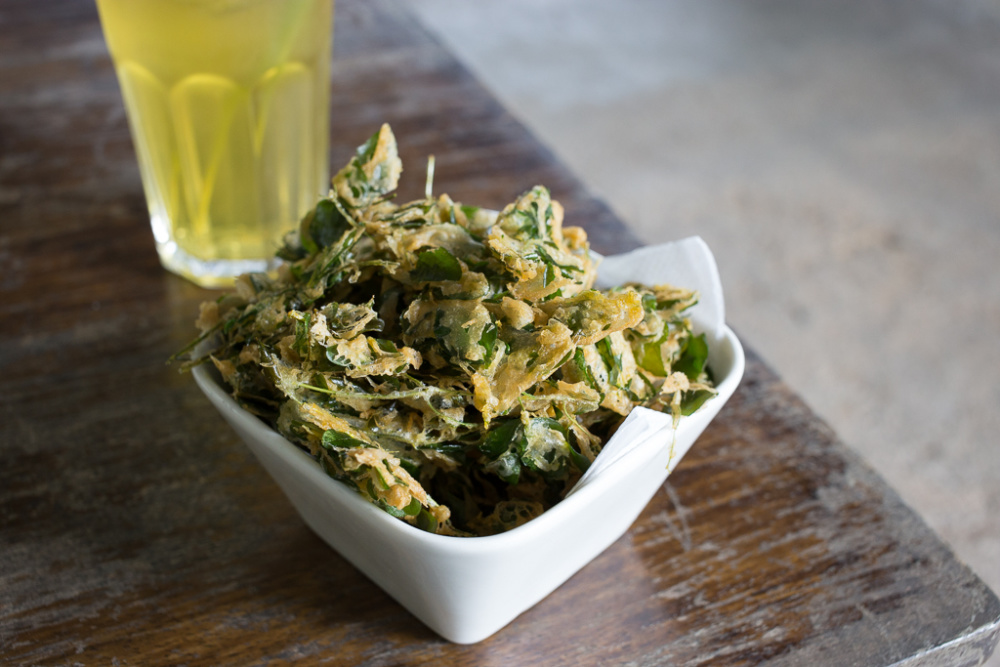
Moringa leaves in tempura batter (Singapore)
Climate
Moringa grows naturally in sub-humid to humid subtropical and tropical lowland to mid-elevation climates, generally in frost-free areas with annual lows of 12 to 25°C, annual highs of 21 to 37°C, annual rainfall of 600 to 4500 mm and a dry season of 2 to 8 months, extending to 12 months with irrigation or groundwater.
Growing
New plants can be started from cuttings or seed, but seed loses much of its viability within the first six to twelve months. Seed harvested for sowing is twice-dried: first in their pods in the sun, then shelled and dried in the shade. If not sown within a few days, they are best kept in a dry, airtight container in cold storage.
Early-flowering varieties such as 'PKM-1' and 'PKM-2', developed by Tamil Nadu University in India, produce pods within a year of sowing. Coppicing, the practice of cutting a tree back to near ground level, encourages the growth of new leaves, flowers and seedpods.
Performs best on rich, free-draining loam and sand soils of a moderately acid to moderately alkaline nature, generally with a pH of 5.5 to 7.5, and on sites with full sun exposure. It has poor tolerance to slow-draining or waterlogged soils.
Problem features
The tree produces many seeds that, although large, are winged and may be carried by the wind some distance from the parent tree. Assessment of its weed risk is conflicting, with a low weed risk outcome from the Hawaii Pacific Weed Risk Assessment (HPWRA) project and a not recommended outcome from the IFAS Assessment of Non-Native Plants in Florida's Natural Areas. In Australia, it is recorded as having escaped cultivation and as a weed of the natural environment.
Where it grows
References
Books
-
Adams, C. D. 1972, Flowering plants of Jamaica, University of the West Indies, Mona, Greater Kingston
-
Booth, F. E. M. & Wickens, G. E. 1988, Non-timber uses of selected arid zone trees and shrubs in Africa, Food and Agriculture Organization of the United Nations (FAO), Rome
-
Bradbear, N. 2009, Bees and their role in forest livelihoods : a guide to the services provided by bees and the sustainable harvesting, processing and marketing of their products, Food and Agriculture Organization of the United Nations (FAO), Rome
-
Brady, G. S. & Clauser, H. R & Vaccari, J. A. 2002, Materials handbook : an encyclopedia for managers, technical professionals, purchasing and production managers, technicians and supervisors, 15th ed., McGraw-Hill, New York
-
Crane, E., Walker, P. & Day, R. 1984, Directory of important world honey sources, International Bee Research Association, London, United Kingdom
-
Elevitch, C. R. & Thaman, R. R. 2011, Specialty crops for Pacific islands, 1st ed, Permanent Agriculture Resources, Hawaii
-
Fawcett, W. 1891, Economic plants, An index to economic products of the vegetable kingdom in Jamaica, Jamaica Government Printing Establishment, Kingston
-
Food and Agriculture Organization of the United Nations (FAO) 1988, Traditional food plants : a resource book for promoting the exploitation and consumption of food plants in arid, semi-arid and sub-humid lands of eastern Africa, Food and Nutrition Paper No. 42, Rome
-
Food and Agriculture Organization of the United Nations (FAO), 1982, Fruit-bearing forest trees : technical notes, FAO, Rome
-
Francis, J. K. and Liogier, H. A. 1991, Naturalized exotic tree species in Puerto Rico, General technical report SO-82, USDA Forest Service, Southern Forest Experiment Station, New Orleans
-
Francis, J. K. et al. 2000, Silvics of Native and Exotic Trees of Puerto Rico and the Caribbean Islands, Technical Report IITF-15, USDA Forest Service, Rio Piedras, Puerto Rico
-
Gohl, B. 1981, Tropical Feeds : feed information summaries and nutritive values (Revised edition), Food and Agriculture Organization of the United Nations (FAO), Rome
-
Grubben, G.J.H. & Denton, O.A. (Editors) 2004, Plant Resources of Tropical Africa, Volume 2 : Vegetables, PROTA Foundation, Backhuys Publishers, Leiden
-
Hocking, D. 1993, Trees for drylands, International Science Publisher, New York
-
Howes, F. N. 1949, Vegetable gums and resins, Chronica Botanica Company, Waltham, Massachusetts
-
Jamieson, G. S. 1943, Vegetable fats and oils : their chemistry, production, and utilization for edible, medicinal and technical purposes, 2d ed, Reinhold, New York
-
Janick, J., & Paull, R. E. 2008, The encyclopedia of fruit & nuts, CABI Publishing, Wallingford, Oxfordshire
-
Jensen, M. 1999, Trees commonly cultivated in Southeast Asia : an illustrated field guide, 2nd ed., Food and Agricultural Organisation of the United Nations (FAO) Regional Office for Asia and the Pacific (RAP), Bangkok
-
Krishen, P. 2006, Trees of Delhi : a field guide, Dorling Kindersley Publishers, Delhi
-
Luna, R. K 1996, Plantation trees, International Book Distributors, Dehradun, Uttarakhand
-
Martin, F. W & Ruberte, R. M. 1975, Edible leaves of the tropics, U.S. Agency for International Development (USAID), and the Agricultural Research Service, U.S. Department of Agriculture (USDA), Mayaguez, Puerto Rico
-
Nair, P. K. R. 1993, An introduction to agroforestry, International Centre for Research in Agroforestry (ICRAF), Kluwer Academic Publishers, Dordrecht
-
National Research Council (Board on Science and Technology for International Development) 2006, Lost Crops of Africa: Volume II: Vegetables, The National Academies Press, Washington D.C.
-
Parrotta, J. A. 2001, Healing plants of peninsular India, CABI Publishing, Wallingford, Oxfordshire
-
Seidemann, J. 2005, World spice plants: economic usage botany taxonomy, Springer-Verlag, Berlin
-
Selvam, V. 2007, Trees and shrubs of the Maldives, Food and Agriculture Organisation (FAO) RAP publication (Maldives), Thammada Press Company Ltd., Bangkok
-
Singh, R. V. 1982, Fodder trees of India, Oxford & IBH Publishing Company, New Delhi
-
Staples, G. & Kristiansen, M. S. 1999, Ethnic culinary herbs : a guide to identification and cultivation in Hawaii, University of Hawaii Press, Honolulu
-
Streets, R. J. & Troup, R. S. 1962, Exotic forest trees in the British Commonwealth, Oxford University Press, Oxford, England
-
Wenkam, N.S. 1983 to 1990, Foods of Hawaii and the Pacific Basin (5 volumes), College of Tropical Agriculture and Human Resources, University of Hawaii, Honolulu
-
Wickens, G. E & Day, Peter R., 1928- & Haq, N & International Symposium on New Crops for Food and Industry 1989, New crops for food and industry, Chapman and Hall, London ; New York
Articles, Journals, Reports and Working Papers
-
Buddenhagen C.E., Chimera C. & Clifford P. 2009, Assessing Biofuel Crop Invasiveness: A Case Study, PLoS ONE 4
-
Morton, J.F. 1964, Honeybee Plants of South Florida, Proceedings of the Florida State Horticultural Society, Vol 77:415-436.