

Common name: Rollinia
Other common names: Biriba
Description
Rollinia is a custard apple relative native to Brazil's Western Amazon Basin. Over time, its distribution expanded to neighbouring Peru, Guyana, Suriname, Venezuela, and Colombia, and more recently to the Caribbean, Hawaii, southern Florida, and Australia, where it has become a popular fruit tree.
It is a fast-growing shrub or small tree up to 15 m (50 ft) tall, though it is typically 4 to 9 m (13 to 30 ft), and develops a dense, initially pyramidal crown that becomes rounded with age. The bark is smooth and grey-brown.
The leaves are elongated-oval, 15 to 25 cm (6 to 10 in) long, glossy green (light to dark), prominently ribbed on top, finely hairy underneath, and leathery. They are alternately arranged along the stems and are briefly deciduous, detaching and falling to the ground in the dry season.
The flowers are 2 to 3.5 cm (0.8 to 1.4 in) wide and made up of two sets of three petals, one set within the other, with the fleshy green outer set the most conspicuous. They are perfect, with both female and male parts and are borne singly or in twos or threes along the stems, mostly in spring, coinciding with the transition from the dry to the rainy season. High humidity conditions are needed for successful pollination, which beetles and other insects carry out.
Fertilised flowers develop into heart-shaped fruit ranging from 10 to 20 cm (4 to 8 in) in length and width, and 1 to 2 kg (2 to 4 lbs) in weight, though fruit weighing up to 5 kgs (11 lbs) has been reported. The rind is leathery and rough, with teat-like spikes; when young and green, it becomes lemon-yellow and softens when ripe. It protects a creamy-white, custardy or translucent pulp embedded with glossy dark brown seeds.
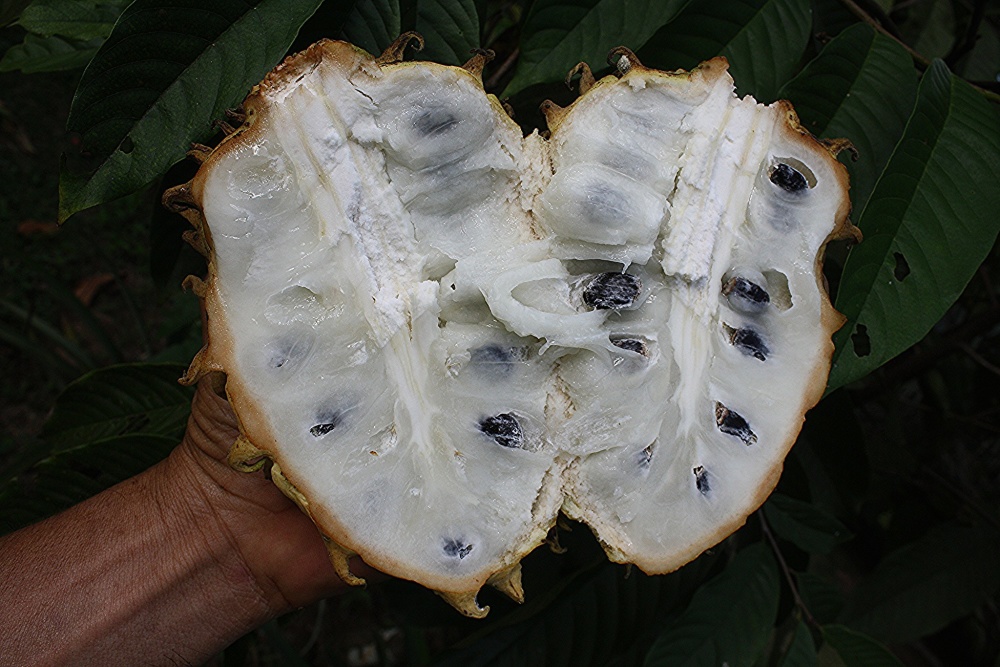
Photo by Ahmad Fuad Bin Morad
Edible uses
Fresh fruit - The ripe fruit is eaten fresh out of hand by slicing it through and scooping out the pulp, which is aromatic, soft, and juicy, with a smooth, custard-like texture and a pleasing subacid-to-sweet flavour. It is arguably the most delicious of the custard apples, with flavour descriptions likened to lemon meringue pie and apple custard. The fruit tastes best just before it is fully ripe, when the rind is mostly yellow but still shows small areas of green. Fully ripe or overripe fruit tends to be less flavoursome, and the pulp may even be insipid.
Fruit puree - Beyond eating it fresh, the de-seeded pulp is pureed or blended to flavour drinks and desserts, including dairy desserts such as yoghurt and ice-cream.
Climate
Grows naturally in humid subtropical and tropical climates, generally frost-free areas with annual lows of 13 to 25°C, annual highs of 24 to 35°C, annual rainfall of 1000 to 4500 mm and a dry season of 4 months or less.
Growing
New plants are usually raised from seed, though vegetative propagation also works well. The seed remains viable only briefly and should be planted soon after removal from the fruit. They are best sown in containers with a free-draining potting mix and transplanted when seedlings are 40 cm (1.3 ft) or taller.
It performs best in deep, fertile, free-draining loam and sand soils that are moderately acid to slightly alkaline, generally with a pH of 5.0 to 7.5, and in sites with full to partial sun exposure.
It tolerates seasonal flooding well but tolerates slow-draining soils and drought poorly, with trees suffering water stress during dry periods longer than three to four months. Because it is drought-intolerant, the tree benefits from a thick layer of mulch over the roots to conserve water, especially in areas near the lower end of its rainfall range and where the dry season is pronounced.
It is an early-bearing tree that, under favourable conditions, starts to flower and fruit at two to three years old.
Varieties common in Australia include 'Limberlost' (a heavy bearer of small fruit), 'Picone' (a consistent cropper of large, juicy fruit) and 'Sputnik' (lemon meringue flavoured fruit). Other varieties include 'Regard' (from the Philippines), 'Prolific' (from Florida) and 'Liso' (from Brazil).
Problem features
It produces fruit with viable seed, but there does not appear to be any record of it anywhere as having escaped cultivation, as a weed or as an invasive species. The Hawaii Pacific Weed Risk Assessment project (HPWRA) assesses it as a low weed risk species for Hawaii.
Where it grows
References
Books
-
Food and Agriculture Organization of the United Nations (FAO) 1986, Food and Fruit-bearing Forest Species, 3 : Examples from Latin America, FAO Forestry Paper no 44/3, Rome
-
Morton, J. F. & Dowling, C. F. 1987, Fruits of warm climates, Creative Resources Systems, Winterville, North Carolina
-
Page, P. E. 1984, Tropical tree fruits for Australia, Queensland Department of Primary Industries (QLD DPI), Brisbane
-
Queensland Department of Primary Industries and Fisheries (QLD DPI) 2008, Queensland tropical fruit : the healthy flavours of North Queensland, Brisbane
-
Randall, R. P. 2007, The introduced flora of Australia and its weed status, Cooperative Research Centre for Australian Weed Management, Glen Osmond, South Australia
Articles, Journals, Reports and Working Papers
-
Watson, B.J., & Moncur, M. 1985, Guideline criteria for determining survival, commercial and best mean minimum July temperatures for various tropical fruit in Australia (Southern Hemisphere), Department of Primary Industries Queensland (DPI QLD), Wet Tropics Regional Publication, Queensland