


Common name: Lychee
Other common names: Chinese Cherry, Leechee, Lichee, Litchi
Description
Although commonly associated only with southern China, the natural range of this well-known fruit tree extends beyond China into neighbouring Vietnam and the Philippines.
It is typically a small- to medium-sized tree, 8 to 15 m (26 to 50 ft) tall, with a single, or occasionally forked, trunk supporting a densely leafy, rounded crown. However, some varieties may reach up to 25 m (82 ft) tall. The bark is grey-brown and slightly rough.
The leaves are compound, made up of four to ten oval to lance-shaped leaflets, each 5 to 8 cm (2 to 3 in) long and arranged in pairs along the length. They emerge bronze-red, become lime green, then dark glossy green with a soft, leathery texture and remain on the tree in all seasons.
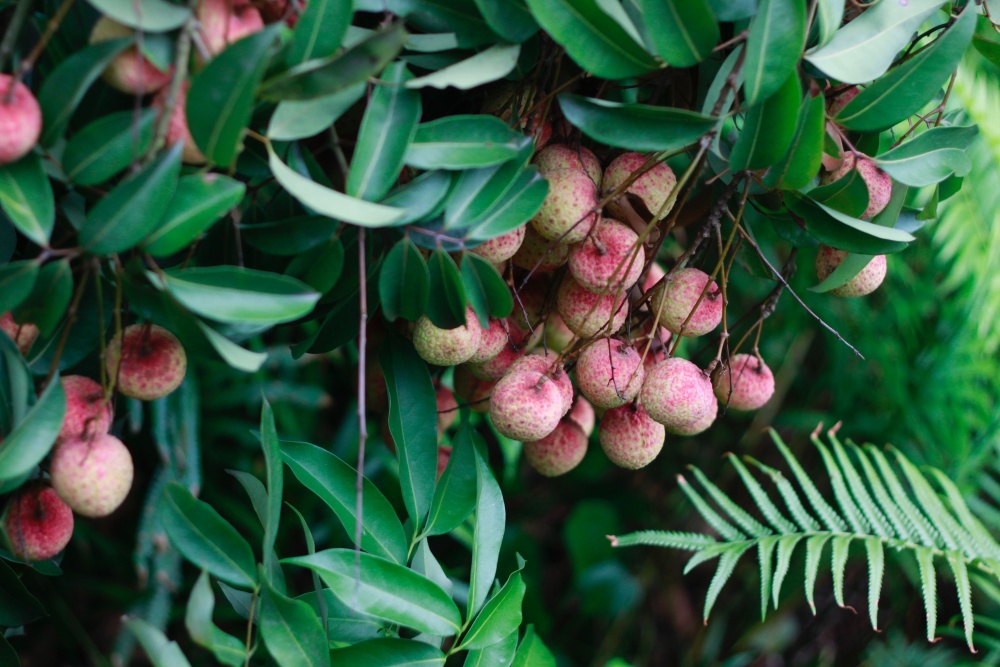
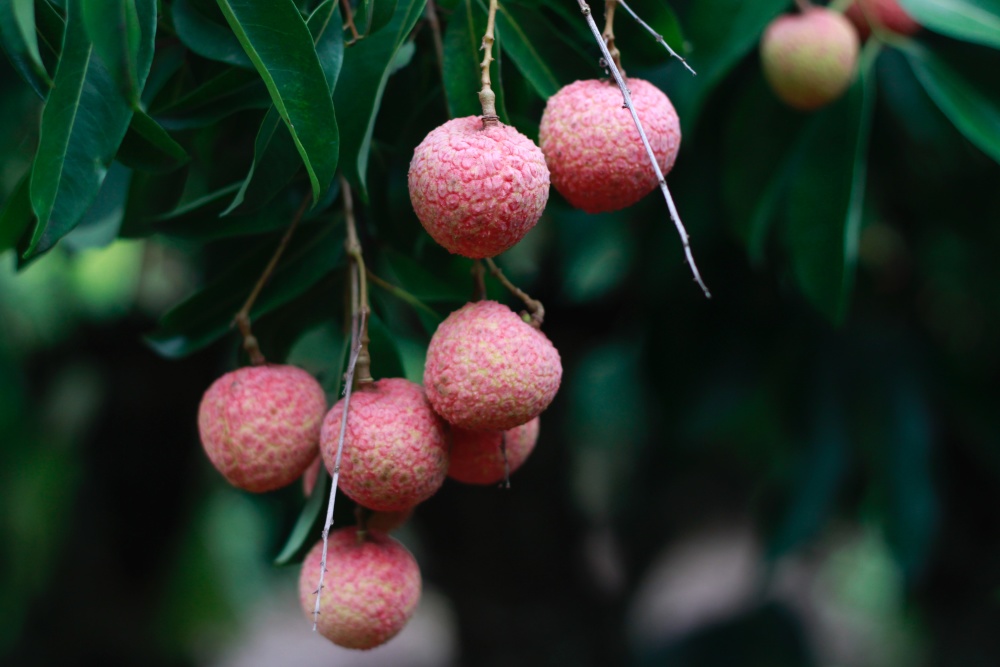
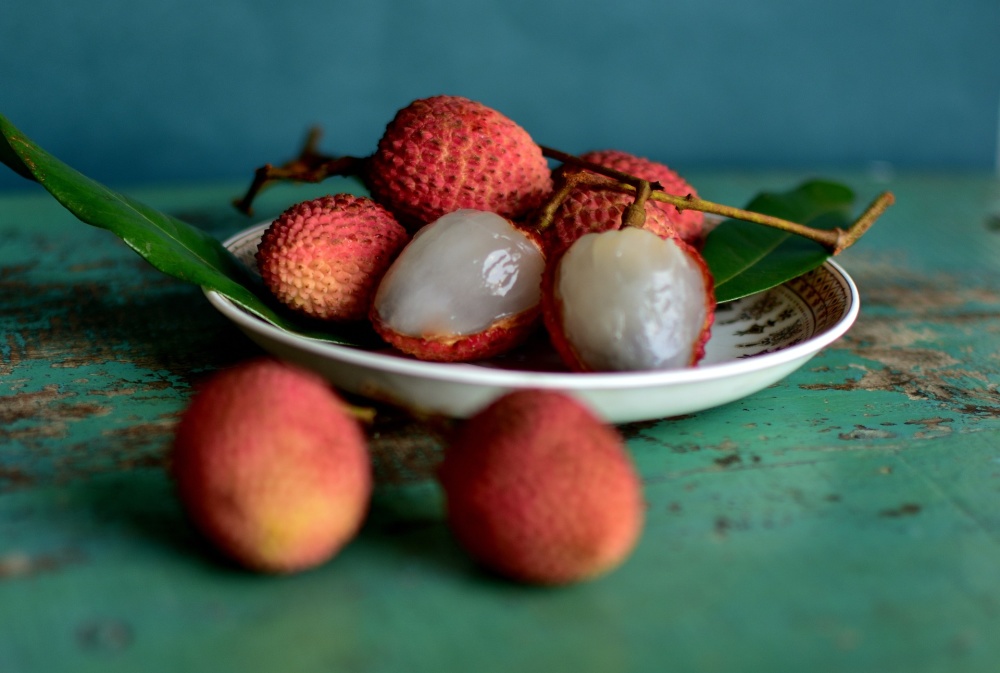
The flowers are small, creamy-white and borne on branched clusters at the ends of the branches. They are unisex, with separate female and male flowers within the same cluster, and they bloom in spring. Fertilised flowers develop into round to egg-shaped fruit, 2.5 to 4 cm (1 to 1.6 in) long, depending on the variety, with thin, warty green skin that becomes pink-red to red when ripe. The pulp is near-white and juicy, and surrounds a single oval, glossy brown seed.
Use
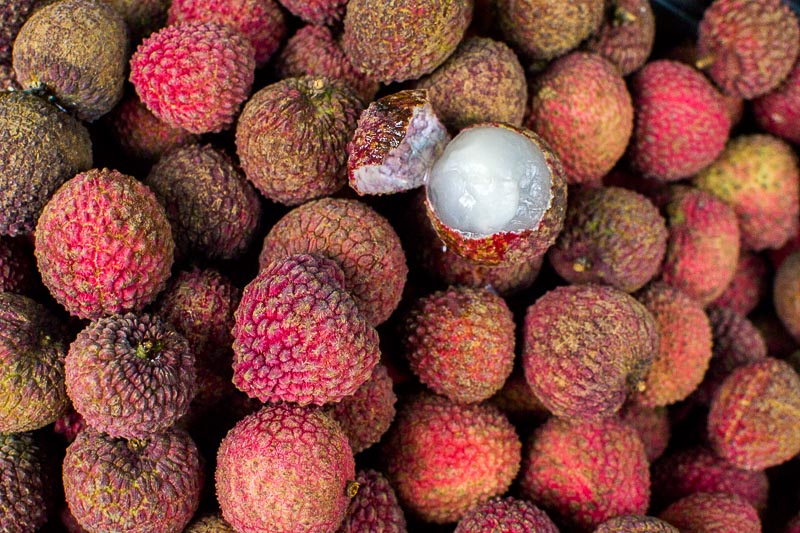
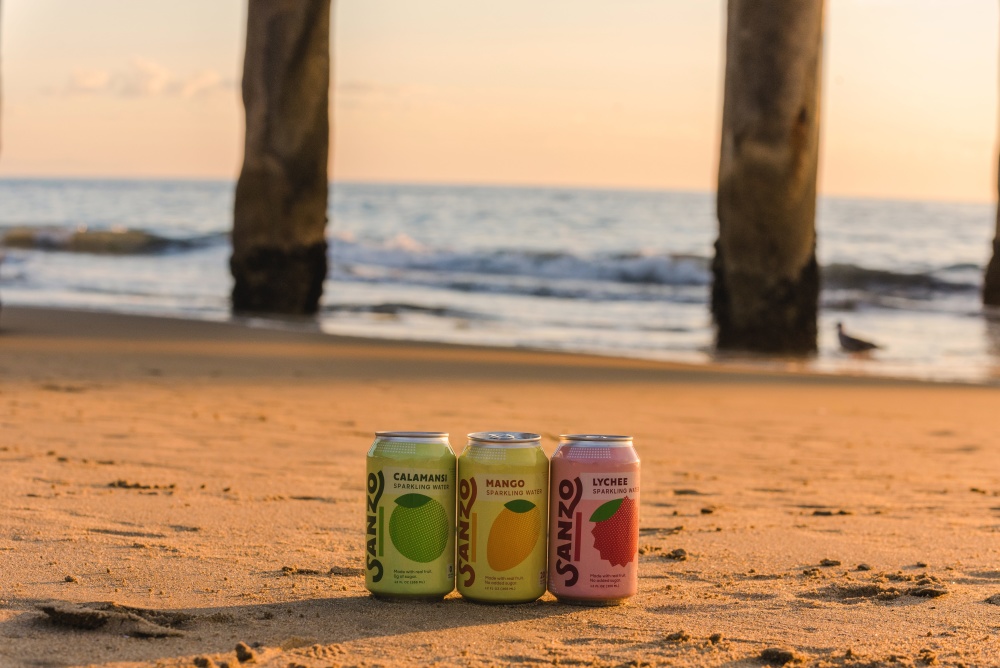
Lychee is cultivated for its fruit, which is at its best when eaten ripe and fresh out of hand. The thin, brittle skin is easily peeled, and the pulp is eaten after the seed, which is inedible, is removed and discarded. The pulp is juicy, smooth, and melting, with an agreeable sweet-acid flavour. Besides being eaten out of hand, the pulp is used to flavour chilled drinks, dairy desserts, such as ice cream and yoghurt, and fruit sauces. The surplus pulp is commonly canned in syrup, mostly in China and India, or dried, pureed, and frozen.
It is reported as a major honey plant in China, India, Mauritius, Thailand, and Taiwan, and as a minor honey plant in South Africa and Florida. Yields are moderate, ranging from 7 to 27 kg (15 to 60 lb) per colony per season. The honey is lightly golden, sometimes with a reddish tinge, or dark in dry years and slightly acid in flavour. After several months, it starts to granulate to a medium grain.
Climate
Lychee cultivation is best suited to humid subtropical climates, generally frost-free areas with annual lows of 11 to 21°C, annual highs of 23 to 33°C, annual rainfall of 1000 to 4000 mm and a dry season of 4 months or less. Lychee trees may fail to flower and fruit, or do so poorly, in areas where the average low temperature of the coldest month is above 16°C (61°F).
Lychee is also cultivated with irrigation in areas with low rainfall and a long dry season. Most lychee cultivation in India is irrigated, with Muzaffarpur, in Bihar state, which experiences a 7-month dry season, as the centre of cultivation.
When conditions are drier-than-normal during flowering, the trees benefit from a microclimate in which irrigation can be misted over the top of their canopy.
High chill varieties suited to cool subtropical climates include 'Brewster', 'Kwai May Red', 'No Mai Tsz’, 'Sah Keng', 'Salathial', 'Shahi' and 'Wai Chee'.
Low chill varieties for warm subtropical and cool-winter tropical climates include 'Amboina', 'San Ye Hong', 'Kaimana', 'Groff', 'Souey Tung', 'Kwai Mi Pink' (aka. 'Bosworth 3') and 'Tai So' (a.k.a 'Mauritius' and 'Da Zo'). However, only 'Tai So' and 'Kwai Mi Pink' crop regularly in cool-winter tropical climates, whereas the other varieties mostly crop irregularly. In the end, 'Kwai Mi Pink' is probably the best choice for cool-winter tropical climates because it both crops regularly and has excellent eating qualities.
Less common are tropical lowland varieties, such as 'Kom' (or 'Khom'), 'Luk Lai', 'Sampao Kaow', 'Kalake Bai Yaow ', and 'Red China', all of which originate from Thailand. These varieties produce fruit in climates warmer than those described above, but lack the depth of flavour of the cool-climate varieties and, as such, may not be as widely appreciated.
Growing
New plants are usually produced vegetatively (using air-layering or circumposition techniques) because seedlings start to bear fruit much later and may not come true to type. Plants are instead used mostly as rootstock onto which selected varieties are grafted.
The seeds lose their viability quickly and should be sown within a few hours of being extracted from the fruit, as they are unlikely to sprout once they begin to dry. Seedlings grow quickly and develop a long taproot that will become root-bound if kept in a container for too long.
Performs best on rich, deep, free-draining clay and loam soils of a moderately acid to slightly alkaline nature, generally with a pH of 5.0 to 7.5, and on sites with full to partial sun exposure. It has poor tolerance to slow-draining and strongly alkaline soils.
Fruit yields vary by variety, tree age, tree size and cultivation practice. Average yields reported for ten-year-old trees in Australia range from 10 to 50 kg (22 to 110 lb) of fruit per tree per year for irregular-bearing varieties, to 30 to 80 kg (66 to 176 lb) for regular-bearing varieties.
Problem features
The seeds germinate readily but are large and not easily dispersed. Despite its widespread introduction and cultivation, there do not appear to be any reports of it becoming a serious weed or invasive species.
It is assessed as a low weed risk species for Hawaii and Florida by the Hawaii Pacific Weed Risk Assessment project (HPWRA) and the IFAS Assessment of Non-Native Plants in Florida's Natural Areas, respectively. However, it is reported as naturalised in northern and central India and in the Kruger National Park in South Africa.
The overripe fruit falls to the ground, creating a messy litter.
Where it grows
References
Books
-
Allen, B. M. 1967, Malayan fruits : an introduction to the cultivated species, Donald Moore Press, Singapore
-
Barwick, M., et al. 2004, Tropical & subtropical trees : a worldwide encyclopaedic guide, Thames and Hudson, London
-
Bradbear, N. 2009, Bees and their role in forest livelihoods : a guide to the services provided by bees and the sustainable harvesting, processing and marketing of their products, Food and Agriculture Organization of the United Nations (FAO), Rome
-
Crane, E., Walker, P. & Day, R. 1984, Directory of important world honey sources, International Bee Research Association, London, United Kingdom
-
Editors of Sunset Magazine 2012, The New Western Garden Book: The Ultimate Gardening Guide, 9th edition, Sunset Publishing Corporation, California
-
Elevitch, C. R. & Thaman, R. R. 2011, Specialty crops for Pacific islands, 1st ed, Permanent Agriculture Resources, Hawaii
-
Florida Department of Environmental Protection 2010, The Florida-Friendly Landscaping Guide to Plant Selection & Landscape Design, 1st ed., University of Florida
-
Gilman, E. F. 1997, Trees for urban and suburban landscapes, Delmar Publishers, Albany, New York
-
Jensen, M. 1999, Trees commonly cultivated in Southeast Asia : an illustrated field guide, 2nd ed., Food and Agricultural Organisation of the United Nations (FAO) Regional Office for Asia and the Pacific (RAP), Bangkok
-
Luna, R. K 1996, Plantation trees, International Book Distributors, Dehradun, Uttarakhand
-
Macmillan, H. F. 1943, Tropical planting and gardening : with special reference to Ceylon, 5th ed, Macmillan Publishing, London
-
Menninger, E. A. 1962, Flowering trees of the world for tropics and warm climates, 1st ed., Heathside Press, New York
-
Menninger, E. A. 1977, Edible nuts of the world, Horticultural Books, Stuart, Florida
-
Queensland Department of Primary Industries and Fisheries (QLD DPI) 2008, Queensland tropical fruit : the healthy flavours of North Queensland, Brisbane
-
Randall, R. P. 2002, A global compendium of weeds, R.G. and F.J. Richardson Press, Melbourne
-
Rosengarten, F. 1984, The book of edible nuts, Walker and Company Publishing, New York
Articles, Journals, Reports and Working Papers
-
Morton, J.F. 1964, Honeybee Plants of South Florida, Proceedings of the Florida State Horticultural Society, Vol 77:415-436.
-
Papademetriou, M. K. & Dent, F. J. 2002, Lychee production in the Asia-Pacific region, Food and Agricultural Organization of the United (FAO), Regional Office for Asia and the Pacific (RAP), Bangkok
-
Percival, S. & Findley, B. 2007 (Reviewed April 2014), What's in Your Tropical Fruit?, Fact Sheet HN 0708, University of Florida IFAS Extension Service, Gainesville, Florida
-
Watson, B.J., & Moncur, M. 1985, Guideline criteria for determining survival, commercial and best mean minimum July temperatures for various tropical fruit in Australia (Southern Hemisphere), Department of Primary Industries Queensland (DPI QLD), Wet Tropics Regional Publication, Queensland
-
Wenkam N.S. & Miller C.D. 1965, Composition of Hawaii fruits (Bulletin 135), University of Hawaii, Honolulu