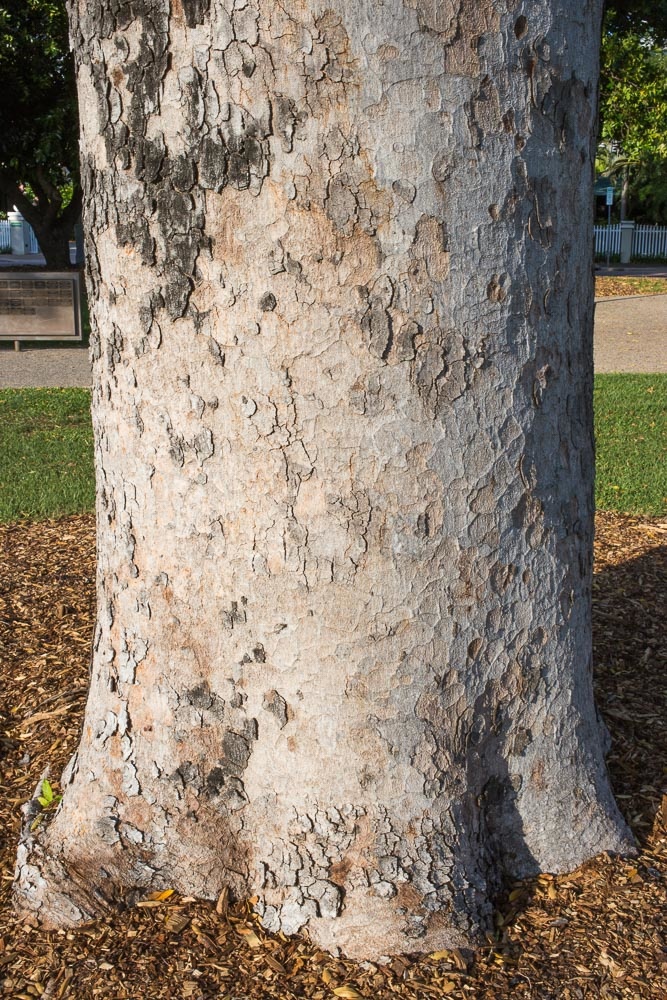


Common name: Dryzone Mahogany
Other common names: African Mahogany, Bastard Mahogany, Gambian Mahogany, Nacre, Senegal Mahogany
Description
Dryzone Mahogany is a fast-growing timber tree native to tropical Africa, with a natural range extending coast to coast across the continent, east-west along a narrow band just north of the equator.
It may grow to 30 m (100 ft) tall under forest conditions and develops a reasonably straight trunk, tending to be short on trees in the drier parts of its range and buttressed at the base of large trees.
The crown is roundish and dense, consisting of large, feathery leaves with numerous leaflets. The leaves fall during the dry season, leaving the branches almost bare until the rainy season when the new leaves emerge.
Flowers are creamy-white and singularly insignificant but bloom in large, showy clusters during the dry season and are either female or male on the same tree. Fertilised female flowers develop into round, tennis-ball-sized, brown, woody seedpods enclosing many winged seeds.
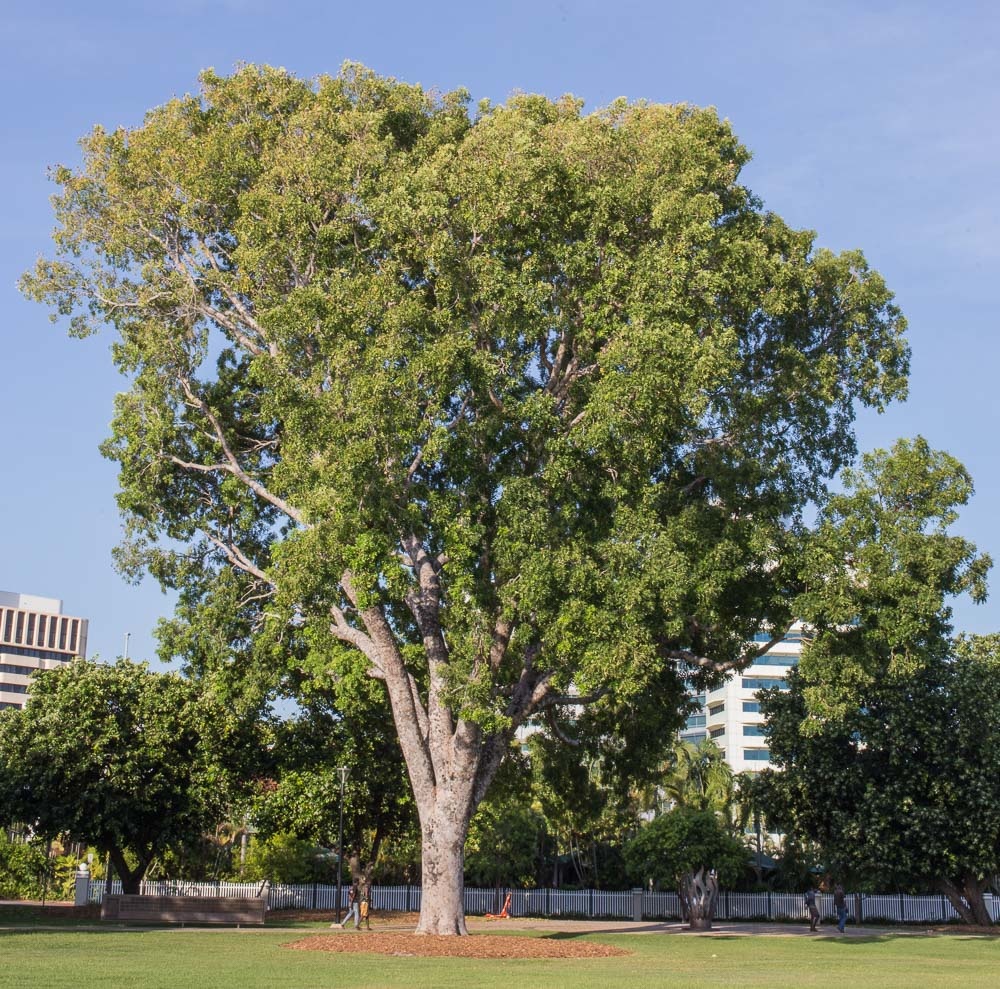
Darwin, Australia
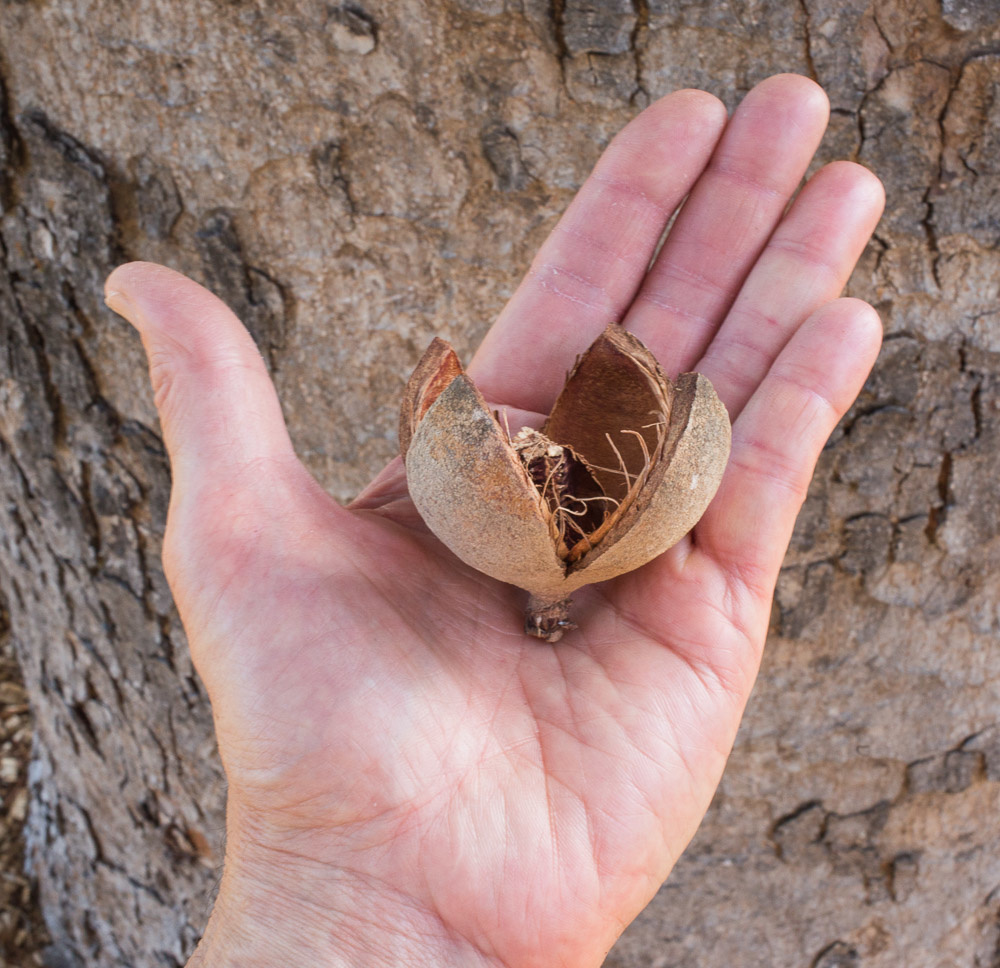
Seedpod
Material uses
Hardwood - The wood weighs 600 to 750 kg per cubic meter (37 to 47 lb per cubic ft), placing it at the soft end of the hardwood scale. The heartwood is light pink-brown when freshly cut, darkening with exposure to a deep red-brown with a purple tinge. The sapwood is not very distinct from the heartwood, being only slightly paler and browner. In texture and general appearance, the wood more closely resembles Cuban Mahogany (Swietenia mahagoni) than any other African species. Its natural resistance to termites and marine borers is as yet unknown.
Timber and lumber - Dryzone Mahogany produces a valuable timber with multiple uses and is much sought after for a range of high-value products. The timber works well with all tools, though its greater hardness than some other African mahoganies can make it more challenging to work with. Turning can cause some surface woolliness, so sharp blades and cutters are recommended. It glues, fixes and finishes without difficulty.
Light construction - Its main uses include light construction...
Flooring and decking - ...including interior flooring...
Furniture and cabinets - ...and furniture and cabinet making.
Decorative veneer - Selected roundwood is also sliced for decorative veneer.
Firewood - The branchwood is cut for firewood.
Edible uses
Edible oil or fat - The seeds contain around 67% oil, rich in oleic acid (66%), and the oil is used for cooking in West Africa (ICRAF online).
Environmental uses
Bee forage - The flowers are a major nectar source for honeybees in Senegal and a moderate to minor source in Guinea-Bissau. However, little information exists on the honey itself, including its colour, taste, or other edible qualities.
Climate
Grows naturally and produces good quality, valuable timber in sub-humid to moderately humid tropical lowland climates, generally areas with annual lows of 16 to 25°C, annual highs of 27 to 35°C, annual rainfall of 800 to 4500 mm and a dry season of 4 to 7 months.
Growing
New plants are usually started from seed. However, vegetative propagation is being trialled to overcome the high variability in seed-grown trees, particularly in trunk size, shape, and uniformity.
Performs well on a wide range of clay, loam or sand soils, from free- to slow-draining, dry to moist and from acid to slightly alkaline, generally with a pH of 5.0 to 7.5. Full sun exposure gives the best results. It tolerates seasonal drought and flooding well.
Problem features
The winged seed can float on the wind over long distances and germinate readily. In Australia, it has escaped cultivation and is recorded as a weed in natural environments.
Dryzone Mahogany is not recommended for planting near buildings or in public areas because its vigorous roots can damage foundations. The tendency of its branches to break in strong winds and fall can cause personal injury or property damage.
Where it grows
References
Books
-
Bechtold, Thomas & Mussak, Rita 2009, Handbook of natural colorants, Wiley, Chichester, U.K
-
Bradbear, N. 2009, Bees and their role in forest livelihoods : a guide to the services provided by bees and the sustainable harvesting, processing and marketing of their products, Food and Agriculture Organization of the United Nations (FAO), Rome
-
Crane, E., Walker, P. & Day, R. 1984, Directory of important world honey sources, International Bee Research Association, London, United Kingdom
-
Food and Agriculture Organization of the United Nations (FAO) 1986, Databook on endangered tree and shrub species and provenances, FAO Forestry Paper 77, Forest Resources Division, Rome
-
Francis, J. K. 1998, Tree species for planting in forest, rural, and urban areas of Puerto Rico, U.S. Department of Agriculture, Forest Service, International Institute of Tropical Forestry, Río Piedras, Puerto Rico
-
Francis, J. K. et al. 2000, Silvics of Native and Exotic Trees of Puerto Rico and the Caribbean Islands, Technical Report IITF-15, USDA Forest Service, Rio Piedras, Puerto Rico
-
Howes, F. N. 1949, Vegetable gums and resins, Chronica Botanica Company, Waltham, Massachusetts
-
Krishen, P. 2006, Trees of Delhi : a field guide, Dorling Kindersley Publishers, Delhi
-
Lemmens, R.H.M.J., Louppe, D. & Oteng-Amoako, A.A. (eds). PROTA, Plant Resources of Tropical Africa, Volume 7(1) : Timbers 1, PROTA Foundation, Backhuys Publishers, Leiden
-
Porter, T. 2012, Wood : identification & use, Compact edition, Guild of Master Craftsman Publications, Lewes, East Sussex
-
Randall, R. P. 2002, A global compendium of weeds, R.G. and F.J. Richardson Press, Melbourne
-
Randall, R. P. 2007, The introduced flora of Australia and its weed status, Cooperative Research Centre for Australian Weed Management, Glen Osmond, South Australia
-
Webb, D. B. 1984, A Guide to species selection for tropical and sub-tropical plantations, 2nd ed., Unit of Tropical Silviculture, Commonwealth Forestry Institute, University of Oxford, Oxfordshire
Articles, Journals, Reports and Working Papers
-
Robertson, B 2006, Growing African mahogany in Northern Australia (Khaya senegalensis), Agnote No. G25, Agdex No. 346/20, Department of Primary Industry, Fisheries and Mines, Darwin.