

Common name: Kangkong
Other common names: Chinese Water Spinach, Kangkong, Swamp Cabbage, Water Convolvulus, Water Spinach
Description
Water Spinach is a close relative of Sweet Potato (Ipomoea batatas) but is cultivated for its succulent stems and leaves rather than its underground tubers.
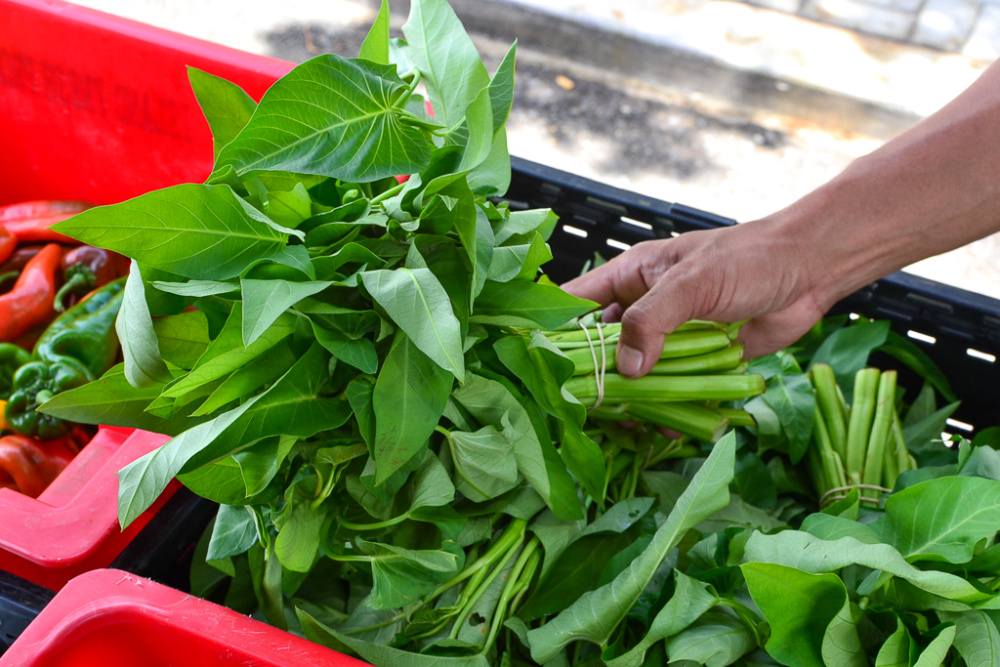
Thought to have originated in Southeast Asia, it is widely cultivated in the region, especially in Vietnam, Thailand, Malaysia and southern China. It is also now cultivated and naturalised in India, Africa, Australia, the South Pacific and South America. Where cultivated, it is usually sold in markets in bundles of ten to fifteen stems.
As its name suggests, Water Spinach grows in wet environments and is a semi-aquatic perennial herb, with all parts of the plant being soft, succulent and green, though some wild forms have wine-red stems. Two main types are recognised: the upland type (formerly Ipomoea reptans), adapted to moist soils, and the lowland type, adapted to flooded conditions.
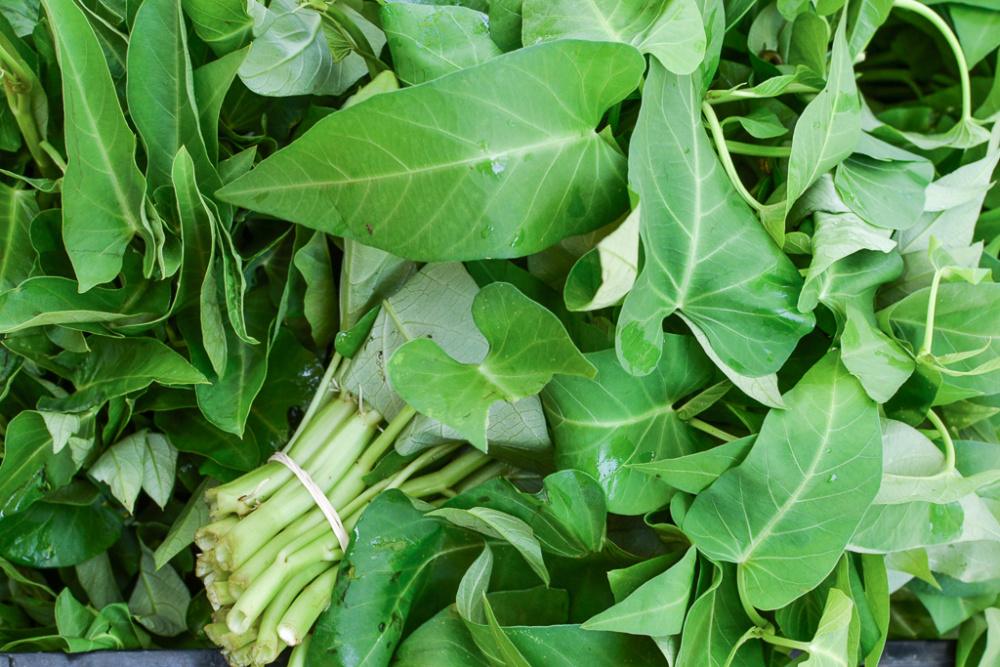
The two types are most easily distinguished by their leaves: on the upland type, the leaves are narrow, lance-shaped, up to 15 cm (6 in) long, and on the lowland type, they are broad, arrow-shaped, and shorter. The upland type also has a more upright growth habit, forming clumps 30 to 50 cm (1 to 1.6 ft) tall, whereas the lowland type is vine-like, with a running or creeping habit but reluctant to climb.
The stems are long, jointed, round, and hollow, and in the lowland type, this enables the plant to float on water, forming dense mats of floating vegetation. Where the stems make contact with water or soil, nodes along the length sprout roots that anchor the plant and allow it to take up nutrients.
Flowers are trumpet-shaped, around 4 cm (1.6 in) in diameter and white or pink with purple centres. In wild forms, they are wholly purple. Flowering occurs in winter, favoured by short days, with flowers arising solitary from the leaf axis. They are followed by small, round seed capsules enclosing two to four grey-coloured seeds.
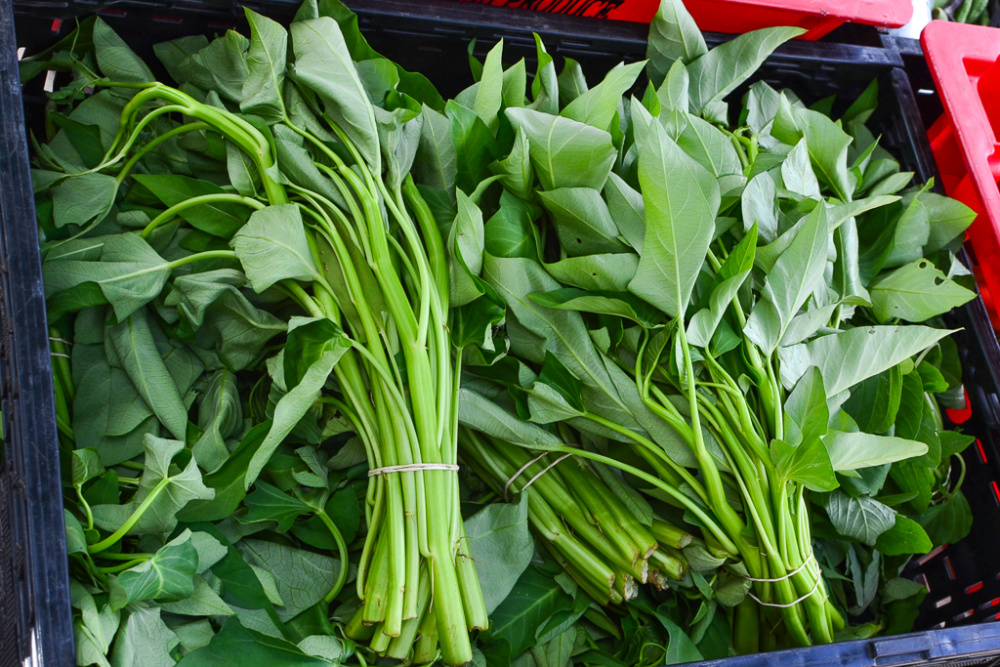
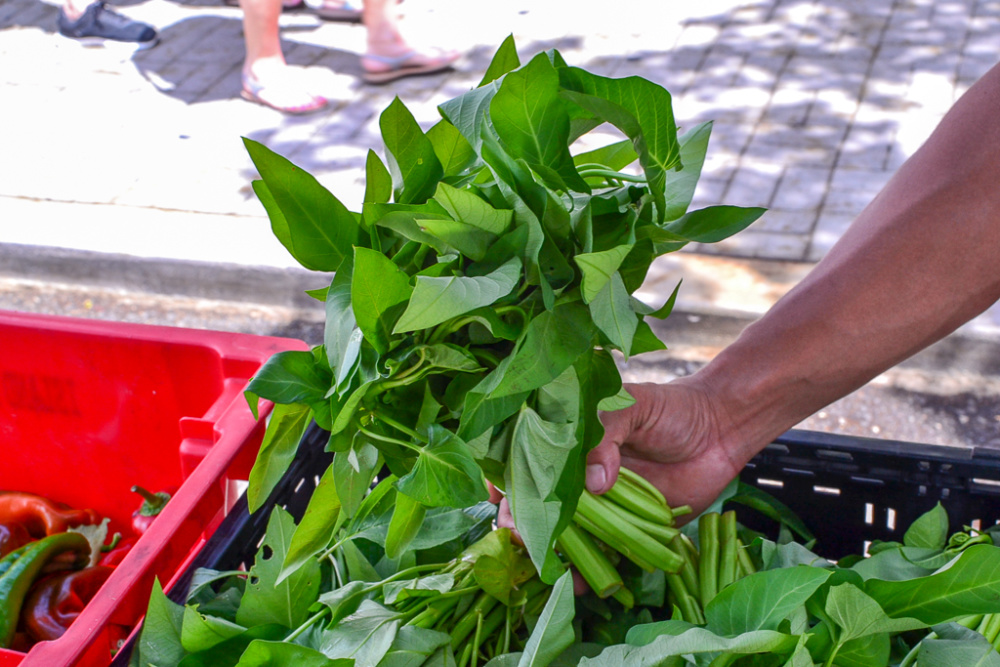
Farmers market (Cayman Islands)
Edible uses
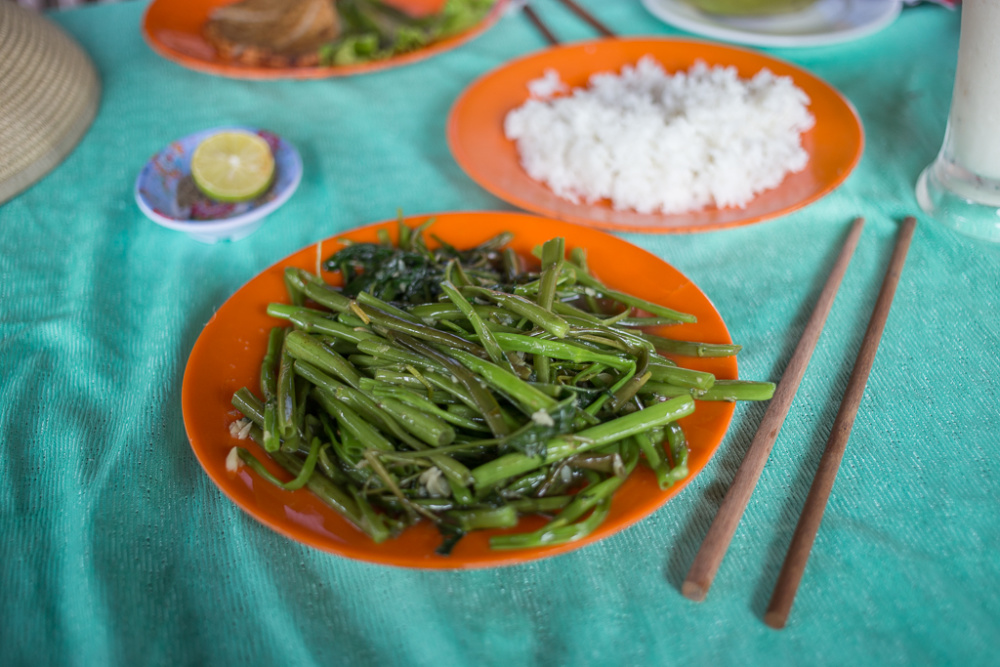
Cooked vegetable - Water Spinach is an important green vegetable in the diets of people in Southeast Asia, eaten regularly, either stir-fried, steamed, or blanched. Young stem tips and leaves are also battered and deep-fried or added to soups, stews, and curries. A common way to cook water spinach is to lightly stir-fry the young stem tips and leaves in garlic, chilli, and soya sauce. Other variations of this popular Asian dish include adding onions, chillies, garlic, galangal, and either shrimp paste or squid. Regional favourites include Thai-style stir-fried water spinach with oyster sauce and shrimp paste; Chinese-style with bean curd, hot bean paste, and shallots; and, in the Philippines, stir-fried water spinach with spicy pork or chicken.
The stems are added first when cooking, as the leaves wilt in only a few seconds. When stir-fried, the slippery texture of the leaves contrasts nicely with the firmer stems, and both have a slightly nutty, spinach-like flavour. Water Spinach retains its green colour when cooked, which helps brighten the finished dish.
Salad vegetable - The young stem tips and leaves are also used raw in salads.
Pickled vegetable - They are sometimes even pickled.
Material uses
Livestock feed - Older stems and leaves are tough and fibrous and unsuitable for cooking, but are highly palatable to livestock; in Southeast Asia, they are fed to pigs and cattle. The whole plant has a high protein content, around 19% of dry weight, but up to 34% in some parts.
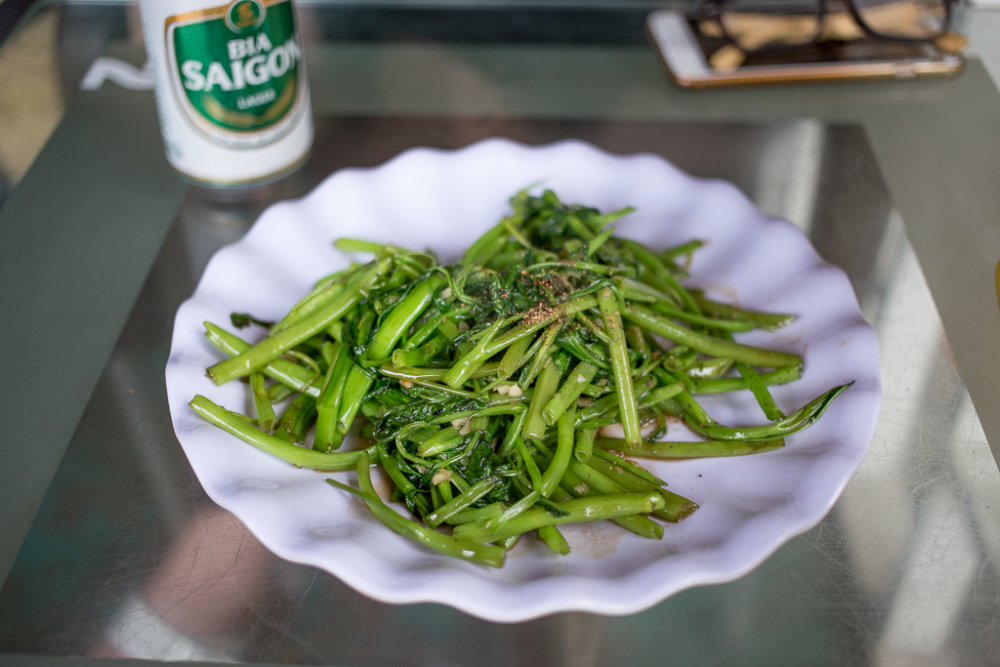
Stir-fried water spinach (Phu Quoc, Vietnam)
Health uses
Beta-carotene, Calcium, Iron, and Manganese - Water Spinach contains good amounts of beta-carotene (provitamin A, important for good vision), calcium, iron, and manganese, as well as copper and protein.
Climate
Grows naturally as a perennial in humid subtropical and tropical climates, generally frost-free areas with annual lows of 16 to 25°C, annual highs of 26 to 35°C, annual rainfall of 2000 to 8000 mm and a dry season of 2 months or less.
Water Spinach is also cultivated with irrigation in drier climates and in much cooler climates, but as an annual, as plants are damaged at temperatures below 10°C (50°F).
Growing
Water Spinach propagates readily from seed or stem cuttings. It grows very quickly under optimal conditions and is highly productive, with yields of up to 10 kg per sq meter (2 lbs per sq foot) reported for greenhouse cultivation, the preferred method in commercial operations because it keeps plants clean and free of dirt.
Under soil cultivation, raised beds are constructed with irrigation or drainage channels on either side. Seeds are then sown in rows on top of the beds. When the plants have sprouted, urea and an organic fertiliser are applied, and the soil kept moist. Cuttings may also be used for planting.
Under flood cultivation, the plants are planted in paddy fields either as cuttings or seedlings. Once the plants have established their root systems and begin to grow, they are flooded, and the water level is raised according to their stage of development. The water under this type of cultivation should not be saline or allowed to become stagnant.
Harvesting of water spinach can start two to three months after planting, and continue regularly thereafter. All parts of the young plants are eaten. However, older stems become fibrous, so young succulent stem tips are preferred. As a general rule, stems and leaves are always picked before the plant flowers to ensure a good eating quality. Harvesting should be carried out in the cooler part of the day to prevent wilting, and the cut ends should be stood in a container with clean water.
The upland type performs best on moisture-retaining clay loam soils enriched with organic matter and adjusted to a moderately acidic to neutral pH, generally 5.3 to 7.0. The planting beds should have full to partial sun exposure, ideally with some afternoon shade. An organic mulch is also recommended to help retain soil moisture.
Problem features
Water Spinach is very fast-growing and in some countries, the lowland type is considered invasive or a noxious weed because it can quickly overrun wetland areas. Florida requires a permit to grow water spinach, even in a home garden.
Where it grows
References
Books
-
Adams, C. D. 1972, Flowering plants of Jamaica, University of the West Indies, Mona, Greater Kingston
-
Gohl, B. 1981, Tropical Feeds : feed information summaries and nutritive values (Revised edition), Food and Agriculture Organization of the United Nations (FAO), Rome
-
Herklots, G. A. C. 1972, Vegetables in south-east Asia, Allen and Unwin, London
-
Holttum, R. E. & Enoch, I. C. 2010, Gardening in the tropics : the definitive guide for gardeners, Marshall Cavendish Editions, Singapore
-
Macmillan, H. F. 1943, Tropical planting and gardening : with special reference to Ceylon, 5th ed, Macmillan Publishing, London
-
Martin, F. W & Ruberte, R. M. 1975, Edible leaves of the tropics, U.S. Agency for International Development (USAID), and the Agricultural Research Service, U.S. Department of Agriculture (USDA), Mayaguez, Puerto Rico
-
Norrington, L. & Campbell, C. 2001, Tropical food gardens : a guide to growing fruit, herbs and vegetables in tropical and sub-tropical climates, Bloomings Books, Hawthorn, Victoria
-
Randall, R. P. 2002, A global compendium of weeds, R.G. and F.J. Richardson Press, Melbourne
-
Speichert, C. G. & Speichert, S. 2004, Encyclopedia of water garden plants, Timber Press, Portland, Oregon
-
Tindall, H. D. & Rice, L. W. 1990, Fruit and vegetable production in warm climates, International ed., Macmillan, London
-
Toensmeier, E. 2007, Perennial Vegetables : From Artichokes to Zuiki Taro, A Gardener's Guide to Over 100 Delicious and Easy to Grow Edibles, White River Junction, Chelsea Green Publishing, Vermont