

Common name: Merbau
Other common names: Borneo Teak, Ipil, Johnstone River Teak, Kwila, Moluccan Ironwood, Vesi
Description
Merbau is a semi-evergreen timber and landscape tree native to the geographic region extending from Tanzania through coastal India and Southeast Asia to Australia and the Pacific.
It may reach up to 35 m (115 ft) tall in closely spaced forests, with a straight, slender trunk clear of branches for about half its height and up to 1 m (3 ft) in diameter. Older trees grow buttresses or mangrove-like prop roots, depending on the site conditions.
In open sites, it is typically 15 to 20 m (50 to 65 ft) tall and develops an upright trunk supporting a wide-spreading, rounded crown. The bark is light brown or grey, smooth but with scattered flaking.
The leaves are compound, consisting of two or four glossy green, oval leaflets arranged in pairs.
The flowers are single-petaled, white, and change to pink, with long red stamens. They are sweetly fragrant and bloom year-round, or on and off, in showy clusters at the branch ends. Fertilised flowers develop into flat, wide seedpods up to 10 cm (4 in) long, green when young, turning brown when mature.
Material uses
Hardwood - The wood is medium-weight to heavy, averaging around 700 kg per cubic meter (44 lbs per cubic ft).
Decay- and rot-resistant wood - It is naturally resistant to rot and decay, placing it in the durable hardwood class and making it suitable for indoor and outdoor construction.
Termite-resistant wood - It is also resistant to termites.
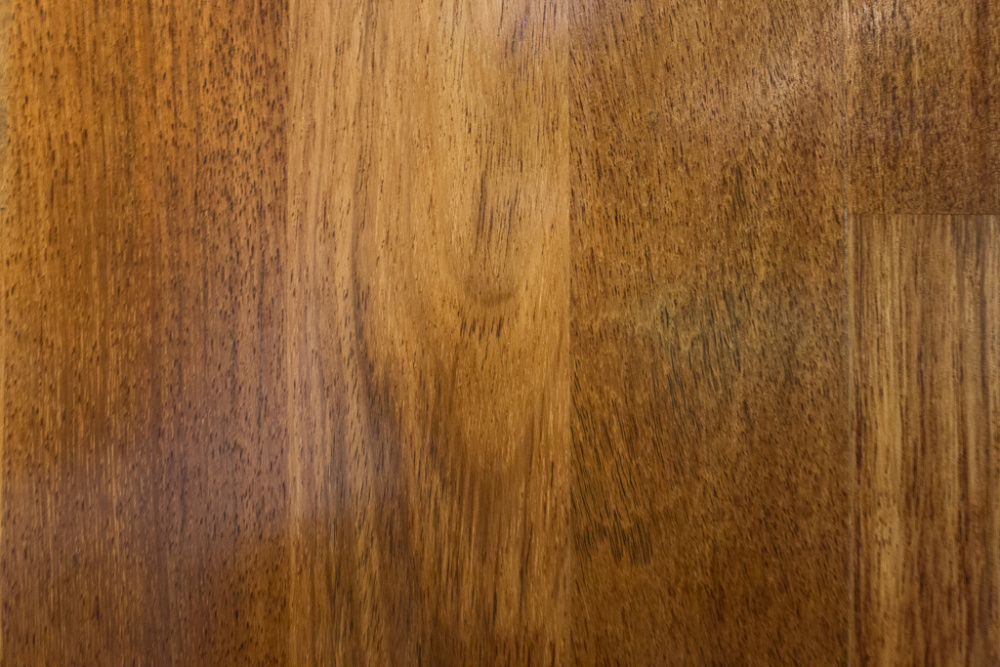
Timber and lumber - The heartwood is yellowish to orange-brown when newly cut, but matures to brown or dark brown, with moderate to high colour variation.
Heavy construction- It is commonly sawn into beams for bridges and pilings.
Flooring and decking - Also sawn into planks for flooring and decking...
Joinery and millwork - ...joinery...
Furniture and cabinets - ...as well as furniture and cabinets.
Decorative veneer - Logs displaying attractively figured wood are sliced for decorative veneer.
Carved craft - Selected small-diameter roundwood is used in turnery for carvings...
Musical instruments - ...and turned musical instruments, such as musical wind instruments.
Poles and posts - Also used for poles, posts...
Tool handles - ...striking tool handles...
Firewood - ...and firewood.
Boat building - It also has traditional uses in canoe building...
Natural dye - ...and in dyeing fabric to produce colour-fast khaki and other shades of light brown.
Natural insect repellent - An insect repellent made from the seed oil is reportedly similar in its repellent activity to Neem oil from the seed of the Neem tree (Azadirachta indica).
Environmental uses
Seaside garden plant - Merbau is commonly cultivated in seaside gardens and coastal landscapes for its showy and fragrant flowers and its tolerance to salty conditions, including soil salt and sea spray. Its typical habitat is near the shoreline or near mangrove stands.
Erosion control - This makes it a good candidate for coastal protection initiatives such as shoreline barriers and preventing soil and sand erosion.
Species conservation - Wild stands have been depleted in parts of its natural range. The IUCN lists it as a tree species in need of protection through conservation. Cultivating it in home gardens and on farms can help ease pressure on dwindling wild populations.
Climate
Grows naturally in moderately humid tropical coastal and lowland climates, generally in areas with annual lows of 19 to 25°C, annual highs of 27 to 35°C, annual rainfall of 1500 to 4000 mm and a dry season of 5 months or less.
Growing
New plants are easily grown from seed. Merbau trees perform best in full sun and on free- to slow-draining soils, ranging from sand to clay and from slightly acidic to alkaline, generally with a pH of 6.0 to 8.0. It tolerates seasonal flooding, slow-draining or saturated soils, and salty and limestone soils. The tree can reportedly grow on almost bare limestone and naturally establish itself on coral islands.
Problem features
Merbau is recorded as a weed in at least one reference publication. Still, there appear to be no confirmed reports of it naturalising anywhere. The Hawaii Pacific Weed Risk Assessment (HPWRA) project has assessed it as a low weed risk species.
The fallen leaves produce some litter, mainly in the dry season.
Where it grows
References
Books
-
Allen, O. N. & Allen, E. K. 1981, The Leguminosae : a source book of characteristics, uses, and nodulation, University of Wisconsin Press, Madison, Wisconsin
-
Barwick, M., et al. 2004, Tropical & subtropical trees : a worldwide encyclopaedic guide, Thames and Hudson, London
-
Brown, William Henry. 1920, Minor products of Philippine forests, Bureau of Printing, Manila
-
Chudnoff, M. 1984, Tropical timbers of the world, Forest Service, U.S. Department of Agriculture (USDA), Washington, D.C.
-
Elevitch, C. R & Wilkinson, K. M. 2000, Agroforestry Guides for Pacific Islands, 1st ed., Permanent Agriculture Resources, Holualoa, Hawaii
-
Elevitch, C. R. 2006, Traditional trees of Pacific Islands: their culture, environment and use, 1st edition, Permanent Agriculture Resources, Holualoa, Hawaii
-
Forest Products Laboratory (U.S.) 2007, The encyclopedia of wood, Skyhorse Pub, New York
-
Jacobson, M. 1958, Insecticides from plants : a review of the literature, United States Department of Agriculture (USDA), Washington D.C.
-
Jensen, M. 1999, Trees commonly cultivated in Southeast Asia : an illustrated field guide, 2nd ed., Food and Agricultural Organisation of the United Nations (FAO) Regional Office for Asia and the Pacific (RAP), Bangkok
-
Kraemer, J. H. 1945, Native woods for construction purposes in the South China Sea region, Bureau of Yards and Docks, United States Navy Department, Washington D.C.
-
National Research Council (Board on Science and Technology for International Development) 1979, Tropical legumes : resources for the future, The National Academies Press, Washington D. C.
-
Porter, T. 2012, Wood : identification & use, Compact edition, Guild of Master Craftsman Publications, Lewes, East Sussex
-
Randall, R. P. 2002, A global compendium of weeds, R.G. and F.J. Richardson Press, Melbourne
-
Reyes, G. 1992, Wood densities of tropical tree species, U.S. Department of Agriculture, Forest Service, Southern Forest Experiment Station, New Orleans, Louisiana
-
Scheffer, T. C & Morrell, J. J. 1998, Natural durability of wood : a worldwide checklist of species, Forest Research Laboratory, Oregon State University, Corvallis, Oregon