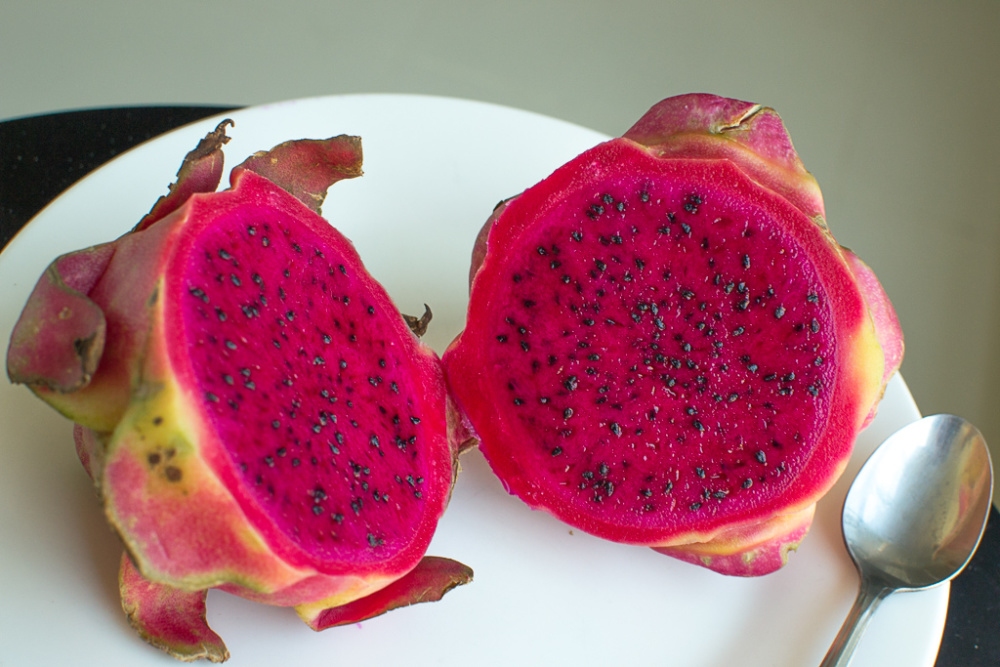



Common name: Dragon Fruit
Other common names: Strawberry Pear, Night Blooming Cereus, Belle of the Night
Description
Dragon Fruit is a fruit-bearing cactus originating from Central America, with a natural range along the Pacific side, extending from Mexico through Guatemala to El Salvador and Costa Rica. Nowadays, it is introduced and cultivated in many parts of the world, particularly Vietnam, Hawaii, South Africa, Australia and Israel.
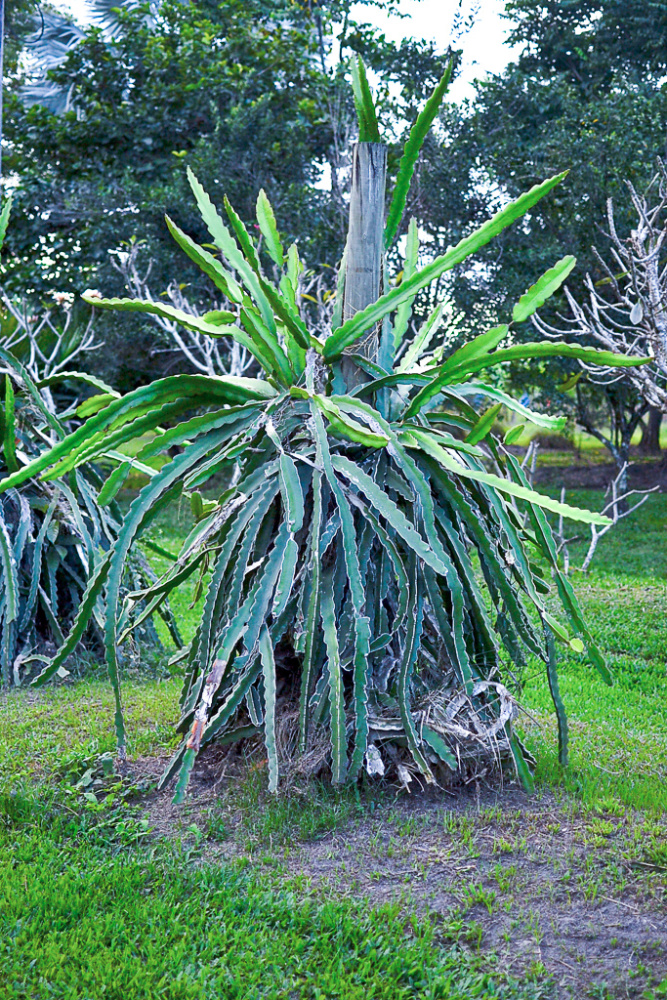
The plant is a mass of slender, succulent green stems that creep in all directions and can climb, with aerial roots arising at nodes along its length. Individual stems are up to 6 m (20 ft) long, jointed and Y-shaped in cross-section with three wings, the margins of which are wavy and armed with clusters of small, sharp spines.
Flowering is induced by long days, with the flowers opening at night in summer, through to early autumn, to be pollinated by bats and nocturnal insects. They emerge as solitary flower buds, borne on the stems' wings, and then grow into very large flowers, up to 20 cm (8 in) across when fully open. They have ivory-white insides, yellow-green outsides and give off a sweet fragrance. Opening once only, they close by morning, but new flowers open most nights over a long blooming period.
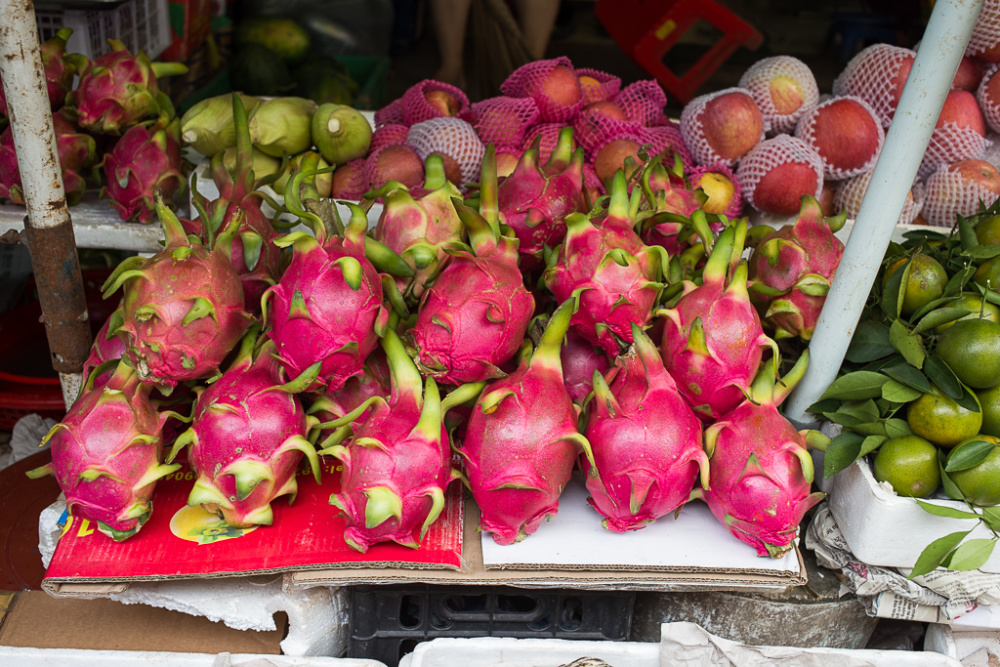
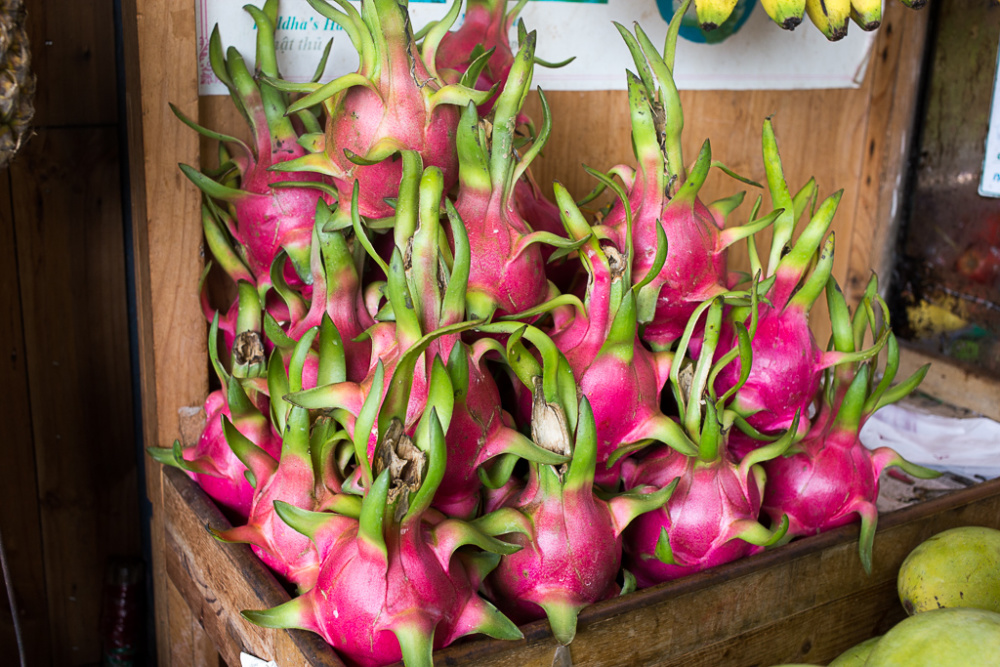
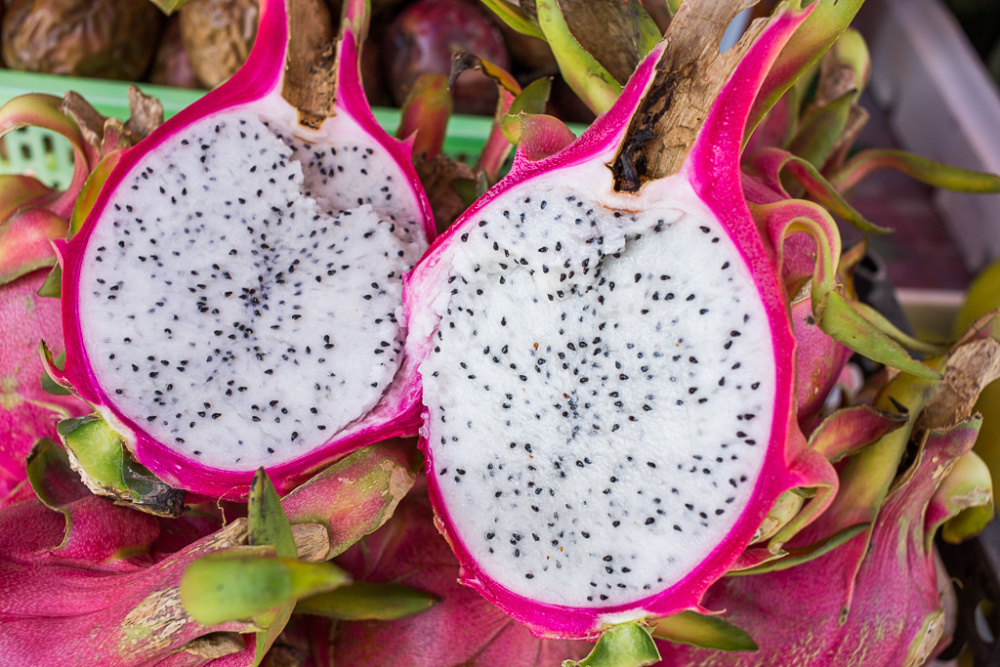
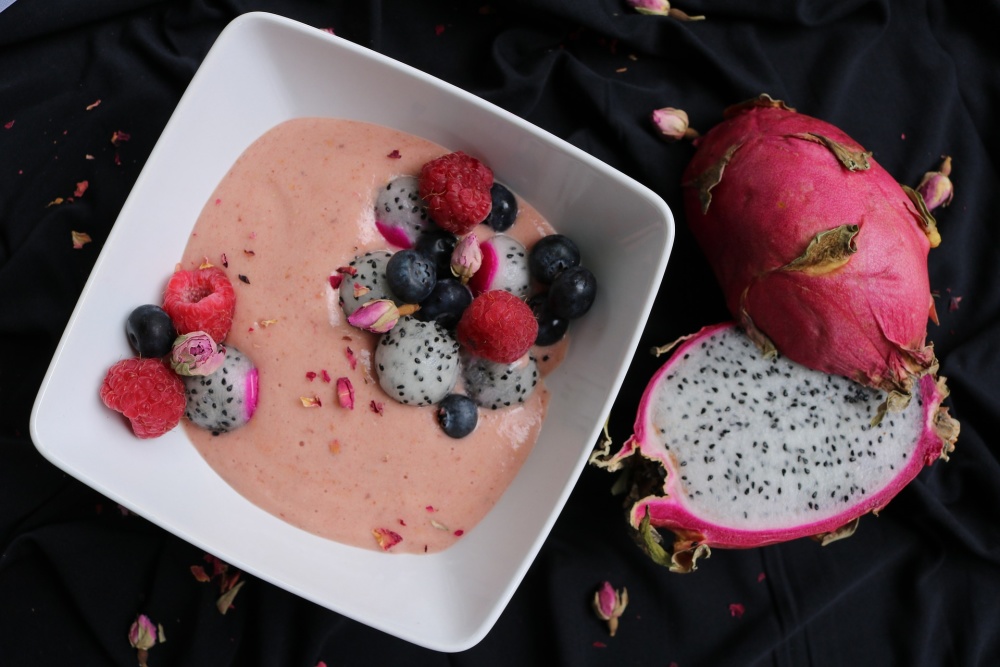
The fertilised flowers are followed by green-skinned, oval-shaped fruit with fleshy scales. As the fruit ripens, the skin becomes deep pink or red, and so does the bottom half of the fleshy scales, while the tips remain green. When fully ripe, they range from 10 to 15 cm (4 to 6 in) in length and 300 to 600 gm (0.7 to 1.3 lbs) in weight. Beneath the skin is soft, juicy, white or burgundy pulp (depending on the variety) studded with tiny black seeds.
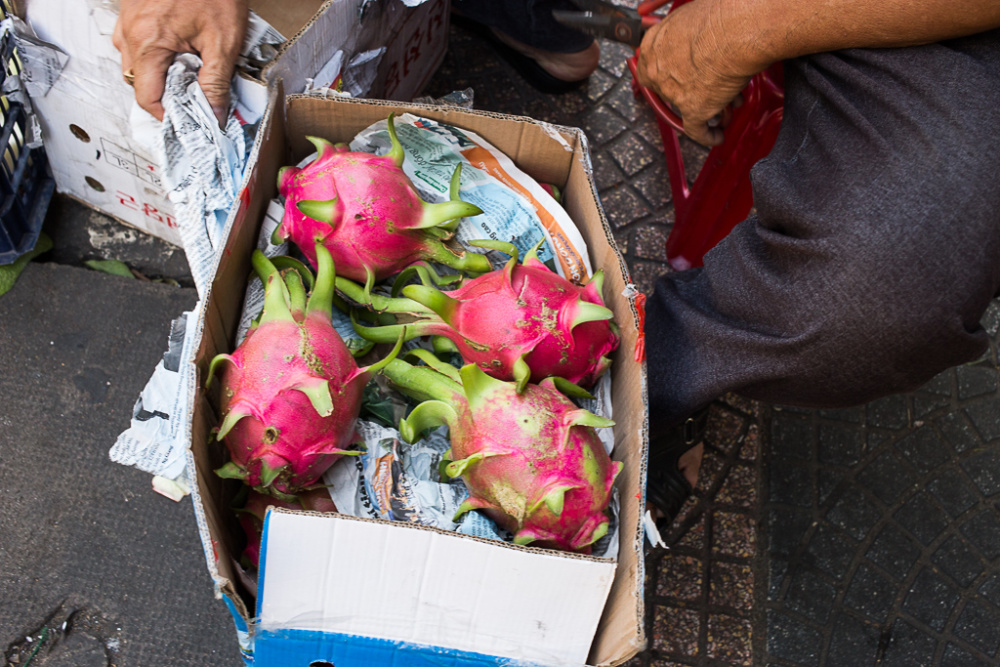
Ho Chi Minh City, Vietnam
Edible uses
Fresh fruit - Dragon Fruit is highly esteemed wherever it is grown and is mostly eaten fresh out-of-hand, especially chilled, cut in half, and the firm, somewhat juicy, delicately sweet pulp scooped straight out. The skin peels away easily, so the pulp can also be cut into chunks for fruit salads, and the tiny black seeds are edible and can be swallowed along with the pulp.
Non-alcoholic drink - Also incorporated into fruit drinks, and in Vietnam commonly blended with milk or condensed milk to make a refreshing cold drink or smoothie.
Cooked vegetable - In some areas, the unopened flower buds are cooked and eaten as a vegetable, with a mucilaginous (slimy) consistency similar to that of Okra (Abelmoschus esculentus).
Health uses
Vitamin C - Dragon Fruit pulp is a good source, with 100 grams of the white- and red-fleshed varieties supplying approximately 5.6 mg (around 12% of the recommended daily intake, RDI) and 4.4 mg (around 10% RDI), respectively (Chen et al. 2024).
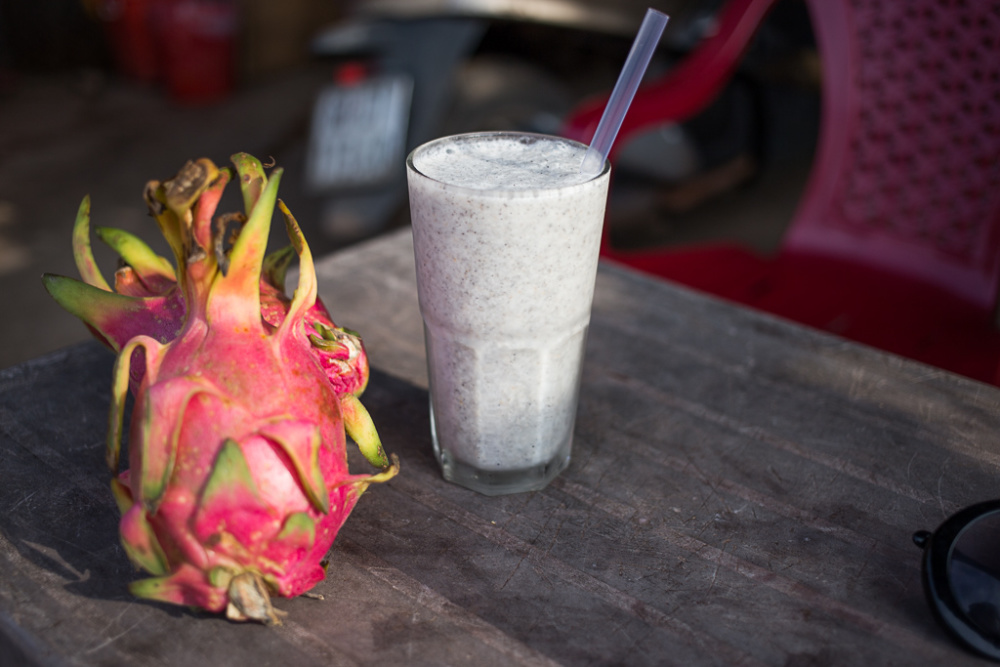
Dragon Fruit smoothie
General interest
There are examples of Dragon Fruit plants that have climbed up tree limbs high above the ground, their aerial roots, over time, growing down 6 m (20 ft) or more to form a curtain of spaghetti-like strands, creating an unusual and spectacular botanical display.
Climate
Dragon Fruit grows naturally and produces fair to good quality fruit in dry to humid subtropical and tropical lowland climates, generally frost-free areas with annual lows of 12 to 25°C, annual highs of 22 to 35°C, annual rainfall of 500 to 3500 mm and a dry season of 7 months or less, extending to 12 months with irrigation.
Although the plant will also grow in wetter climates with no dry season, there is a high risk of flower drop and fruit rot due to excessive humidity.
Growing
New plants are usually started from cuttings 15 to 20 cm (6 to 8 inches) long taken from mature stems. These are then left to cure for about a week in a cool, dry place before planting the cut end in containers with a free-draining potting mix. They are then watered frequently but sparingly to encourage good root development.
Plants perform best on free-draining loam, sandy-loam and sand soils enriched with organic matter and adjusted to a moderately acid to slightly alkaline pH, generally in the 5.5 to 8.0 range. Dragon fruit plants have good tolerance to drought and limestone soils.
The stems are susceptible to sunburn if exposed to full sun conditions for too long, especially under persistently dry conditions. Under such conditions, the plant does best in some afternoon shade. Planting is done mostly on raised and mulched beds, and staking or trellising is essential for good vine growth and fruit production.
Dragon fruit plants start to flower and fruit in the second year after planting. The fruit is ripe and can be harvested when they are completely pink or red, but is best left on the plant a few days longer to allow more sweetness to develop.
Problem features
Fruit-eating birds are known to break open the fruit with their beaks, eat the pulp and disperse the seed. It has been assessed as a high weed risk species for Hawaii by the Hawaii Pacific Weed Risk Assessment (HPWRA) project.
Where it grows
References
Books
-
Griffiths, M. & Burras, J. K. 1994, Manual of climbers and wall plants, Royal Horticultural Society (Great Britain), Timber Press, Portland, Oregon
-
Janick, J., & Paull, R. E. 2008, The encyclopedia of fruit & nuts, CABI Publishing, Wallingford, Oxfordshire
-
Martin, F. M., et al. 1987, Perennial edible fruits of the tropics : an inventory, U.S. Dept. of Agriculture (USDA), Agricultural Research Service, U.S. Government Printing Office (GPO), Washington, D.C.
-
Morton, J. F. & Dowling, C. F. 1987, Fruits of warm climates, Creative Resources Systems, Winterville, North Carolina
-
Perry, F. & Hay, R. 1982, A field guide to tropical and subtropical plants, Van Nostrand Reinhold Company, New York
-
Queensland Department of Primary Industries and Fisheries (QLD DPI) 2008, Queensland tropical fruit : the healthy flavours of North Queensland, Brisbane
-
Randall, R. P. 2002, A global compendium of weeds, R.G. and F.J. Richardson Press, Melbourne
-
Randall, R. P. 2007, The introduced flora of Australia and its weed status, Cooperative Research Centre for Australian Weed Management, Glen Osmond, South Australia
-
Standley, P. C. 1920, Trees and shrubs of Mexico, Government Printing Office (GPO), Washington D.C.
Articles, Journals, Reports and Working Papers
-
Chen, S.-Y., Xu, C.-Y., Mazhar, M.S. & Naiker, M. 2024, 'Nutritional Value and Therapeutic Benefits of Dragon Fruit: A Comprehensive Review with Implications for Establishing Australian Industry Standards', Molecules, vol. 29, no. 23, article 5676.
-
Morton, J. F. 1976, Pestiferous spread of many ornamental and fruit species in south Florida. In Proceedings of the Florida State Horticultural Society (Vol. 89, pp. 348-353).
-
Zee F, Yen C-R, Nishina M. 2004. Pitaya (dragon fruit, strawberry pear). Honolulu (HI): University of Hawaii. 3 p. (Fruits and Nuts; FN-9).