

Common name: Fish Mint
Other common names: Chameleon Plant, Chinese Lizard Tail, Fish Plant, Fishwort, Heartleaf, Edible Houttuynia, Heartleaf Houttuynia, Saururus, Vietnamese Fish Plant, White Chaplu, Wild Houttuynia
Description
Fish Mint is a medicinal and culinary herb native to Asia, with a range extending from the Himalayan foothills through Southeast Asia to Taiwan and Japan.
A moisture-loving perennial herb, it prefers damp places and grows in clumps of erect stems 30 to 60 cm (1 to 2 ft) tall, these arising from underground rhizomes. The stems are soft, green, less commonly wine-red and jointed, with nodes along the length.
The rhizomes are much-branching and creeping, running off in all directions just below the soil surface, quickly colonising new ground, starting new clumps, and eventually filling in empty spaces to create a densely leafy groundcover.
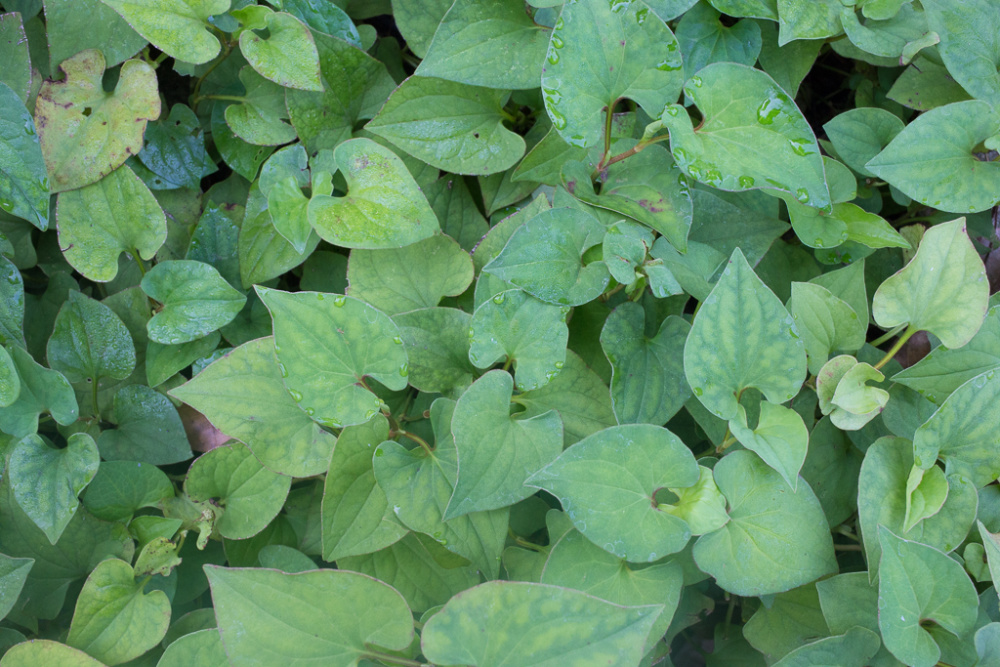
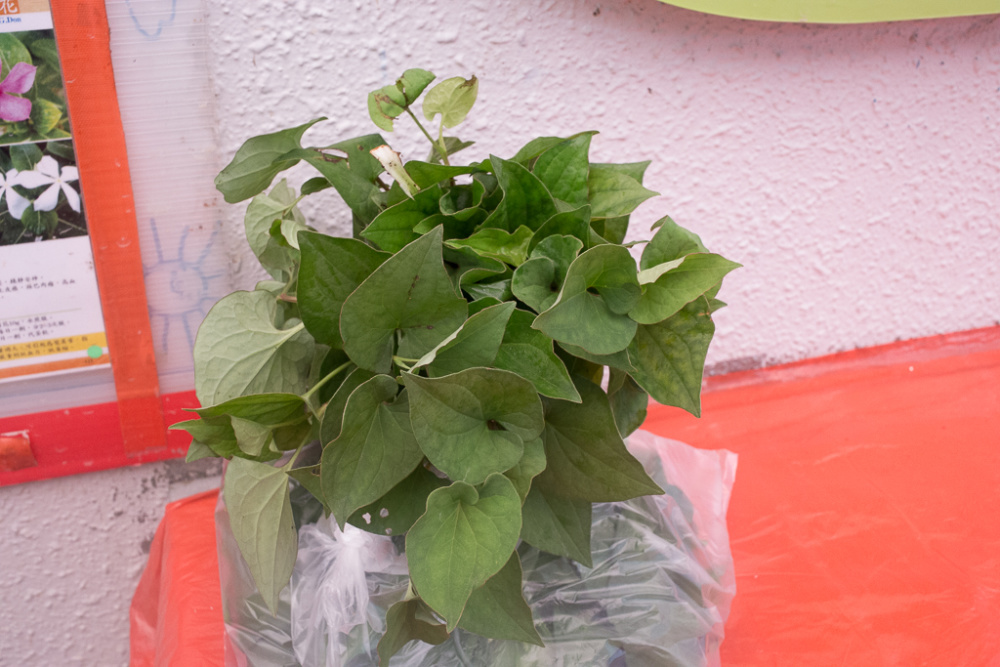
Leaves are heart-shaped, 4 to 10 cm (1.5 to 4 in) long, dull green on top and pale green or purplish underneath, though some varieties are variegated in colour. They are alternately and spirally arranged along the stems and with the lower part of the leaf stalk, forming a sheath that wraps around the stem. When crushed, they release a strong aroma that can be citrusy or fishy, depending on the type.
There are two main types of Fish Mint: the Chinese or Vietnamese type, with a fishy aroma, and the Japanese type, with citrus- or ginger-like aromas.
The flowers are small, yellow and clustered on a short flower spike about 2 cm (0.8 in) long, with four white, petal-like bracts at the base. These are followed by tiny oval seed capsules containing many seeds.
Use
Although not widely appreciated, people in Asia use the young stems and leaves as a salad herb or add them to soups, stews, and sauces.
In Vietnam, people sometimes use chopped leaves in rice paper rolls, either on their own or with other herbs such as Coriander (Coriandrum sativum). They are also added to boldly flavoured fish and noodle soups or are eaten together with grilled meats. The taste is aromatic, close to Vietnamese Mint (Persicaria odorata), but with a slightly astringent aftertaste.
In Thailand, Fish Mint is eaten mostly with 'Larb', a salad of minced chicken or pork seasoned with lemongrass, lime juice, coriander and chillies and wrapped in a lettuce leaf, or with 'Nam phrik', a spicy chilli sauce made from fresh or dry chillies, garlic, shallots, lime juice and fish or shrimp paste.
Like coriander, Fish Mint has a love/hate relationship. This phenomenon is common among people from different regions and cultures. Some people love its aroma, while others find it has an unpleasant, soapy smell and flavour. This difference is due to one's genetic make-up.
Controlled studies in Thailand found that an essential oil distilled from the flowers has excellent mosquito-repellent properties.
The variegated variety is not usually eaten but is cultivated in gardens as a groundcover.
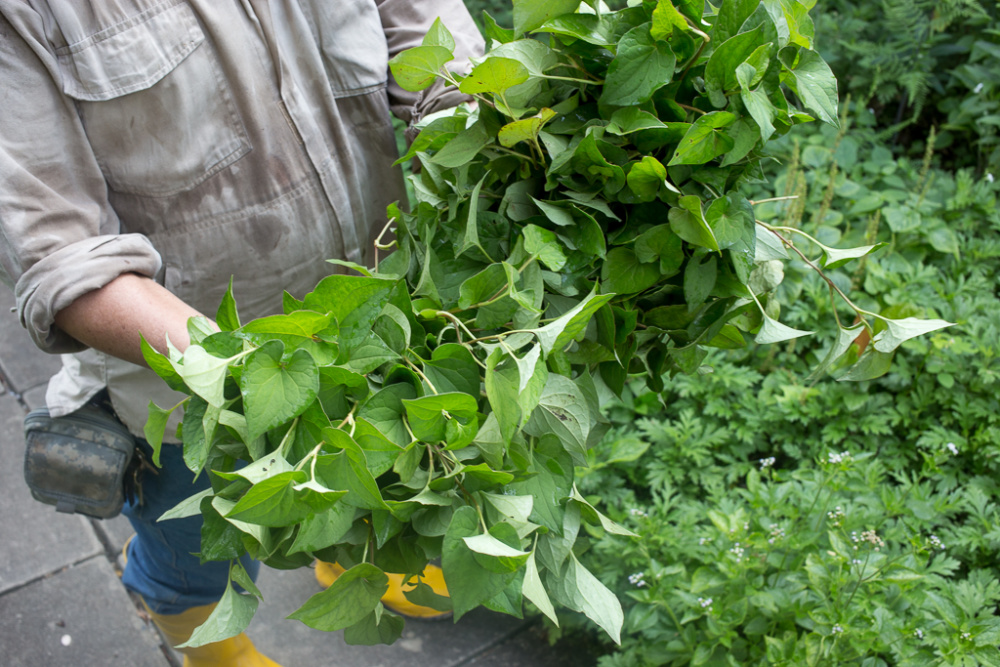
Freshly harvested leaves (Singapore)
Health use
In traditional Chinese medicine, a decoction of the stems and leaves is used to treat respiratory tract infections, pleurisy, asthma and ulcerative colitis. It is also used for ear inflammation, urinary tract inflammation, and, in traditional Vietnamese medicine, ocular infections, including conjunctivitis. In some cases, it is more effective than Dexamethasone, a standard anti-inflammatory drug.
Climate
Grows naturally in a wide range of climates, generally warm temperate, subtropical and tropical areas with annual lows of 7 to 25°C, annual highs of 15 to 35°C, annual rainfall of 1700 to 8000 mm and a dry season of 4 months or less.
Growing
New plants are usually started from root divisions, as the plant does not always produce seeds.
It performs best in free- or slow-draining clay-loam and loam soils that are moderately acidic to neutral (pH 5.0 to 7.0) and in sites with full to partial sun exposure. It has poor tolerance to prolonged drought conditions.
Fish Mint is an excellent candidate plant for cultivation in water gardens, including water-holding containers.
Problem features
Fish Mint is an aggressive, invasive plant spreading rapidly and, once established, is difficult to eradicate. It has been introduced to Australia, New Zealand, some Pacific islands and North America and is frequently considered a weed. The Hawaii Pacific Weed Risk Assessment (HPWRA) project and the IFAS Assessment of Non-Native Plants in Florida's Natural Areas have assessed it as a high weed-risk species in Hawaii and Florida.
Where it grows
References
Books
-
Editors of Sunset Magazine 2012, The New Western Garden Book: The Ultimate Gardening Guide, 9th edition, Sunset Publishing Corporation, California
-
Jacquat, C. & Bertossa, G. 1990, Plants from the markets of Thailand : descriptions and uses of 241 wild and cultivated plants, with 341 colour photographs, Editions Duang Kamol, Bangkok
-
Martin, F. W & Ruberte, R. M. 1975, Edible leaves of the tropics, U.S. Agency for International Development (USAID), and the Agricultural Research Service, U.S. Department of Agriculture (USDA), Mayaguez, Puerto Rico
-
Nguyen, V. D. & Doan, T. N. 1989, Medicinal plants in Vietnam, World Health Organization (WHO), Regional Office for the Western Pacific, Manila, Institute of Materia Medica, Hanoi
-
Randall, R. P. 2002, A global compendium of weeds, R.G. and F.J. Richardson Press, Melbourne
-
Schafer, Peg & Foster, Steven, 1957- & Fannin, Sean 2011, The Chinese medicinal herb farm : a cultivator's guide to small-scale organic herb production, Chelsea Green Pub, White River Junction, Vt
-
Seidemann, J. 2005, World spice plants: economic usage botany taxonomy, Springer-Verlag, Berlin
-
Speichert, C. G. & Speichert, S. 2004, Encyclopedia of water garden plants, Timber Press, Portland, Oregon
-
Staples, G. & Kristiansen, M. S. 1999, Ethnic culinary herbs : a guide to identification and cultivation in Hawaii, University of Hawaii Press, Honolulu
-
Thomson, G. 2007, The health benefits of traditional Chinese plant medicines : weighing the scientific evidence, Rural Industries Research and Development Corporation (RIRDC), Barton, Australian Capital Territory
Articles, Journals, Reports and Working Papers
-
Tawatsin A, Asavadachanukorn P, Thavara U, Wongsinkongman P, Bansidhi J, Boonruad T, Chavalittumrong P, Soonthornchareonnon N, Komalamisra N, Mulla MS., (2006): Repellency of essential oils extracted from plants in Thailand against four mosquito vectors (diptera culicidae) and oviposition deterrent effects against Aedes aegypti. Southeast J. Tropi. Medi. Pub. Health, 37(5): 915-31.