

Common name: Rubber Tree
Other common names: Rubbertree, Vegetal Leather
Description
Originating from the humid tropical forests of Brazil, Bolivia, Colombia and Peru, the Rubber tree is valued for its latex, the world's principal source of natural rubber.
It is a tall, fast-growing tree, reaching up to 40 m (130 ft) in native forests, though it is more typically 15 to 20 m (50 to 65 ft) tall.
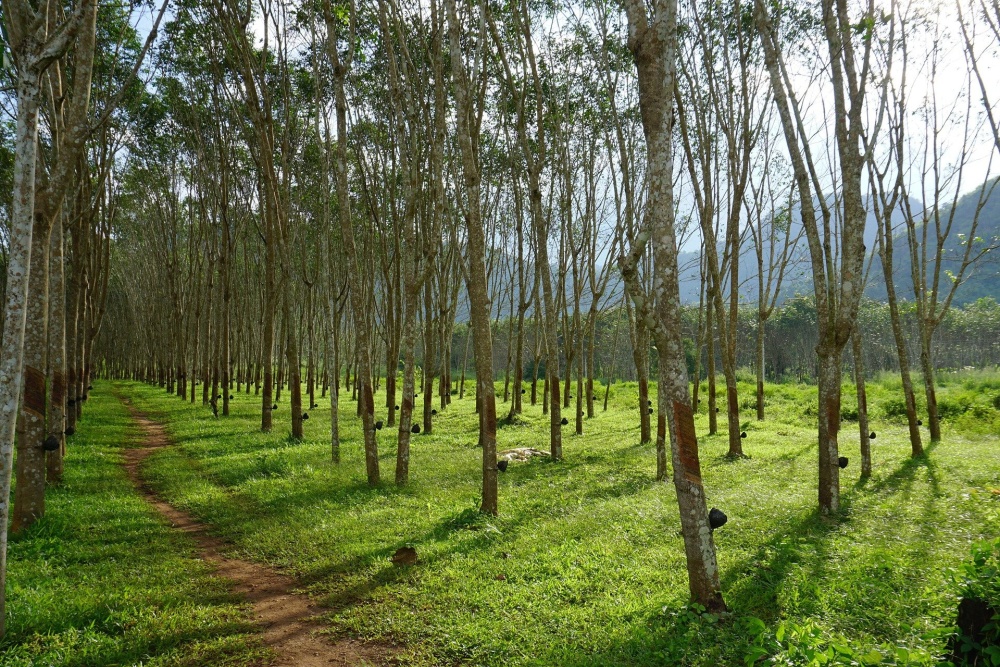
The trunk is usually straight and round, with smooth, light grey, and often mottled bark. It supports a moderately branched, narrow crown, the branches tending to angle upward in closely spaced forests and plantations. On open sites, the branches grow outward, forming a rounded, compact crown.
Leaves are compound, consisting of three oval leaflets, dark green above and light green below. They fall in the dry season but are soon replaced by new leaflets that emerge at the start of the rainy season.
The flowers are small and insignificant, with hairy, pale yellow petals and either female or male, in clusters arising at the sides and ends of the branches. They bloom in the rainy season, coinciding with new leaf growth, and are soon followed by three-lobed seed capsules that are green when young and become dark brown and woody. Each lobe contains a smooth, brown, egg-shaped seed patterned with black markings. When mature, the capsule bursts open with a popping sound and scatters its seed a considerable distance from the parent tree.
.5912.jpg)
Image by Tracey Wong from Pixabay
Material uses
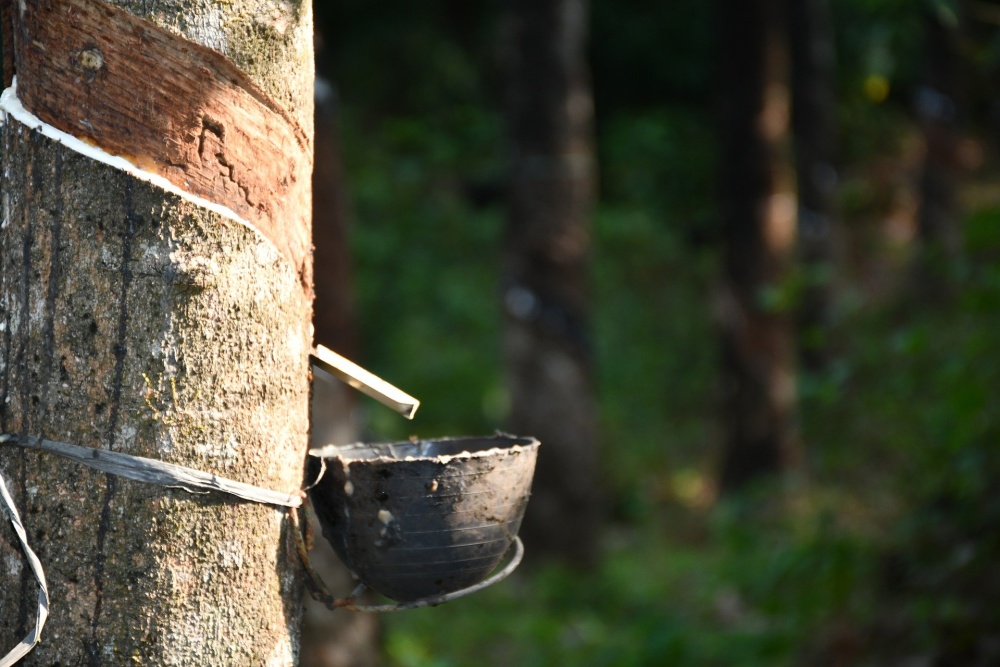
Latex - A sticky, white latex is tapped from the trunk through a series of connected incisions, allowing it to flow into a receptacle. After collection, the latex is coagulated, traditionally by warming it over a fire but now by using a coagulant such as formic acid, making the process cleaner and more efficient. The resulting coagulated mass is crude rubber, which is then dried and readied for further processing into rubber products.
Rubber is used to manufacture various products, including footwear components, rubber gloves, and condoms. In the early 1900s, the mass commercialisation of rubber automobile tyres led to their widespread adoption. Today, it remains a major component of automobile tyres and aircraft tyres.
Yields of fresh latex are influenced by various factors, including climate, soil and planting densities, which, among other things, affect trunk diameter. Annual yields in commercial plantations range from 1000 to 1500 kg of latex per hectare (900 to 1300 lb per acre).
Drying oil - The seed kernel, which makes up 50% of the seed, contains about 45% red-coloured drying oil known as 'Para seed oil'. After refining, it can also be used in paints. Drying oils are plant-based vegetable oils that harden into a solid, tough film when exposed to air through a chemical process called oxidation and polymerisation, and are primarily used in oil paints, varnishes, and printing inks. Some of the best-known and most widely used drying oils are Safflower oil (from Carthamus tinctorius) and Tung oil (from Vernicia fordii)
Natural soap - It is used chiefly in soap manufacturing.
Biofuel - It has also reportedly been successfully engine-tested as a biodiesel.
Livestock feed - The leftover cake or meal can be used as stock feed.
Environmental uses
Bee forage - The flowers produce abundant nectar suitable for honey production, with nectar flows lasting up to 40 days during the flowering period. It is a major honey plant in India, with Kerala and Karnataka states the leading producers. Each tree is estimated to produce enough nectar to yield 3 kg (6.6 lb) of honey.
Green manure - The leftover seedcake is also a suitable soil builder or fertiliser.
Edible uses
Honey - Reported yields vary from 10 to 40 kg (22 to 88 lb) of honey per colony per season. The honey is clear, water-white to pale yellow, very sweet and quick to granulate, with crystals starting to form after two months.
.5911.jpg)
Image by Abhilash Jacob from Pixabay
Climate
Grows naturally and yields reasonable quantities of latex in humid to very humid tropical lowland climates, generally frost-free areas with annual lows of 19 to 25°C, annual highs of 27 to 36°C, annual rainfall of 1500 to 4000 mm and a winter dry season of 4 months or less.
Rubber trees do not thrive in areas with a long or pronounced dry season, in areas with frost, or where the average low of the warmest month is below 10°C (50°F).
Growing
New plants are usually grown from seed. It performs best on deep, rich, free-draining clay and loam soils of an acid to neutral nature, generally with a pH of 4.5 to 7.0, and on sites with light shade to partial sun exposure. The trees are ready to be tapped for their latex when they are around five to six years old.
Problem features
The mature fruit ejects its seed with force, propelling it up to 15 m (50 ft) away from the parent plant. It is reported as an invasive species, a serious weed, and naturalised in Australia. It would appear to be a high weed risk under conditions optimal for germination and growth.
Where it grows
References
Books
-
Adams, C. D. 1972, Flowering plants of Jamaica, University of the West Indies, Mona, Greater Kingston
-
Barwick, M., et al. 2004, Tropical & subtropical trees : a worldwide encyclopaedic guide, Thames and Hudson, London
-
Bradbear, N. 2009, Bees and their role in forest livelihoods : a guide to the services provided by bees and the sustainable harvesting, processing and marketing of their products, Food and Agriculture Organization of the United Nations (FAO), Rome
-
Crane, E., Walker, P. & Day, R. 1984, Directory of important world honey sources, International Bee Research Association, London, United Kingdom
-
Food and Agriculture Organization of the United Nations (FAO) 1986, Food and Fruit-bearing Forest Species, 3 : Examples from Latin America, FAO Forestry Paper no 44/3, Rome
-
Hill, A. F. 1952, Economic botany : a textbook of useful plants and plant products, 2nd ed, McGraw-Hill, New York
-
Jamieson, G. S. 1943, Vegetable fats and oils : their chemistry, production, and utilization for edible, medicinal and technical purposes, 2d ed, Reinhold, New York
-
Jensen, M. 1999, Trees commonly cultivated in Southeast Asia : an illustrated field guide, 2nd ed., Food and Agricultural Organisation of the United Nations (FAO) Regional Office for Asia and the Pacific (RAP), Bangkok
-
Lopez, C., et al. 2004, Riches of the forest: fruits, remedies and handicrafts in Latin America, Center for International Forestry Research (CIFOR), Bogor, Indonesia
-
Lorenzi, H. 2002, Brazilian trees : a guide to the identification and cultivation of Brazilian native trees. Vol. 1, 4. ed, Instituto Plantarum de Estudos da Flora, Nova Odessa, Sao Paulo
-
Luna, R. K 1996, Plantation trees, International Book Distributors, Dehradun, Uttarakhand
-
Macmillan, H. F. 1943, Tropical planting and gardening : with special reference to Ceylon, 5th ed, Macmillan Publishing, London
-
Marshall, E. (Elaine) & Schreckenberg, Kathrin & Newton, A. C & UNEP World Conservation Monitoring Centre 2006, Commercialization of non-timber forest products : factors influencing success : lessons learned from Mexico and Bolivia and policy implications for decision-makers, UNEP World Conservation Monitoring Centre, Cambridge
-
McIlroy, R.J. 1963, An introduction to tropical cash crops, Ibadan University Press, Ibadan, Nigeria
-
Mors, W. B & Rizzini, C. T. 1966, Useful plants of Brazil, Holden-Day Publishing, San Francisco, California
-
Randall, R. P. 2002, A global compendium of weeds, R.G. and F.J. Richardson Press, Melbourne