
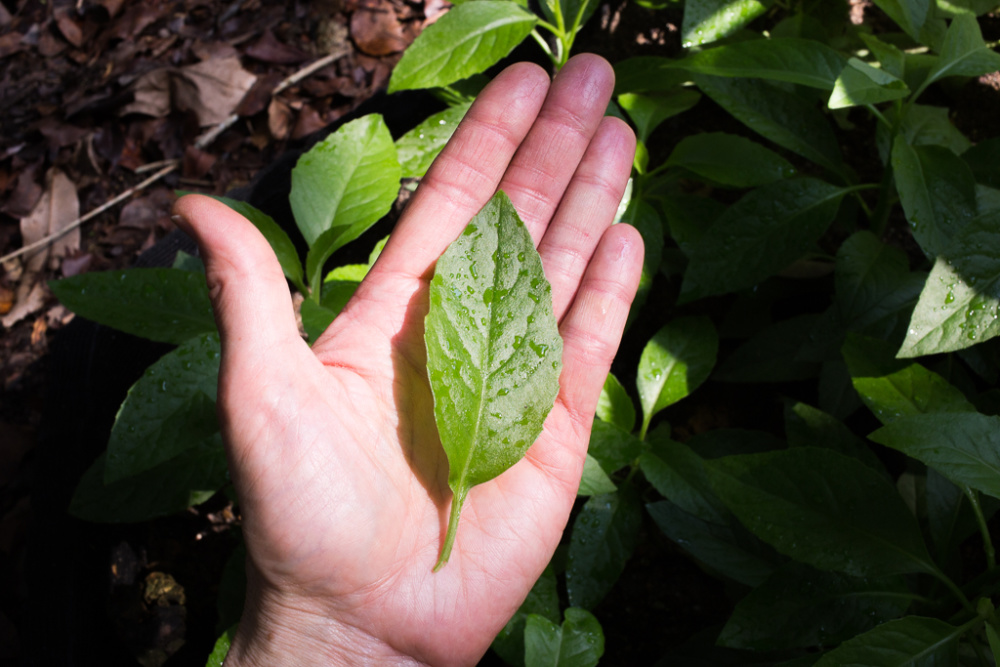


Common name: Longevity Spinach
Other common names: Akar, Leaves of the Gods, Mollucan Spinach, Sambung, Scrambling Gynura, Velvet Plant
Description
Longevity Spinach is a leaf vegetable and medicinal herb originating in India and Southeast Asia, with a natural range extending from the Himalayan foothills to southern China and the Philippines.
It is a fast-growing perennial herb or small shrub up to 0.8 m (2.6 ft) tall, with many branches and long stems that start erect, then twine and climb on structures or creep along the ground to lengths of up to 5 m (16 ft). The new growth at the ends of the stems is soft and succulent; the rest is semi-woody. The bark is either green, purple or mottled.
Leaves are oval with a pointed tip, 2.5 to 7.5 cm (1 to 3 in) long, dark and glossy green on top, toothed along the margins, and fleshy. They are alternately arranged along the stems and remain on the plant year-round.
The flowers are small and thistle-like, with orange filaments. They are self-pollinating and come into bloom in spring, borne in loose clusters of only a few, though they are sometimes not produced. Tiny cylindrical, ribbed seed capsules follow, each containing a single seed.

Singapore Botanic Gardens
Edible uses
Cooked vegetable - The leaves can be used as a spinach-type vegetable. People also eat the young, tender stem tips, usually with the leaves, mainly in steamed dishes. Both are added to egg dishes, curries and soups. Longevity Spinach is commonly sold in markets in its native region, usually in neatly tied bundles.
Salad vegetable - The leaves can also be eaten raw. When raw, they are crisp and fleshy and have a flavour similar to green beans. People add both the leaves and young stem tips to salads and smoothies.
Environmental uses
Groundcover - The plant's long stems and creeping habit make it suitable for cultivation as an edible groundcover.
Container plant - It is also easily grown in a container or pot.
Health uses
The leaves are used in traditional medicine to treat diabetes. Only recently have laboratory tests on diabetic rats shown that ethanol extracts of the leaf exhibit significant blood glucose-lowering activity.
Climate
Grows naturally in humid subtropical and tropical climates, generally frost-free areas with annual lows of 10 to 25°C, annual highs of 20 to 35°C, annual rainfall of 1000 to 4500 and a dry season of 5 months or less.
Longevity Spinach is also cultivated under irrigation in drier climates and as an annual in cooler climates.
Growing
New plants are mostly started from cuttings, as the plant does not always produce seeds.
It performs best in rich, moist, free-draining sandy loam and loamy sand soils that are moderately acidic to neutral (generally pH 5.0 to 7.0), and in sites with partial sun or light shade. It tolerates dry conditions poorly.
Problem features
Longevity Spinach is listed as a weed in at least one reference publication. It is recorded as an agricultural weed on the island of Java in Indonesia. Still, it does not appear to be recorded as a serious weed or invasive species anywhere.
Where it grows
References
Books
-
Martin, F. W & Ruberte, R. M. 1975, Edible leaves of the tropics, U.S. Agency for International Development (USAID), and the Agricultural Research Service, U.S. Department of Agriculture (USDA), Mayaguez, Puerto Rico
-
Randall, R. P. 2002, A global compendium of weeds, R.G. and F.J. Richardson Press, Melbourne
-
Randall, R. P. 2007, The introduced flora of Australia and its weed status, Cooperative Research Centre for Australian Weed Management, Glen Osmond, South Australia
-
Seidemann, J. 2005, World spice plants: economic usage botany taxonomy, Springer-Verlag, Berlin