

Common name: Gmelina
Other common names: Kashmir Teak, Snapdragon Tree, White Teak
Description
Gmelina is a timber tree and a relative of Teak (Tectona grandis), native to a wide geographic area encompassing parts of Pakistan, India and Southeast Asia.
It is fast-growing and may attain heights of up to 30 m (100 ft) in native forests, with a trunk diameter of 1.4 m (4.6 ft), though on open sites it is more commonly 15 to 20 m (50 to 65 ft) tall.
In deep, fertile soil with ample moisture, the tree develops a straight trunk and a densely branched, rounded-to-oval crown. Otherwise, it is typically stunted in shallow soils and dry climates, with a crooked or forked trunk and an irregularly shaped crown.
The bark is pale grey and smooth, becoming corky, rough and flaking off in patches on older trees, exposing smooth light-brown underbark.
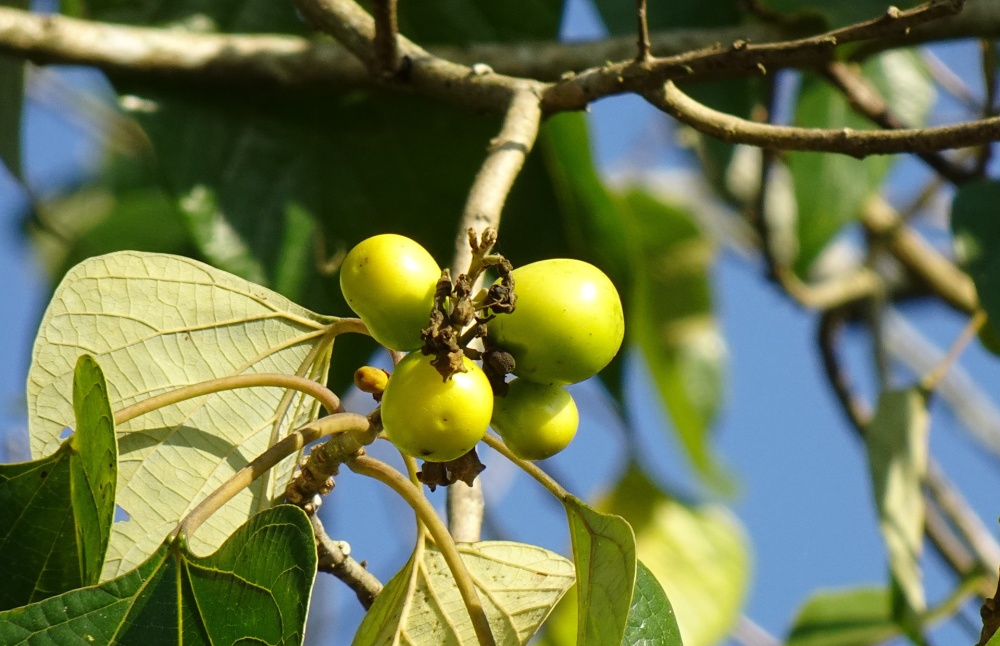
Leaves are heart-shaped, 10 to 23 cm (4 to 9 in) long, dark green, thin and lightweight and with soft velvety hairs underneath. On young trees, the margins are serrated; on mature trees, smooth. They shed their leaves at the start of the dry season to conserve water, leaving the branches bare until the rainy season, when new leaf growth returns.
Flowers are yellow to orange-brown and curiously shaped, with one petal longer than the rest. They come into bloom in the dry season, between leaf-fall and new leaf growth, opening at night, then staying open for only a day before wilting and falling to the ground.
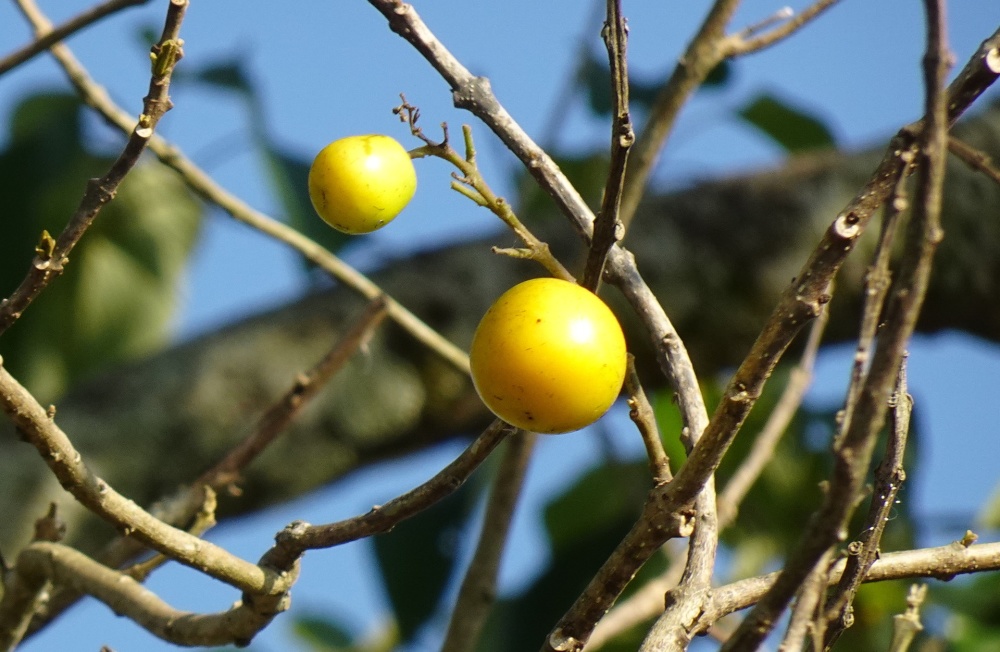
Fertilised flowers are followed by small oval fruit with a fleshy pulp surrounding a single, hard stone enclosing one to three seeds. They ripen around two months after fruit-set, gradually changing colour from green to yellow.
Material uses
Softwood - Gmelina produces a medium-weight wood in the 400 to 550 kg per cubic meter (25 to 34 lb per cubic ft) range, with creamy-white to pale yellow-grey heartwood and low natural resistance to rot and decay, making it a non-durable softwood.
Light construction - Well-formed logs are sawn into beams and planks used in lightweight, above-ground construction.
Furniture and cabinets - Also used to make furniture and cabinets.
Boxes, crates and pallets - Also made into boxes and crates.
Manufactured wood - Some logs are sliced into thin sheets to make plywood, while misshapen or smaller-diameter logs are processed into matches and particleboard.
Plant fibre pulp - Also processed into pulp for paper manufacture.
Wood turning - The branchwood is used for turnery.
Wood craft and wares - Also crafted into implements and utensils.
Firewood - The wood is suitable for fuelwood, pulpwood, and various manufactured wood products and because the tree coppices, or regrows, well after being cut back to ground level, it is commonly cultivated in forestry systems for repeated harvesting over time.
Environmental uses
Bee forage - Gmelina is a major honey plant in The Gambia, tropical West Africa, and in Tamil Nadu state, Southern India, with yields of up to 20 kg (44 lb) of marketable honey per colony per season.
Street tree - Sometimes grown in its native range as a street tree.
Shade tree - Also grown to provide shade.
Edible uses
Fresh fruit - The fruit is edible with a bitter-sweet taste, though it is considered a minor fruit with little or no commercial value.
Health uses
Traditional medicine - The roots have astringent properties and are used in traditional Indian (Ayurvedic) medicine, primarily to treat digestive complaints and fevers.
Natural memory tonic - Also used as a memory tonic.
Climate
Grows naturally in sub-humid to humid subtropical and tropical climates, generally in areas with annual lows of 16 to 25°C, annual highs of 26 to 35°C, annual rainfall of 1000 to 2500 mm and a dry season of 3 to 7 months. However, it is widely cultivated as a plantation timber tree in areas with annual rainfall of up to 5000 mm and without a distinct dry season.
Growing
New plants are usually started from cuttings or seed, which quickly lose their viability. The seed is usually soaked in cold water for one or two days before sowing to improve germination.
It performs best in deep, free-draining loam soils of an acid to alkaline nature, generally with a pH of 5.0 to 8.0, and in sites with full sun exposure.
Problem features
Gmelina has been introduced as a forestry tree in many tropical regions of Africa and the Americas and is recorded as an agricultural weed in Australia. Still, it does not appear to be recorded as a serious weed anywhere.
It produces abundant fruit and seed, but seedlings need direct sunlight to establish and grow; forest edges, gaps, and disturbed areas are the most frequently colonised. The Hawaii Pacific Weed Risk Assessment (HPWRA) project assessed it as a low weed risk for Hawaii.
The spent leaves and flowers fall to the ground, where they create litter.
Where it grows
References
Books
-
Barwick, M., et al. 2004, Tropical & subtropical trees : a worldwide encyclopaedic guide, Thames and Hudson, London
-
Bradbear, N. 2009, Bees and their role in forest livelihoods : a guide to the services provided by bees and the sustainable harvesting, processing and marketing of their products, Food and Agriculture Organization of the United Nations (FAO), Rome
-
Burns R.M., Mosquera M.S. & Whitmone J.L. 1998, Useful trees of the tropical region of North America, North American Forestry Commission Publication (Number 3), Washington D.C.
-
Chudnoff, M. 1984, Tropical timbers of the world, Forest Service, U.S. Department of Agriculture (USDA), Washington, D.C.
-
Crane, E., Walker, P. & Day, R. 1984, Directory of important world honey sources, International Bee Research Association, London, United Kingdom
-
Dastur, J. F. 1964, Useful plants of India and Pakistan : a popular handbook of trees and plants of industrial, economic, and commercial utility, 2nd ed., D. B. Taraporevala Sons, Bombay
-
Do, D. S. & Nguyen, H. N. 2003, Use of indigenous tree species in reforestation in Vietnam, Agricultural Publishing House, Hanoi
-
Food and Agriculture Organization of the United Nations (FAO). 1993. Timber Plantations in the Humid Tropics of Africa. Forestry Paper 98.
-
Francis, J. K. 1998, Tree species for planting in forest, rural, and urban areas of Puerto Rico, U.S. Department of Agriculture, Forest Service, International Institute of Tropical Forestry, Río Piedras, Puerto Rico
-
Jensen, M. 1999, Trees commonly cultivated in Southeast Asia : an illustrated field guide, 2nd ed., Food and Agricultural Organisation of the United Nations (FAO) Regional Office for Asia and the Pacific (RAP), Bangkok
-
Krishen, P. 2006, Trees of Delhi : a field guide, Dorling Kindersley Publishers, Delhi
-
Letourneux, C. 1957, Tree planting practices in tropical Asia, Food and Agriculture Organization of the United Nations (FAO), Rome
-
Liegel, L. H. 1987. A technical guide for forest nursery management in the Caribbean and Latin America, U.S. Dept. of Agriculture, Forest Service, Southern Forest Experiment Station, New Orleans
-
Little, E.L. Jr. 1983, Common fuelwood crops: a handbook for their identification, McClain Printing Company, Parsons, West Virginia
-
Luna, R. K 1996, Plantation trees, International Book Distributors, Dehradun, Uttarakhand
-
Nair, P. K. R. 1993, An introduction to agroforestry, International Centre for Research in Agroforestry (ICRAF), Kluwer Academic Publishers, Dordrecht
-
National Research Council (Board on Science and Technology for International Development) 1980, Firewood crops : shrub and tree species for energy production (Volume 1), The National Academies Press, Washington D. C.
-
Parrotta, J. A. 2001, Healing plants of peninsular India, CABI Publishing, Wallingford, Oxfordshire
-
Reyes, G. 1992, Wood densities of tropical tree species, U.S. Department of Agriculture, Forest Service, Southern Forest Experiment Station, New Orleans, Louisiana
-
Scheffer, T. C & Morrell, J. J. 1998, Natural durability of wood : a worldwide checklist of species, Forest Research Laboratory, Oregon State University, Corvallis, Oregon
-
Sheikh M. I. 1993, Trees of Pakistan, USAID Forestry Planning and Development Project, Pictorial Printers, Islamabad
-
Singh, R. V. 1982, Fodder trees of India, Oxford & IBH Publishing Company, New Delhi
-
Streets, R. J. & Troup, R. S. 1962, Exotic forest trees in the British Commonwealth, Oxford University Press, Oxford, England
-
Troup, R.S. & Joshi, H. B. 1975 to 1981, Silviculture of Indian Trees (3 volumes), Government of India Publications, New Delhi
-
Webb, D. B. 1984, A Guide to species selection for tropical and sub-tropical plantations, 2nd ed., Unit of Tropical Silviculture, Commonwealth Forestry Institute, University of Oxford, Oxfordshire
Articles, Journals, Reports and Working Papers
-
Commonwealth Forestry Institute, Department of Forestry, University of Oxford, Fast growing timber trees of the lowland tropics (No. 1-6; 1968-1973), Oxford, U.K.
-
Singh, K. P. & Kushwaha, C. P. 2006, Diversity of flowering and fruiting phenology of trees in a tropical deciduous forest in India, Oxford University Press