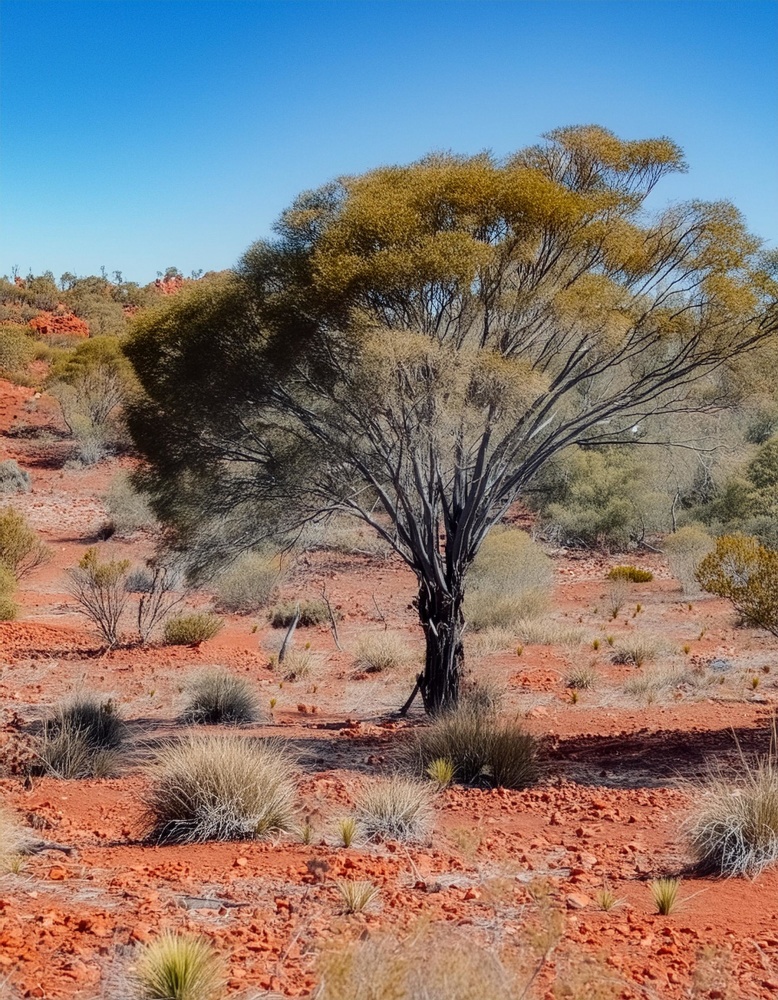


Common name: Mulga
Other common names: Mulga acacia
Description
Mulga is a landscape shrub or small tree native to outback Australia and well suited to dry climates. It has been introduced into Kenya, South Africa and the south-western United States.
A highly variable species, it has up to ten naturally evolved varieties reported in its native range, ranging from multi-trunked shrubs 2 to 3 m (7 to 10 ft) tall to trees up to 10 m (30 ft) tall. In cultivation, it is more commonly a small tree 3 to 5 m (10 to 16 ft) tall with a round- to wide-spreading crown of ascending branches.
Leaves are lance-shaped and have a blue-green or silver-grey colouration that contrasts strongly with the usual browns and greys of dry landscapes.
Flowers are bright yellow, packed in dense clusters resembling small bottle brushes and bloom after a shower of rain or intermittently under irrigation, as is common in gardens and landscapes.
Fertilised flowers are followed by flat seedpods up to 5 cm (2 in) long, becoming brown and resinous when mature. They are, however, sometimes absent or are only a few as a result of poor fruit set.
Environmental uses
Home garden tree - Mulga is a commonly cultivated small garden tree in dry-area residential landscapes.
Poolside plant - It is also a valued poolside plant in dry climates.
Street tree - As well as a street tree in urban settings such as traffic islands.
Erosion control - It is sometimes planted for erosion control, especially on low-fertility soils, because of its extensive root system.
Nitrogen-fixing - As a legume, it can also fix nitrogen in the soil.
Bee forage - It is an important bee forage plant in its native range, visited by honeybees, though not for nectar, mainly for high-protein pollen to feed their larvae.
Livestock browsing resistant - It is reasonably resistant to livestock grazing, with the resilience to re-leaf and recover.
Material uses
Hardwood - The wood is hard and heavy, averaging around 1000 kg per cubic metre, and is closely grained, with attractively contrasting shades of brown.
Wood craft and wares - The roundwood lengths, though small in diameter, have a traditional use in Aboriginal woodcraft.
Wood turning - They are also sought after for decorative wood turning.
Tool handles - As well as tool handles.
Poles and posts - The larger-diameter stems are cut for poles and posts, particularly fence posts.
Firewood - As well as for firewood.
Charcoal - And charcoal.
Livestock forage - In some areas, the leaves are a valued source of livestock feed and are foraged during the dry season. They have a crude protein content of 11% to 16% of their dry weight. Still, they are deficient in sulphur and phosphorus and are only moderately digestible, so they require supplementation with other feeds.
Climate
Grows naturally in desert, dry savanna and Mediterranean climates. Generally, areas with annual lows of 9 to 20°C, annual highs of 22 to 35°C, annual rainfall of 200 to 500 mm and a dry season of 6 to 12 months, extending to drier areas with irrigation or groundwater.
Growing
New plants are usually started from seed. They remain viable for up to 10 years if dried and stored under cool, low-humidity conditions.
Performs best on free-draining clay loam, loam, sandy loam, loamy sand, sand, and limestone or gravelly soils of an acid to alkaline nature, generally with a pH of 5.0 to 8.5. Being a nitrogen-fixing plant, it also thrives on nutrient-poor soils. It is highly drought-tolerant and, although intolerant of waterlogged soils, withstands seasonal flooding.
Problem features
It is listed as a weed in at least one reference publication. Still, no reports describe it as a serious weed anywhere. Instead, it is most commonly reported for its reseeding habit, its formation of dense thickets, and its vigorous root growth, which can block sewer and other underground pipes. In Australia, a minimum planting distance of four meters from any underground pipes is recommended.
Where it grows
References
Books
-
Allen, O. N. & Allen, E. K. 1981, The Leguminosae : a source book of characteristics, uses, and nodulation, University of Wisconsin Press, Madison, Wisconsin
-
Boland, D. & Brooker, I. & McDonald, M. W. 2006, Forest trees of Australia, 5th ed., CSIRO Publishing (Ensis), Melbourne
-
Clemson, A. 1985, Honey and pollen flora, New South Wales Department of Agriculture, Inkata Press, Melbourne
-
Doran, J. C & Turnbull, J. W. 1997, Australian trees and shrubs : species for land rehabilitation and farm planting in the tropics, 2nd ed, Australian Centre for International Agricultural Research (ACIAR), Canberra, Australian Capital Territory
-
Gohl, B. 1981, Tropical Feeds : feed information summaries and nutritive values (Revised edition), Food and Agriculture Organization of the United Nations (FAO), Rome
-
Hall, N. 1972, The use of trees and shrubs in the dry country of Australia, Australian Government Publishing Service, Canberra, Australian Capital Territory
-
Hocking, D. 1993, Trees for drylands, International Science Publisher, New York
-
Holliday, I. 2002, A field guide to Australian trees, 3rd revised editon, New Holland Publishers, Frenchs Forest, New South Wales
-
Leech, M. 2013, Bee Friendly: A planting guide for European honeybees and Australian native pollinators, Rural Industries Research and Development Corporation (RIRDC), Canberra, Australian Capital Territory
-
Lefroy, EC 2002-05-01, Forage Trees and shrubs in Australia, Rural Industries Research and Development Corporation Australia (RIRDC)
-
Maslin, B. R. & McDonald, M. W. 2004, Acacia Search : Evaluation of Acacia as a woody crop option for southern Australia, Rural Industries Research and Development Corporation (RIRDC), Barton, A.C.T., Australia
-
National Research Council (Board on Science and Technology for International Development) 1979, Tropical legumes : resources for the future, The National Academies Press, Washington D. C.
-
Peate, N. & Macdonald, G. & Talbot, A. 2006, Grow what where : over 3,000 Australian native plants for every situation, special use and problem area, 3rd ed., Bloomings Books, Richmond, Victoria, Australia
-
Randall, R. P. 2002, A global compendium of weeds, R.G. and F.J. Richardson Press, Melbourne
-
Randall, R. P. 2007, The introduced flora of Australia and its weed status, Cooperative Research Centre for Australian Weed Management, Glen Osmond, South Australia
-
Sheikh M. I. 1993, Trees of Pakistan, USAID Forestry Planning and Development Project, Pictorial Printers, Islamabad
-
Streets, R. J. & Troup, R. S. 1962, Exotic forest trees in the British Commonwealth, Oxford University Press, Oxford, England
Articles, Journals, Reports and Working Papers
-
South East Water Company 1999, Tree roots : a growing problem, South East Water, Moorabbin, Victoria