

Common name: Fern Tree
Other common names: Japanese Fern tree, Pihimbiya, Thika Palm
Description
Native to Sri Lanka, the Western Ghats of southern India, and small highland areas of East Africa, the Fern Tree, or Thika Palm, is best known for its striking foliage, though large specimens also produce heavy wood.
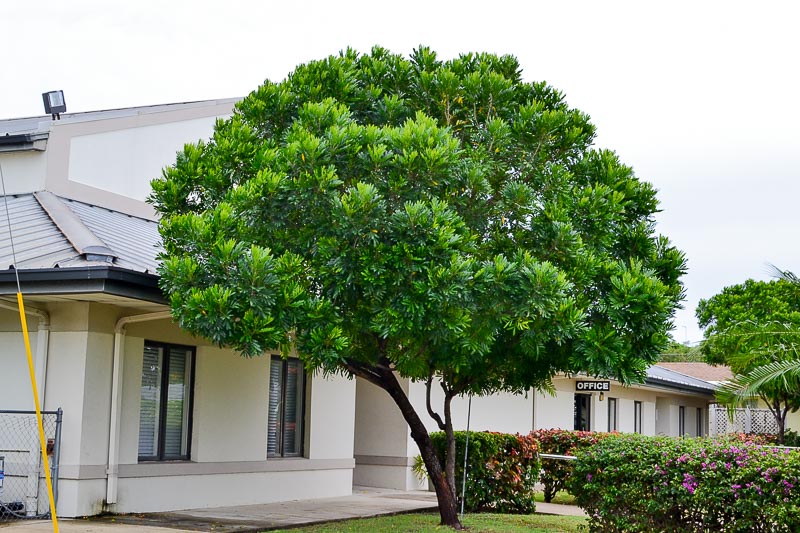
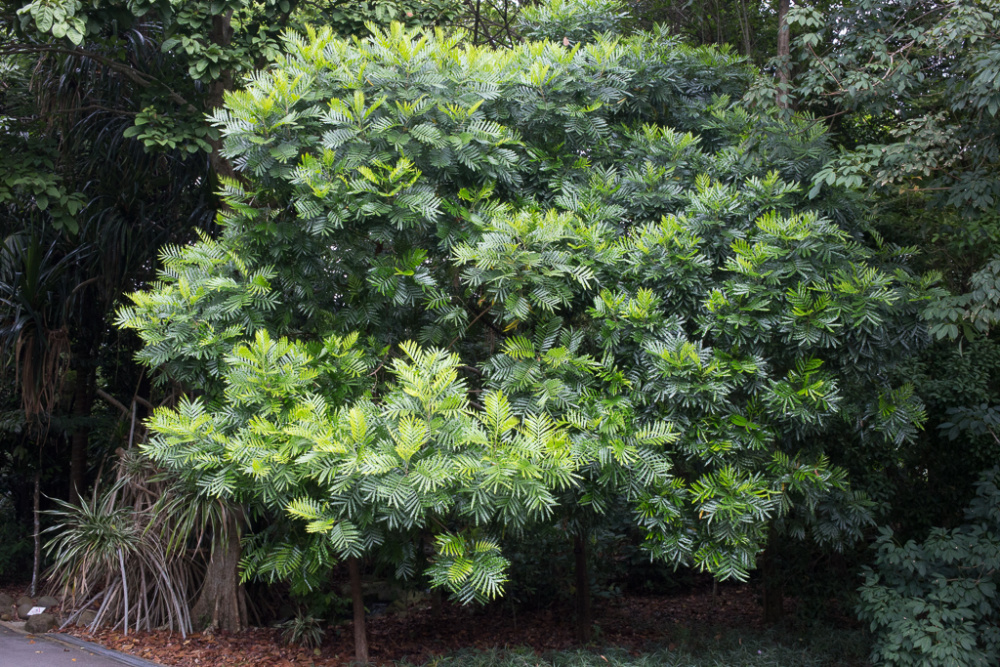
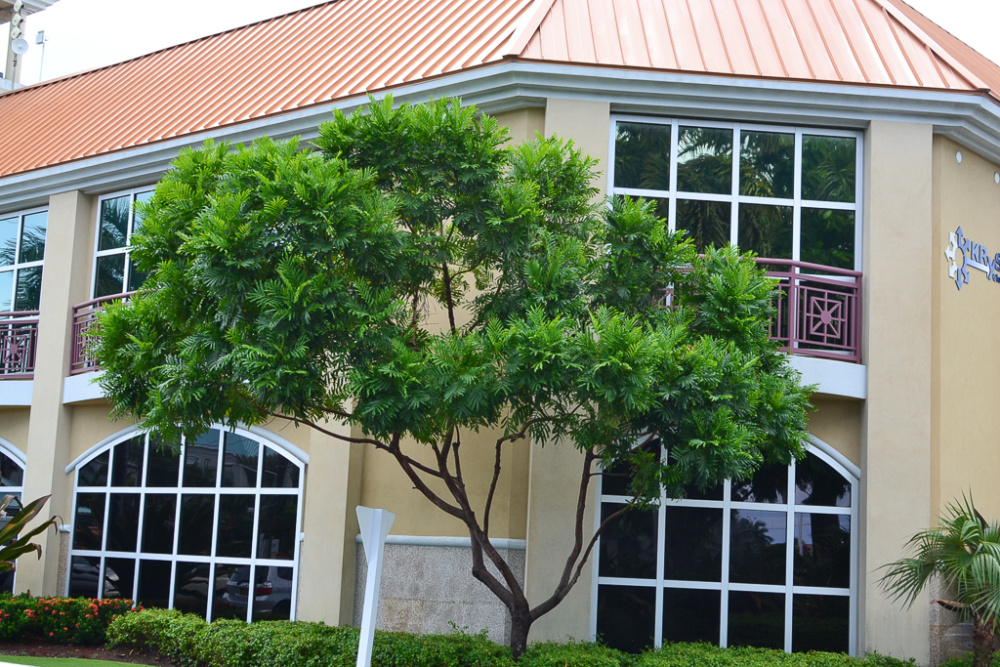
It is a slow-growing tree with a short, straight trunk and a dense, neatly shaped, rounded crown. The bark is smooth and pale brown on young trees, becoming rough, fissured, and flaking on older trees. In native forests, it reaches up to 27 m (88 ft), though it is typically 5 to 20 m (16 to 65 ft) tall.
Leaves are large, fern-like and showy, up to 40 cm (1.3 ft) long and made up of glossy green elongated oval leaflets arranged in pairs along the length. These are evergreen and remain on the tree year-round.
The flowers are small and white with a pink tint, held in loose clusters that are hardly visible, hidden by the dense foliage. They bloom from late winter to spring, coinciding with the transition from the dry to the rainy season and are followed by small green oval fruit that become purple-red when ripe.
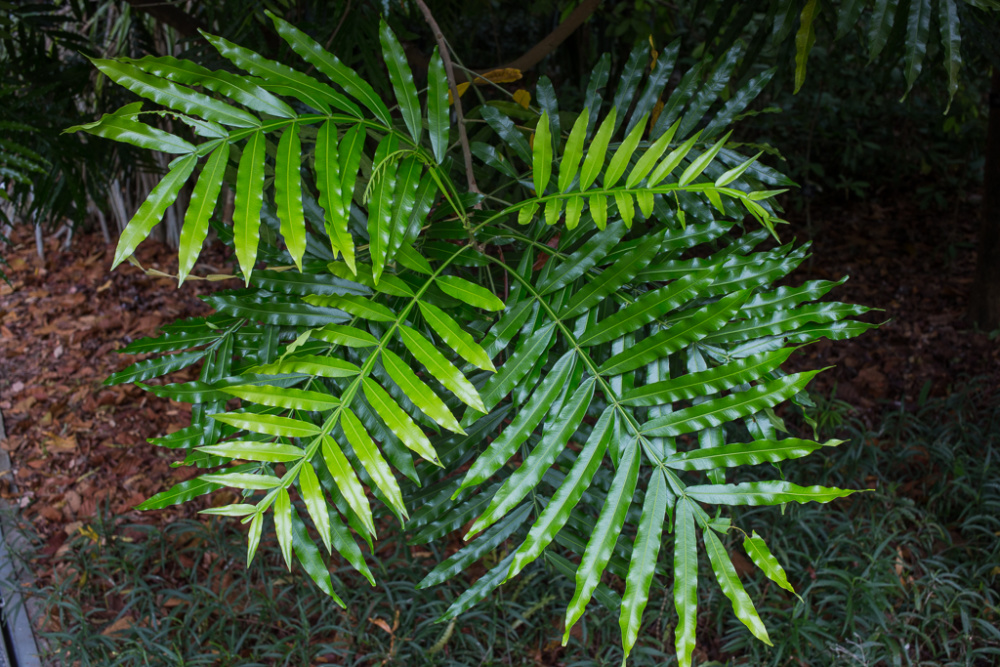
Singapore Botanic Gardens
Environmental uses
Home garden tree - The tree is commonly cultivated in tropical gardens and landscapes...
Foliage ornamental - ...for its lush green, eye-catching foliage, compact size...
Shade tree - ...and shade.
Shade or privacy screen - It is a good candidate for a large privacy screen...
Windbreak - ...or windbreak because of its low-branching habit and dense foliage.
Material uses
Hardwood - On favourable sites, trees produce hard, heavy wood, averaging above 900 kg per cubic meter (56 lb per cubic ft), with attractive reddish-brown heartwood.
Decay- and rot-resistant wood - The wood has moderate to high natural resistance to decay...
Termite-resistant wood - ...and termites.
Timber and lumber - Well-formed logs are sawn into durable beams and posts...
Heavy construction - ...used in heavy construction.
Tool handles - Small-diameter roundwood and branchwood are crafted into tool handles...
Firewood - ...and, when properly dried, makes excellent slow-burning firewood.
Climate
Grows naturally in sub-humid to humid subtropical and tropical climates, generally frost-free areas with annual lows of 13 to 25°C, annual highs of 27 to 35°C, annual rainfall of 800 to 4500 mm and a dry season of 7 months or less. However, it develops best as a timber tree in tropical lowland areas with annual rainfall of 1500 mm or more.
Growing
New plants are usually started from seed, which quickly loses its viability and should be sown within a few days of fruit harvest. It performs best in free- to slow-draining clay and loam soils that are moderately acidic to alkaline (generally pH 5.0 to 8.0) and in sites with full to partial sun exposure.
Problem features
Birds are known to eat the fruit and disperse the seed outside of cultivation. At least one reference publication lists it as a weed, and it has naturalised on some Hawaiian islands. For some reason, trees in Florida rarely produce viable fruit; hence, they are not considered invasive there.
Where it grows
References
Books
-
Barwick, M., et al. 2004, Tropical & subtropical trees : a worldwide encyclopaedic guide, Thames and Hudson, London
-
Dharani, N. 2011, Field guide to common trees & shrubs of East Africa, 2nd ed., Struik Nature Publishing, Cape Town
-
Krishen, P. 2006, Trees of Delhi : a field guide, Dorling Kindersley Publishers, Delhi
-
Macmillan, H. F. 1943, Tropical planting and gardening : with special reference to Ceylon, 5th ed, Macmillan Publishing, London
-
Prasanna, P.V. 2012, Trees of Hyderabad: A Pictorial Guide, 1st ed., Botanical Survey of India (BSI), Indian Government Ministry of Environment and Forests, Kolkata
-
Randall, R. P. 2007, The introduced flora of Australia and its weed status, Cooperative Research Centre for Australian Weed Management, Glen Osmond, South Australia
-
Rauch, F. D. & Weissich, P. R. 2000, Plants for tropical landscapes : a gardener's guide, University of Hawaii Press, Honolulu
-
Troup, R.S. & Joshi, H. B. 1975 to 1981, Silviculture of Indian Trees (3 volumes), Government of India Publications, New Delhi
Articles, Journals, Reports and Working Papers
-
National Resources Conservation Service (NRCS) 2012, Pacific Islands Area Vegetative Guide, Technical Note 7., United States Department of Agriculture (USDA), Washington D.C.