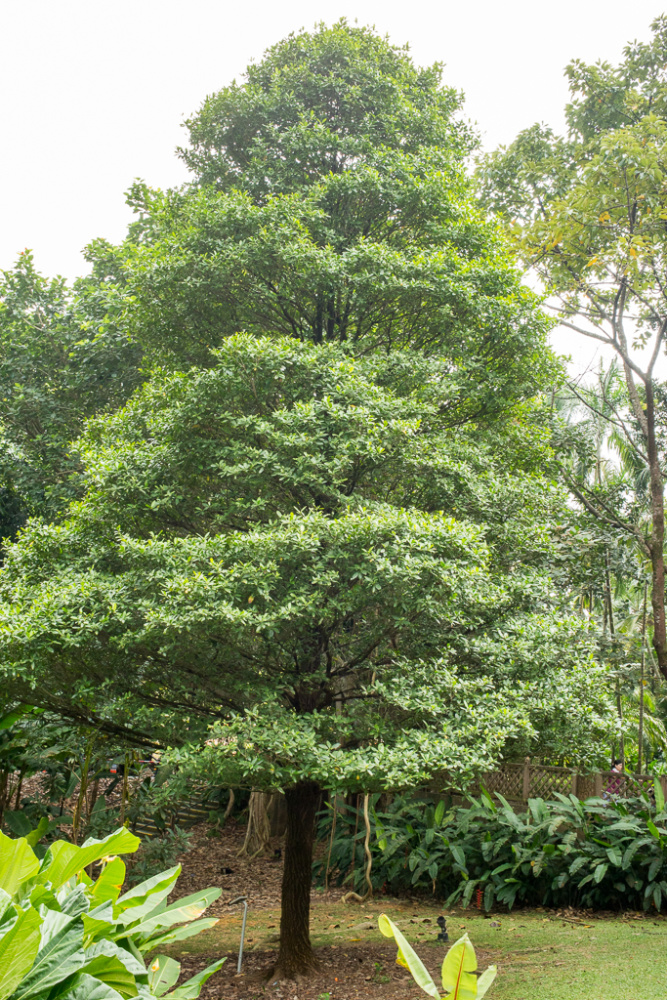


Common name: Tembusu
Other common names: Ironwood
Description
Tembusu is a landscape and timber tree native to India and Southeast Asia, with its natural range extending from the Andaman and Nicobar Islands off the south-east coast of India to Myanmar (Burma), then east through Thailand, Malaysia, and Singapore to the Philippines, Indonesia, and Papua New Guinea.
It grows slowly, reaching up to 30 m (98 ft) tall under favourable conditions, with a slim, straight trunk up to 60 cm (2 ft) in diameter, often fluted at the base, and supporting a narrow, pyramidal crown. The bark is grey-brown to dark brown, smooth on young trees, becoming thick and rough with deep vertical furrows.
The leaves are elongated oval, light glossy green, 8 to 13 cm (3 to 5 in) long, smooth on the margins and remain on the tree in all seasons.
The flowers are creamy-white, trumpet-shaped, 2 cm (0.75 in) wide, and bloom in clusters arising at the sides and ends of the branches. They come into bloom at the start of the rainy season, which occurs twice a year in some areas, and open at sunset, releasing a sweet fragrance that lasts into the night. After five to six days, the petals yellow and the fragrance becomes unpleasant, changing from sweet to rotting.
They are followed by small, round, 0.6 to 1.2 cm (0.25 to 0.5 in) in diameter, green berries that turn orange, then red, when mature, usually from late summer to autumn, and contain many small seeds.
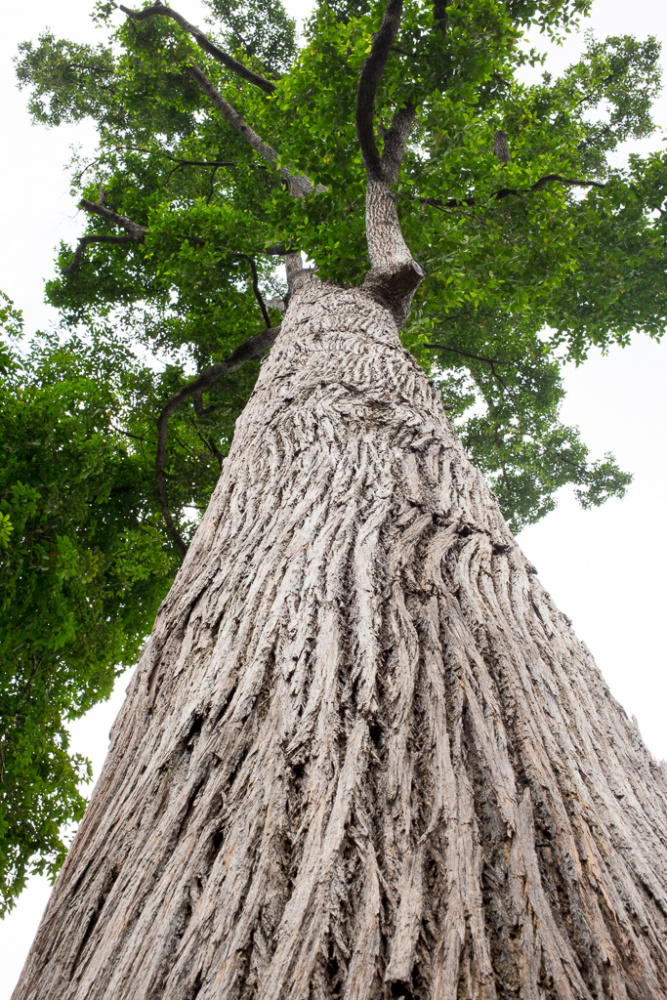
Singapore Botanic Gardens
Environmental uses
Street tree - It is sometimes cultivated as a street tree...
Public garden tree - ...and in public gardens in its native range...
Flowering ornamental - ...for its shapely form, shade, and creamy-white flowers...
Fragrant plant - ...which are also fragrant.
Material uses
Hardwood - The wood is medium-weight to heavy, ranging from 650 to 850 kg per cubic meter. The heartwood is pale yellow-brown with a pinkish tinge, darkening on exposure to deep orange to golden brown.
Decay- and rot-resistant wood - Its natural resistance to decay and wood-boring insects varies widely, from non-resistant to very resistant.
Timber and lumber - Well-formed logs are sawn into beams, planks and boards.
Heavy construction - The beams are used in heavy construction, including wharves and bridges.
Boat building - The planks and boards are used for boat-building...
Flooring and decking - ...flooring and decking...
Furniture and cabinets - ...and furniture and cabinets.
Poles and posts - Mis-shapen or small-diameter logs and branchwood are used for poles and posts...
Carved craft - ...carvings...
Wood turning - ...turnery...
Firewood - ...as well as firewood...
Charcoal - ...and charcoal.
Climate
Grows naturally in moderately humid to humid tropical lowland climates, generally areas with annual lows of 19 to 25°C, annual highs of 27 to 35°C, annual rainfall of 1400 to 3500 mm, and a dry season of 5 months or less.
Growing
New plants are usually raised from cuttings or seed. The seed remains viable for up to six months but must be separated from the fruit pulp soon after harvesting and dried before storing.
It performs best on sites with full to partial sun exposure. Suitable soils range from compacted clay to sand and are moderately acidic to neutral, generally with a pH of 5 to 7. It tolerates seasonal flooding but not long-standing water or waterlogged soils.
The lower branches remain close to the ground on trees growing in open spaces, hindering the formation of a tall, straight trunk. Pruning the lower branches encourages the tree to grow taller, improve its form, and thereby its value, should it ever be cut down for timber.
Problem features
Birds and bats are attracted to the fruit and disperse the seed outside of cultivation; however, there do not appear to be any reports of it becoming a weed or invasive species. So far, no formal assessment has evaluated its weed risk.
Where it grows
References
Books
-
Barwick, M., et al. 2004, Tropical & subtropical trees : a worldwide encyclopaedic guide, Thames and Hudson, London
-
Chudnoff, M. 1984, Tropical timbers of the world, Forest Service, U.S. Department of Agriculture (USDA), Washington, D.C.
-
Holttum, R. E. & Enoch, I. C. 2010, Gardening in the tropics : the definitive guide for gardeners, Marshall Cavendish Editions, Singapore
-
Macmillan, H. F. 1943, Tropical planting and gardening : with special reference to Ceylon, 5th ed, Macmillan Publishing, London
-
Menninger, E. A. 1962, Flowering trees of the world for tropics and warm climates, 1st ed., Heathside Press, New York
-
Morton, J. F. 1971, Exotic plants, Golden Press, New York
-
Polunin, Ivan 1987, Plants and flowers of Singapore, Times Editions, Singapore
-
Randall, R. P. 2007, The introduced flora of Australia and its weed status, Cooperative Research Centre for Australian Weed Management, Glen Osmond, South Australia
-
Scheffer, T. C & Morrell, J. J. 1998, Natural durability of wood : a worldwide checklist of species, Forest Research Laboratory, Oregon State University, Corvallis, Oregon
-
Streets, R. J. & Troup, R. S. 1962, Exotic forest trees in the British Commonwealth, Oxford University Press, Oxford, England
-
Westphal, E & Jensen, P. C. M & Centrum voor Landbouwpublikaties en Landbouwdocumentatie (Netherlands) & Prosea Project 1989, Plant resources of South-east Asia : a selection, Pudoc, Wageningen