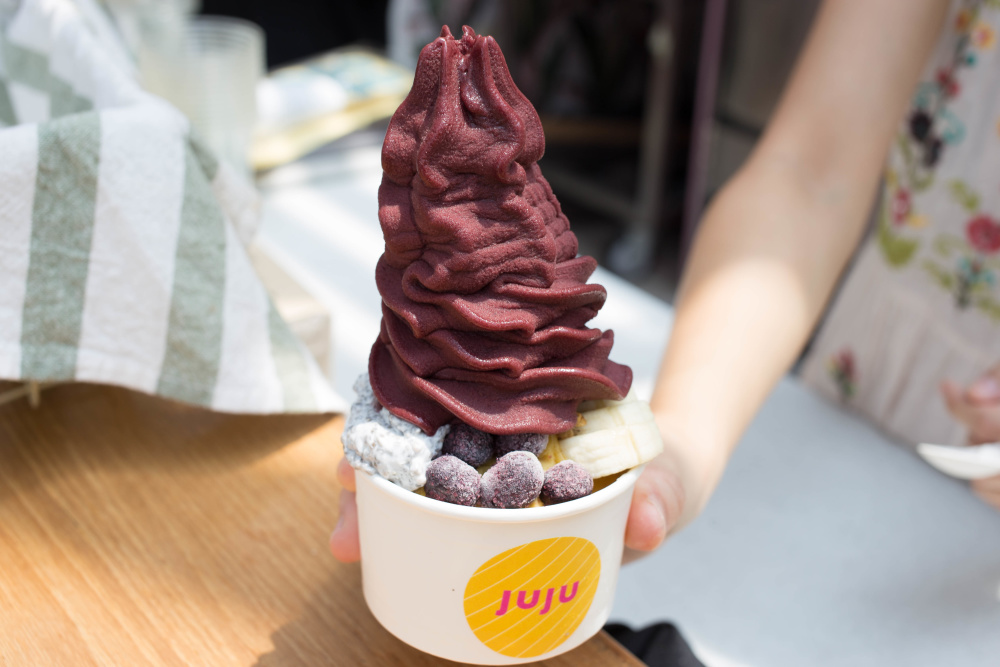


Common name: Acai
Other common names: Cabbage Palm, Manac
Description
Acai is a fruiting palm native to South America, specifically the Amazon floodplains of Brazil and Peru.
It is a clumping palm that produces suckers that grow into new stems. Large clumps may have up to forty stems at different stages of development, of which only about four to eight are mature and palm-like in appearance.
Mature stems are up to 25 m (82 ft) tall, straight, round, with ringed grey bark and slender, only 10 to 15 cm (4 to 6 in) in diameter. A smooth, green crown shaft sits at the top of the stem, holding long palm leaves above it.
The palm leaves, or fronds, are 2 to 3 m (7 to 10 ft) long, with drooping green leaflets arranged in pairs along the length.
Flowers are creamy-white, small and insignificant, either female or male, borne close together on large, branching flower stalks. One or more flower stalks periodically emerge and grow from just below the crown shaft throughout the year.
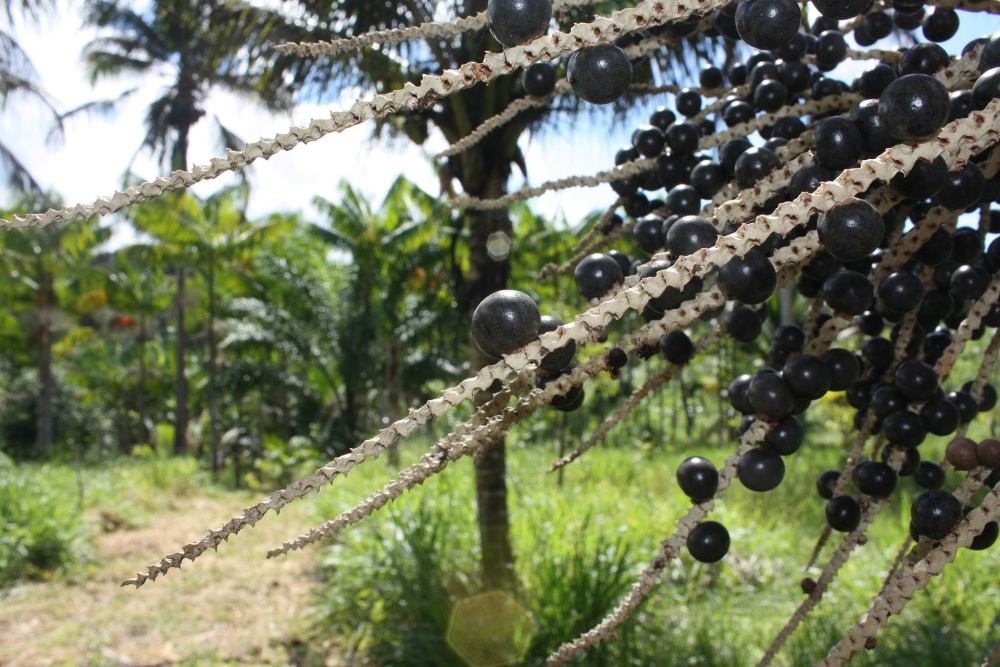
Fertilised flowers develop into small round fruit 1 to 2 cm (0.4 to 0.8 in) in diameter. When young, they are green, turning dark purple or near black when ripe, and have thin pulp covering a sizeable hairy seed. Although produced in all seasons, they are most abundant during the dry season.
Edible uses
Juice - The fruit is harvested when ripe and made into a thick, dark purple juice much esteemed in its native range. The juice is prepared by stripping the ripe fruit from the bunches into a container, covering it with warm water, and letting it sit for about an hour or two to soften the pulp. The fruit is then strained and macerated in a small amount of water until the pulp separates from the seed, and a second straining removes the seeds. Acai fruit pulp is mainly consumed in drinks and smoothies,
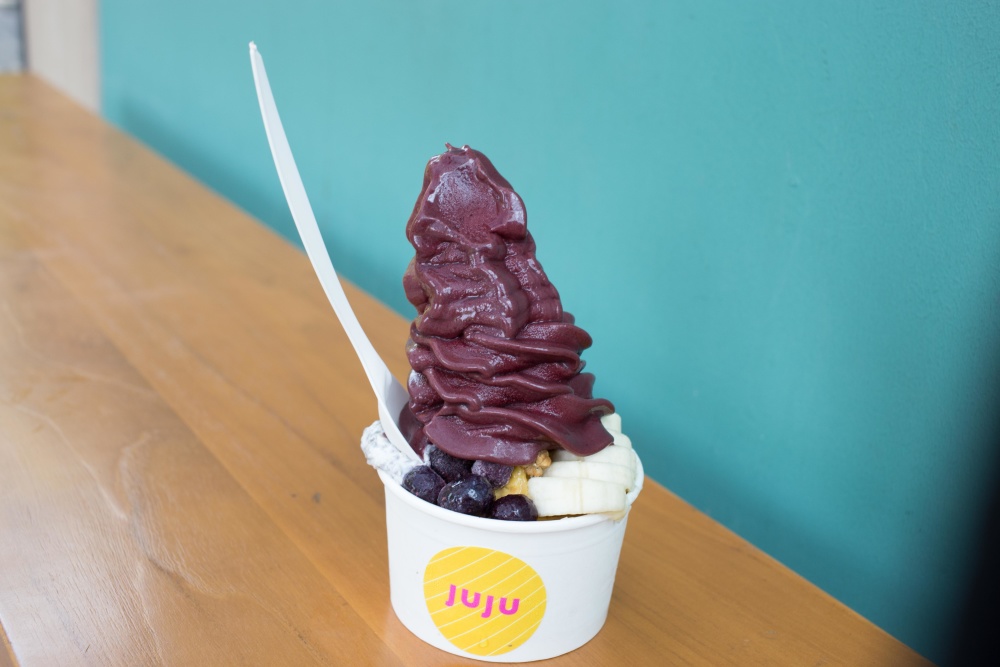
Natural flavouring - ...but is also used to flavour ice creams, sorbets and other desserts. It has a somewhat nutty flavour, a creamy-gritty texture, and an oily appearance.
Salad vegetable - The crownshaft, which measures about 1 m (3.3 ft) in length, is frequently harvested for its soft centre and eaten as a salad vegetable after cooking. Known locally as 'Palmitos' or 'Palmilito' and in English as 'Palm heart', it is mainly canned for local consumption and export.
Health uses
Vitamin A - The fruit pulp is rich in antioxidants and has reasonable amounts of Vitamin A,
Calcium - ...Calcium,
Phosphorus - ...Phosphorus,
Iron - ...and Iron.
Singapore
Climate
Grows naturally in humid to very humid tropical forests, generally frost-free areas with annual lows of 18 to 25°C, annual highs of 27 to 35°C, annual rainfall of 1500 to 5000 mm and a dry season of 3 months or less.
Growing
New plants start from seed, which usually germinate within fifty days of sowing. Seedlings are tended in a nursery with filtered or partial sun for about seven months or until they are about 50 cm (1.6 ft) tall.
It performs best on free-draining clay, loam, and sand soils of an acid nature, generally with a pH of 4.5 to 6.5, and on sites with full to partial sun exposure. It tolerates seasonal flooding well but does not tolerate permanently wet or waterlogged soils.
Problem features
It is an aggressive coloniser of swamp forests through the dispersal of its fruit and seed by fruit-eating birds, rodents and floodwaters. In addition, its suckers grow to form dense, multi-stemmed clumps. It is recorded in Panama as having escaped cultivation, as a weed of the natural environment, and as invasive, a weed class reserved for the most serious of weeds.
Where it grows
References
Books
-
Blombery, A. M. & Rodd, A. N. 1992, An informative, practical guide to palms of the world : their cultivation, care and landscape use, (Revised edition), Angus & Robertson, North Ryde, New South Wales
-
Fellows, P. 1997, Traditional foods : processing for profit, Intermediate Technology, Technical Centre for Agricultural and Rural Co-operation, London
-
Food and Agriculture Organization of the United Nations (FAO) 1986, Food and Fruit-bearing Forest Species, 3 : Examples from Latin America, FAO Forestry Paper no 44/3, Rome
-
Henderson, A., Galeano, G. and Bernal, R. 1995, Field guide to the palms of the Americas, Princeton University Press, Princeton, New Jersey
-
Janick, J., & Paull, R. E. 2008, The encyclopedia of fruit & nuts, CABI Publishing, Wallingford, Oxfordshire
-
Lorenzi, H. 2002, Brazilian trees : a guide to the identification and cultivation of Brazilian native trees. Vol. 1, 4. ed, Instituto Plantarum de Estudos da Flora, Nova Odessa, Sao Paulo
-
Rubatzky, V. E. & Yamaguchi, M. 1997, World vegetables : principles, production, and nutritive values, 2nd ed., Chapman & Hall, New York
-
Shanley, P. 2002, Tapping the green market : certification and management of non-timber forest products, Earthscan Publishing, London
-
Wallace, Alfred Russel 1989, Palm trees of the Amazon and their uses By Alfred Russel Wallace. With forty-eight plates, John Van Voorst, 1 Paternoster Row, London
Articles, Journals, Reports and Working Papers
-
Clay, J.W. and Clement, C.R. 1993, Selected species and strategies to enhance income generation from Amazonian forests, FAO Working Paper, Food and Agriculture Organisation of the United Nations (FAO), Rome