

Common name: Jelutong
Other common names: Hill Jelutong
Description
Jelutong is a large landscape and gum-yielding tree native to Southeast Asia, with its natural range extending from peninsular Thailand to Malaysia, Singapore and Indonesia.
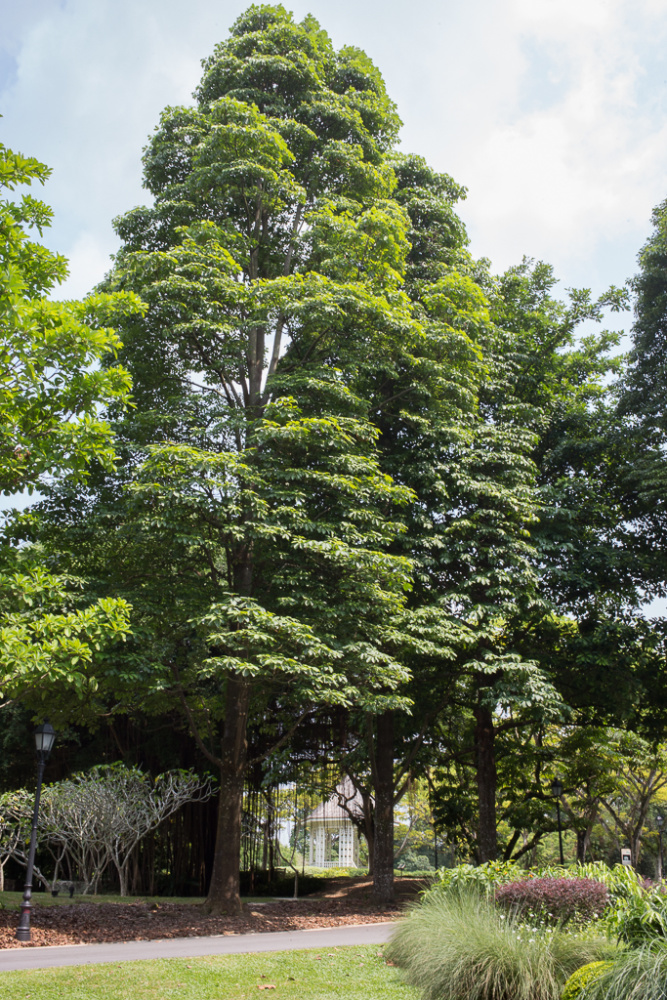
In natural forests, it is a tall tree, reaching up to 60 meters (198 ft), with a straight, round trunk up to 2.5 m (8 ft) in diameter and no branches for half its height. On open sites, it is more commonly below 30 meters (98 ft), and the trunk is low-branching, forming a pyramidal crown.
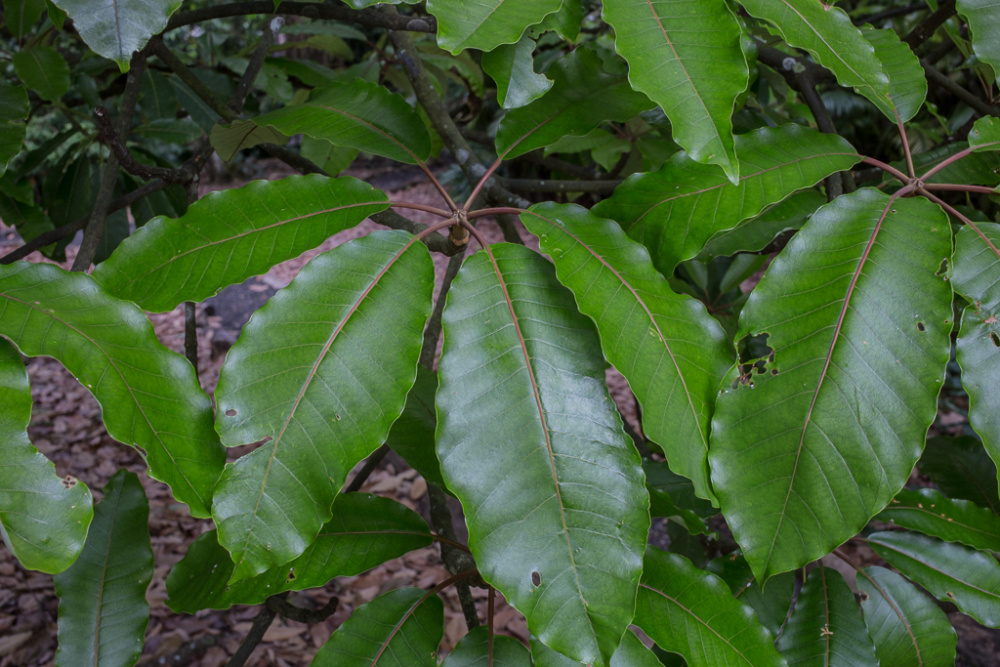
The leaves are elongated and oval, 12 to 25 cm (5 to 10 in) long, emerge orange-red before becoming glossy green, and occur in whorls of about six at the ends of the branches. In seasonally dry areas, they fall off the tree to conserve water, but remain on the tree year-round where the climate is constantly humid.
The flowers are bisexual, small, white, star-shaped and held in clusters arising at the leaf bases. They bloom in the rainy season, opening at night to be pollinated, then fall to the ground the following day, creating a white carpet.
The fertilised flowers are followed by curved, chocolate-brown seedpods up to 40 cm (1.3 ft) long, containing numerous winged seeds.
Material uses
Latex - Jelutong has long been exploited for its latex, tapped from the trunk, mainly as a substitute for chicle from the Sapodilla tree (Manilkara zapota) for use as chewing gum. Because of its non-elastic properties, it was once also used to insulate cables and electrical wires and to provide material for dental work and waterproofing.
The latex is tapped by making incisions in the trunk, similar to harvesting latex from the Rubber tree (Hevea brasiliensis). The collected latex is then coagulated with phosphoric acid and pressed into blocks, stored underwater to prevent oxidation, which otherwise darkens the colour. Trees in Malaysia are reported to average about 11 litres (3 gallons) of latex a month when tapped daily, yielding about 3.5 kg (7.7 lbs) of coagulated gum.
Softwood - Jelutong wood is light- to medium-weight, in the 350 to 460 kilograms per cubic meter (22 to 29 lbs per cubic ft) range, and has low natural resistance to rot, decay and wood-boring insects. It turns creamy-white or pale yellow on exposure and dries well, with little tendency to warp or split.
Boxes and crates - Typical uses include making wooden boxes.
Wood craft and wares - It is also used for blackboards, picture frames and light articles such as pencils, toy models, match-boxes and fishing lures.
Manufactured wood - The wood is also pulped for making insulation and manufactured wood.
Natural cork - Wood taken from the roots is used as a cork substitute.
Environmental uses
Public garden tree - Jelutong is a handsome tree occasionally planted in urban gardens and parks for its shapely form and attractive foliage.
Climate
Grows naturally in humid to very humid tropical lowland climates, generally frost-free areas with annual lows of 20 to 25°C, annual highs of 28 to 35°C, annual rainfall of 1800 to 5000 mm and a dry season of 3 months or less.
Growing
New plants are usually raised from seed sown in containers in a free-draining soil and sand mix. The seedlings are raised in a nursery under shade until planted, when they are about eight to twelve months old or 40 cm (1.3 ft) tall.
It performs best in free-draining clay and loam soils that are moderately acidic to neutral (pH 5.0 to 7.0) and in sites with full to partial sun exposure. It has poor tolerance to drought and slow-draining or waterlogged soils.
Problem features
The seeds are winged, allowing the wind to disperse them over a wide area. It is recorded as a weed in the Congo in West Africa, though not as a serious weed.
Where it grows
References
Books
-
C.A.B. International 2013, The CABI encyclopedia of forest trees, CABI Publishing, Wallingford, Oxfordshire
-
Chudnoff, M. 1984, Tropical timbers of the world, Forest Service, U.S. Department of Agriculture (USDA), Washington, D.C.
-
Coppen, J. J. W. 1995, Gums, resins and latexes of plant origin, Food and Agriculture Organization of the United Nations (FAO), Rome
-
Forest Products Laboratory (U.S.) 2007, The encyclopedia of wood, Skyhorse Pub, New York
-
Holttum, R. E. & Enoch, I. C. 2010, Gardening in the tropics : the definitive guide for gardeners, Marshall Cavendish Editions, Singapore
-
Kukachka, B. F & Forest Products Laboratory (U.S.) 1970, Properties of imported tropical woods, United States, Department of Agriculture, Forest Service, forest Products Laboratory, Madison
-
Macmillan, H. F. 1943, Tropical planting and gardening : with special reference to Ceylon, 5th ed, Macmillan Publishing, London
-
Mors, W. B & Rizzini, C. T. 1966, Useful plants of Brazil, Holden-Day Publishing, San Francisco, California
-
Porter, T. 2012, Wood : identification & use, Compact edition, Guild of Master Craftsman Publications, Lewes, East Sussex
-
Randall, R. P. 2007, The introduced flora of Australia and its weed status, Cooperative Research Centre for Australian Weed Management, Glen Osmond, South Australia
-
Reyes, G. 1992, Wood densities of tropical tree species, U.S. Department of Agriculture, Forest Service, Southern Forest Experiment Station, New Orleans, Louisiana
-
Scheffer, T. C & Morrell, J. J. 1998, Natural durability of wood : a worldwide checklist of species, Forest Research Laboratory, Oregon State University, Corvallis, Oregon
Articles, Journals, Reports and Working Papers
-
Seth, M.K 2003-10-01, 'Trees and their economic importance' The Botanical Review, vol. 69, no. 4, pp. 321(56).