

Common name: Stuffing Cucumber
Other common names: Bolivian Cucumber, Ladies Slipper, Slipper Gourd, Wild Cucumber
Description
Stuffing Cucumber, or Achocha, is an annual vine native to Central and South America, with its natural range limited to highland areas extending from Mexico to Peru.
The plant has soft, herbaceous vines that are 3 to 5 m (10 to 16 ft) long, highly branched, and with twining tendrils that enable it to climb up, on, and over structures.
The leaves are composed of three to five toothed, light green, lance-shaped leaflets fused at the base, in a cartwheel shape up to 20 cm (8 in) in diameter. They are attached to the vine on 8 to 10 cm (3 to 4 in) long leaf stalks and give off a strong cucumber aroma when crushed.
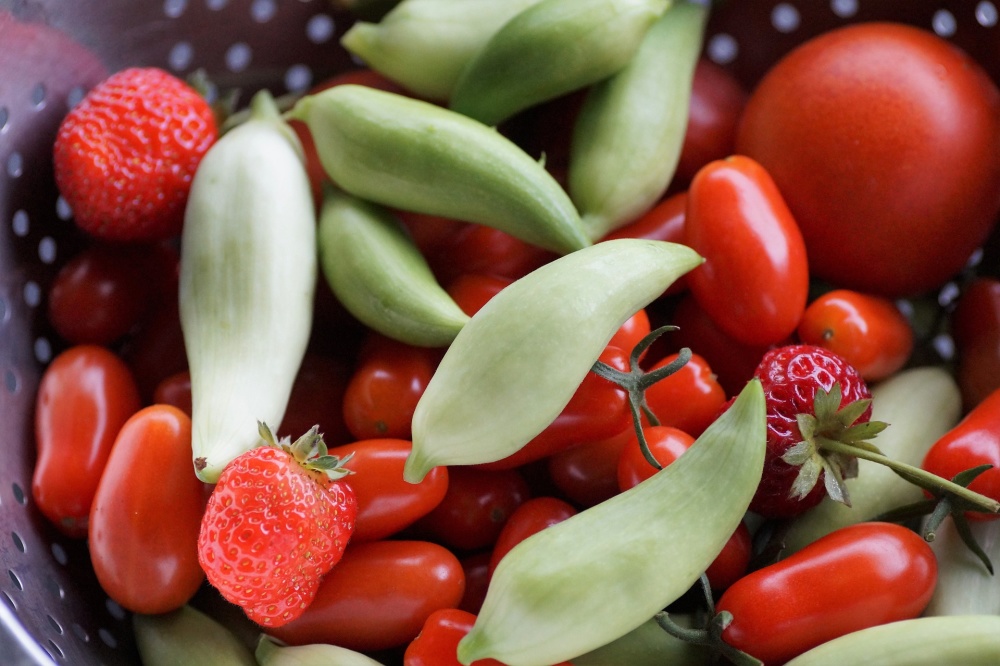
The flowers are small, green-white and unisex; the male flowers are in small clusters, and the female flowers are solitary. Flowering occurs from autumn to early winter, in response to shortening day lengths, and female flowers that are fertilised develop into chilli-pepper-shaped pods up to 15 cm (6 in.) long. The pods have thin, smooth light green skin and are almost hollow inside, with a small amount of spongy pulp embedded with small black seeds.
Edible uses
Salad vegetable - The small, immature fruit pods without seeds are sliced or chopped for adding to salads,
Cooked vegetable - ...while the larger pods are de-seeded, stuffed and baked. Traditional recipes call for stuffing the hollow insides with ground meat, seafood, rice, vegetables, or a combination of these before baking, usually in a tomato-based sauce. They have a subtle, artichoke-like flavour.
Climate
Grows naturally in sub-humid to moderately humid subtropical and tropical mid- to high-elevation climates, generally areas with annual lows of 11 to 20°C, annual highs of 20 to 29°C and annual rainfall of 500 to 2000 mm.
Growing
New plants are usually started from seed, sown in the rainy season. It performs best in rich, well-manured, free-draining loam and sandy soils of a moderately acid to neutral nature, generally with a pH of 6.0 to 7.0, and in sites with full to partial sun exposure. As the vine grows, it needs to be trained to climb on a trellis or similar structure to encourage pollination and fruit development and to make it easier to harvest them.
The pods are harvested when immature, starting around three months after the seeds are sown. Pods for salads are ready to harvest when they are very young and less than 6 cm (2 to 3 in) long, whereas those destined for the pot or oven are left to grow to about twice that size. Fruiting is reportedly abundant, with a harvesting period lasting months.
Problem features
It is listed as a weed in at least one reference publication, but there does not appear to be any record of it anywhere as a serious weed. An assessment of its weed risk for Florida, undertaken by the University of Florida's Institute of Food and Agricultural Sciences (IFAS), was inconclusive.
Where it grows
References
Books
-
Grubben, G.J.H. & Denton, O.A. (Editors) 2004, Plant Resources of Tropical Africa, Volume 2 : Vegetables, PROTA Foundation, Backhuys Publishers, Leiden
-
Herklots, G. A. C. 1972, Vegetables in south-east Asia, Allen and Unwin, London
-
Janick, J., & Paull, R. E. 2008, The encyclopedia of fruit & nuts, CABI Publishing, Wallingford, Oxfordshire
-
Leon, J & Hernandez Bermejo, J. Esteban & Programma Ethnobotanica 92. 1994, Neglected crops : 1492 from a different perspective, Food and Agriculture Organization of the United Nations, Rome
-
National Research Council (Board on Science and Technology for International Development) 1989, Lost Crops of the Incas: Little-Known Plants of the Andes with Promise for Worldwide Cultivation, The National Academies Press, Washington D. C.
-
Randall, R. P. 2002, A global compendium of weeds, R.G. and F.J. Richardson Press, Melbourne
-
Randall, R. P. 2007, The introduced flora of Australia and its weed status, Cooperative Research Centre for Australian Weed Management, Glen Osmond, South Australia
-
Roecklein, J. C & Leung, P.S. 1987, A Profile of economic plants, Transaction Books, New Brunswick, New Jersey
-
Tindall, H. D 1983, Vegetables in the Tropics, Macmillan Press, London
-
Vavilov, N. I. (Nikolaĭ Ivanovich) & Dorofeev, V. F. (Vladimir Filimonovich) 1992, Origin and geography of cultivated plants, English ed, Cambridge University Press, Cambridge [England] ; New York, NY, USA
-
Winters, H. F & Miskimen, G. W. 1967, Vegetable gardening in the Caribbean area, U.S. Dept of Agriculture, Washington D.C.
Articles, Journals, Reports and Working Papers
-
Vasquez, R. and Gentry, A. H. 1989, Use and misuse of forest-harvested fruits in the Iquitos area. Conservation Biology, 3: 350–361. doi: 10.1111/j.1523-1739.1989.tb00241.x