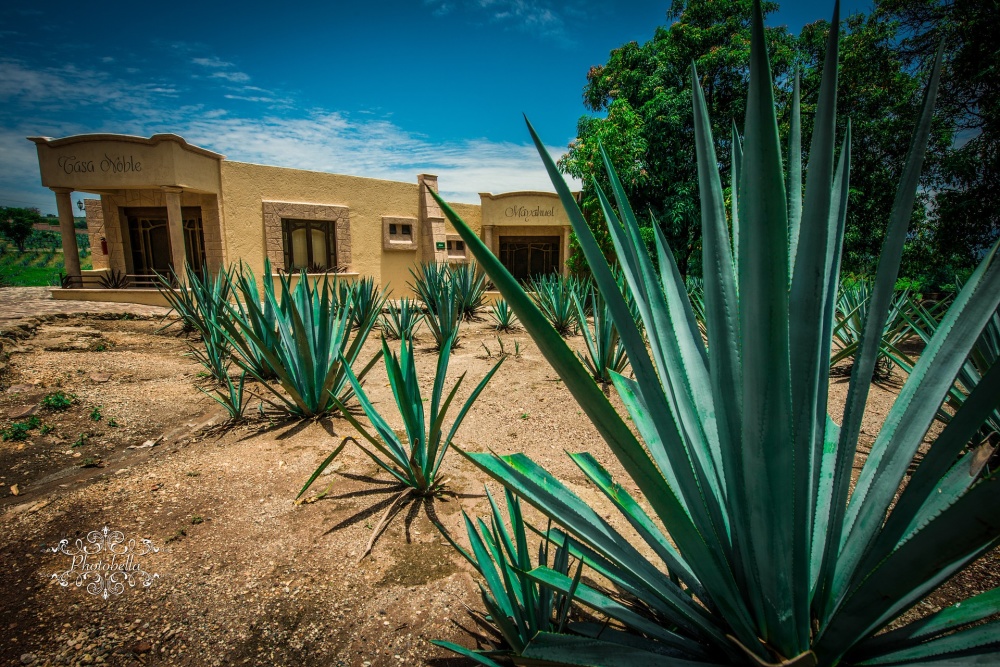


Common name: Sisal
Other common names: Century Plant, Mescal, Sisal Agave, Sisal Hemp
Description
Sisal is a succulent native to Mexico and valued for the long, strong fibres in its leaves.
Commonly 1 to 3 m (3 to 10 ft) tall, it develops a thick, stout central stem on which long, fleshy, sword-shaped leaves attach in an encircling arrangement. Individual leaves are up to 1.5 m (5 ft) long, with smooth, dark- to light-green skin and a sharp, needle-like tip.
Flowering only once at the end of an eight-year lifespan, the plant grows a towering flower spike straight up from the centre, reaching up to 7 m (23 ft) tall. At the top of the spike, yellow-greenish flowers bloom in the final spring to summer of the plant's life. Fruit rarely follows. Instead, numerous young plantlets, known as bulbils, usually grow to replace the flowers; they are complete plants in their own right and can be planted directly in the soil.
Material uses
Natural fibre - A strong, highly tensile, durable fibre is stripped from the leaf. The leaves can be harvested year-round but are usually harvested periodically, on average around 20 times over the plant's life, beginning when the plant is around 2 to 3 years old.
The raw fibres are stripped from the leaves, washed and sun-dried, then further refined, including brushing, to prepare them for manufacturing. It has many industrial uses, including manufacturing carpet, carpet backing, rugs, wash and cleaning cloths, wall plaster reinforcement, composite materials (such as fibre-plastic composites), and materials to replace fibreglass in moulded products.
Rope or cordage - Because they have high tear resistance and toughness, they are also used to make rope and cordage,
Natural packaging - ...as well as large bags or sacks, such as coffee sacks.
Plant fibre pulp - It is also used to produce speciality pulps for durable paper products such as coffee filters and banknotes. Paper products made from sisal are reported to have notably high tear strength.
Dried flowers and foliage - The dried, skeletonised leaves are also used as a textural component,
Floral arrangement - ... particularly in floral arrangements.
Environmental uses
Foliage ornamental - It is sometimes cultivated as an ornamental in gardens for its handsome foliage.
Barrier plant - Its sharp thorns also serve as a barrier, deterring unwelcome visitors.
Bee forage - The flowers produce nectar in such abundance that it drips onto the leaves, providing good energy value to brood-rearing honeybees. Honey made from it is dark and intense but of poor flavour and is generally unpalatable.
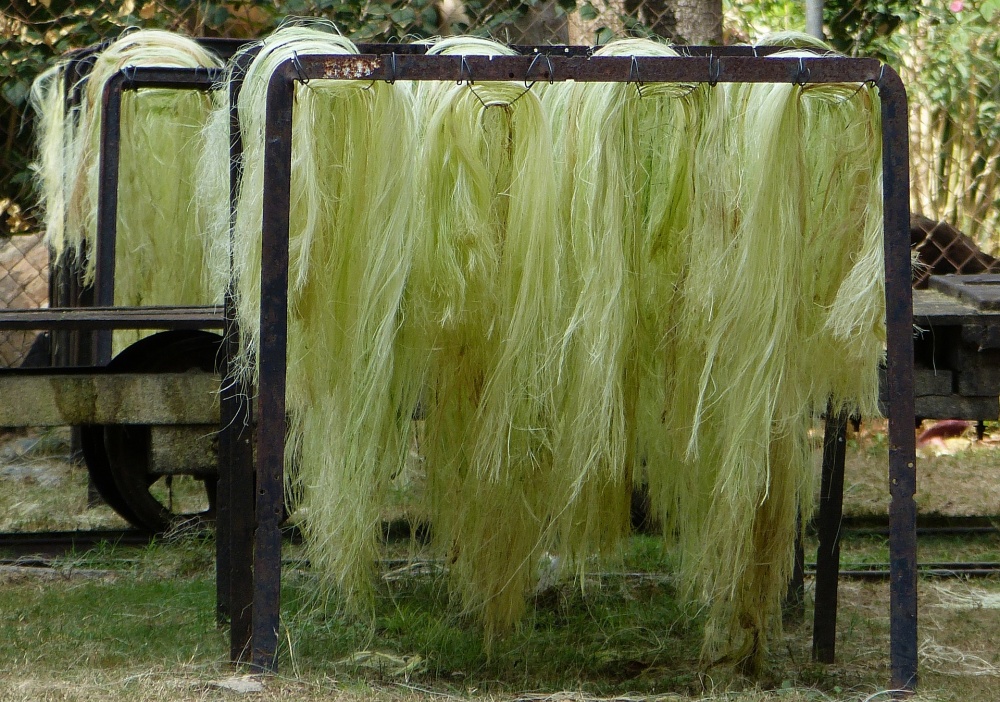
Sisal fibres hung to dry
Climate
Sisal grows naturally in sub-humid to moderately humid subtropical and tropical climates, generally areas with annual lows of 12 to 25°C, annual highs of 24 to 36°C, annual rainfall of 500 to 1400 mm and a dry season of 4 to 9 months.
Growing
New plants are usually grown from plantlets taken from the flower spike. Still, suckers borne from around the base of mature plants are also considered suitable planting material.
Sisal performs best on free-draining sand or loam soils with a slightly acidic to alkaline pH, generally 6.0 to 8.5, and in full sun. It is intolerant of waterlogging.
Problem features
It produces hundreds of plantlets that eventually fall from the flower spike to the ground, where some take root, creating new plants that can form dense, impenetrable thickets over successive generations.
It is listed as a weed in more than one reference publication and is assessed to be a high weed risk species for Hawaii by the Hawaii Pacific Weed Risk Assessment project (HPWRA)
The sap from the leaves is an irritant and can cause contact dermatitis and swelling of the mouth and throat tissues. The sharp, needle-like spine at the end of the leaf can cause serious injury.
Where it grows
References
Books
-
Adams, C. D. 1972, Flowering plants of Jamaica, University of the West Indies, Mona, Greater Kingston
-
Dastur, J. F. 1964, Useful plants of India and Pakistan : a popular handbook of trees and plants of industrial, economic, and commercial utility, 2nd ed., D. B. Taraporevala Sons, Bombay
-
Dewey, L. H. 1943, Fiber production in the western hemisphere, U. S. Department of Agriculture (USDA), Washington D.C.
-
Duke, J.A. 1993, CRC Handbook of Alternative Cash Crops, CRC Press, Boca Raton, Florida
-
Gilbert, V., Smith, S. & Young, L. 2006, Foliage for florists, Society of Floristry, United Kingdom
-
Litzenberger, S. C. 1974, Guide for field crops in the tropics and the subtropics, Office of Agriculture, Technical Assistance Bureau, Agency for International Development (USAID), Washington D.C.
-
Perkins, K. D. & Payne, W. 1981, Guide to the poisonous and irritant plants of Florida, Florida Cooperative Extension Service, Gainesville, Florida
-
Purseglove, J. W. 1981, Tropical crops: Monocotyledons, Longman, Harlow, London
-
Randall, R. P. 2002, A global compendium of weeds, R.G. and F.J. Richardson Press, Melbourne
-
Randall, R. P. 2007, The introduced flora of Australia and its weed status, Cooperative Research Centre for Australian Weed Management, Glen Osmond, South Australia
-
Smith, F. G. 2003, Beekeeping in the tropics, Northern Bee Books, Hebden Bridge, West Yorkshire
-
Wood, I. M. 1997, Fibre crops : new opportunities for Australian agriculture, Queensland Department of Primary Industries (QLD DPI), Brisbane
Articles, Journals, Reports and Working Papers
-
Morton, J.F. 1964, Honeybee Plants of South Florida, Proceedings of the Florida State Horticultural Society, Vol 77:415-436.