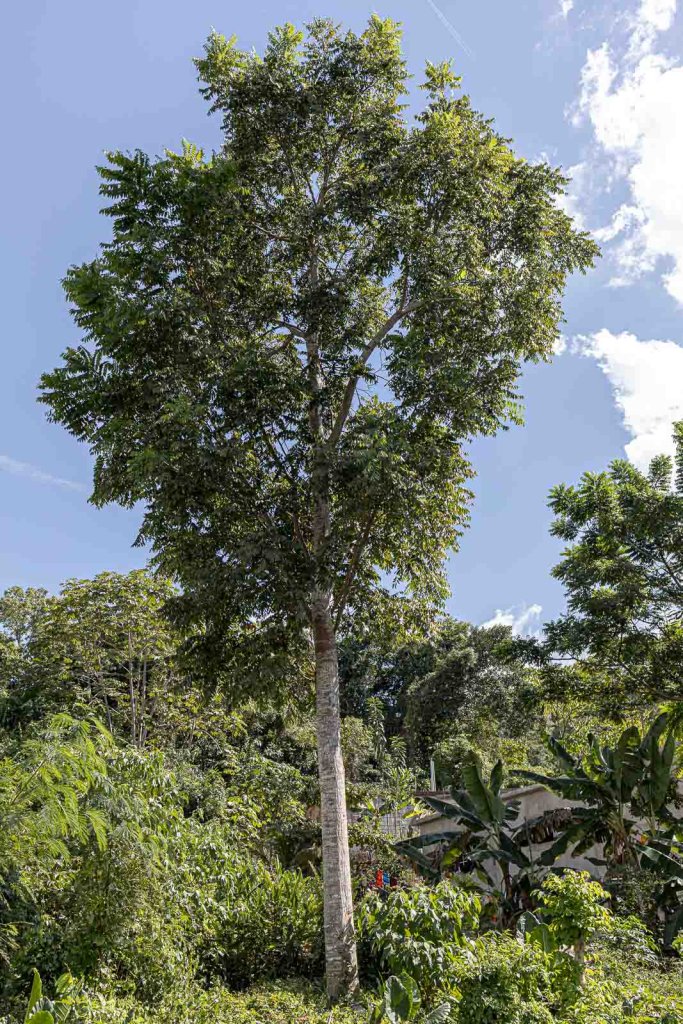


Common name: West Indian Cedar
Other common names: Barbados Cedar, Cigar Box Cedar, Mexican Cedar, Spanish Cedar, Sugar Crate Wood
Description
West Indian Cedar, or Spanish Cedar, is a fast-growing timber tree native to a wide expanse of tropical America, its natural range extending from Central America and the Caribbean south into South America, as far south as northern Argentina.
It may reach up to 30 m (98 ft) in its natural habitat, though it is more typically 15 to 20 m (50 to 65 ft) tall, with a straight trunk supporting a densely leafy, rounded crown. The bark is light grey or light brown, smooth when young, and becomes rough and furrowed with age.
Leaves are large, up to 80 cm (2.6 ft) long and feathery, made up of ten to twenty-eight deep green, oval to lance-shaped leaflets, each 8 to 15 cm (3 to 6 in) long and arranged in pairs along the length. They drop their leaves in the dry season to conserve water, leaving the branches bare until the rainy season, when new leaves emerge.
Tiny, inconspicuous white flowers soon follow the new leaves, borne in loose clusters at the tips of the branches. These are succeeded by small, woody, egg-shaped capsules that turn brown when mature, then split open inside-out to expel their seed, which are winged for wind dispersal.
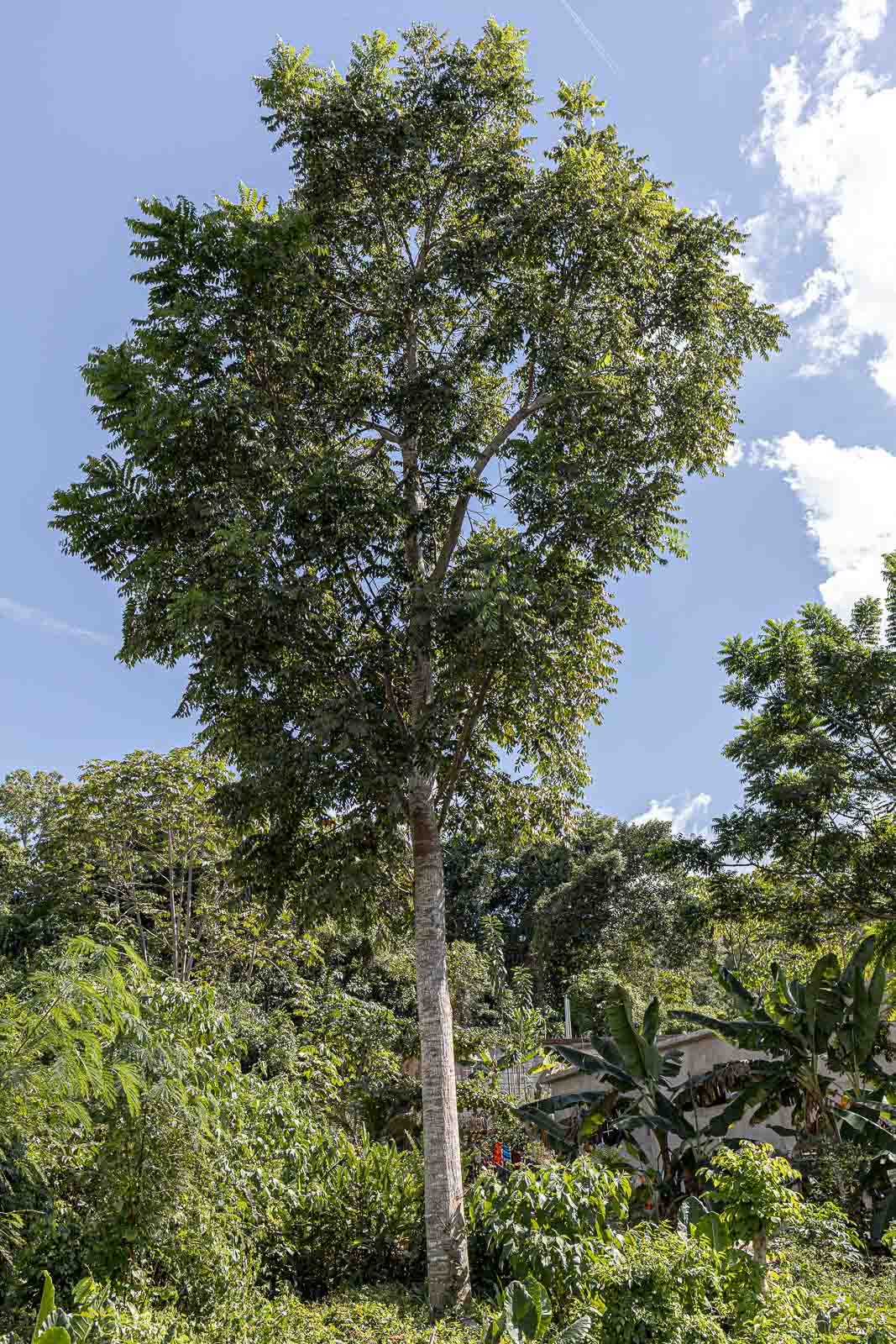
Balaclava, Jamaica
Material uses
Timber and lumber - West Indian Cedar is a well-known timber species with sweetly aromatic, versatile wood. The wood weighs 400 to 650 kg per cubic metre (25 to 41 lb per cubic ft), placing it at the lighter end of the range for many hardwood species.
Decay- and rot-resistant wood - Its natural durability, or resistance to decay, varies with growing conditions, with slow-growing trees from low-rainfall areas tending to develop heavier, more durable wood than fast-growing trees from high-rainfall areas.
Termite-resistant wood - It has natural pest-repellent properties and termite resistance that similarly vary with growing conditions.
Furniture and cabinets - The heartwood is pinkish to red-brown, sometimes with a purple tinge, and is sought after for building interior cabinets and shelves.
Boxes and crates - Also used for making wooden cigar boxes.
Decorative veneer - Selected roundwood lengths are sliced for decorative veneer.
Manufactured wood - And for making plywood.
Essential oil - An essential oil is steam-distilled from waste wood material collected from sawmills. Known as 'Cedrela oil', it is a greenish-yellow to olive-coloured liquid with a pleasing, powerful dry-woody aroma reminiscent of cedarwood oil, a commercially important essential oil derived from various cold-climate conifers.
Natural fragrance - It is mainly used as a fragrance for soaps, disinfectants, and air fresheners.
Environmental uses
Species conservation - Overexploitation of West Indian Cedar has led to its listing as a vulnerable species by the International Union for Conservation of Nature and Natural Resources (IUCN). Cultivating it in home gardens and on farms can help ease pressure on dwindling wild populations.
Climate
Grows naturally and develops well as a timber tree in moderately humid subtropical and tropical climates, generally areas with annual lows of 15 to 25°C, annual highs of 25 to 35°C, annual rainfall of 1200 to 3500 mm and a dry season of 6 months or less, extending to 9 months with irrigation or groundwater.
Areas with 2000 mm or more annual rainfall are preferred for timber plantations, as the trees grow fast and produce long, straight trunks. However, this usually comes at the expense of natural resistance to rot, decay, and wood-boring insects.
In Jamaica, West Indian Cedar grows naturally at elevations from near sea level to 1025 m (3360 ft), where the average low of the warmest month is 17°C (63°F) or above.
Growing
New plants are usually started from seed, which have a high germination rate. Seedlings and trees grow quickly, performing best in free-draining clay loam, loam, sandy loam, loamy sand, and limestone soils that are slightly acid to alkaline, generally with a pH of 6.0 to 8.0, and on sites with full to partial sun exposure. Trees have poor tolerance to slow-draining or waterlogged soils.
Problem features
The thin, paper-like seeds germinate readily and are designed for wind dispersal, carrying them far. Its ability to spread outside cultivation has made it a problem weed in some areas, mainly where it is introduced and can disrupt natural ecology. The Hawaii Pacific Weed Risk Assessment (HPWRA) project assesses it as a high weed-risk species for Hawaii.
Where it grows
References
Books
-
Adams, C. D. 1972, Flowering plants of Jamaica, University of the West Indies, Mona, Greater Kingston
-
Arctander, S. 1960, Perfume and flavor materials of natural origin, Elizabeth, New Jersey
-
Barwick, M., et al. 2004, Tropical & subtropical trees : a worldwide encyclopaedic guide, Thames and Hudson, London
-
Burns R.M., Mosquera M.S. & Whitmone J.L. 1998, Useful trees of the tropical region of North America, North American Forestry Commission Publication (Number 3), Washington D.C.
-
Burns, R.M. & Honkala, B.H. 1990, Silvics of North America (Volume 2) : Hardwoods, Agricultural Handbook 654, U.S. Department of Agriculture (USDA), Washington D.C.
-
Croat, T. B. 1978, Flora of Barro Colorado Island, Stanford University Press, Stanford, California
-
Food and Agriculture Organization of the United Nations (FAO) 1986, Databook on endangered tree and shrub species and provenances, FAO Forestry Paper 77, Forest Resources Division, Rome
-
Francis, J. K. 1998, Tree species for planting in forest, rural, and urban areas of Puerto Rico, U.S. Department of Agriculture, Forest Service, International Institute of Tropical Forestry, Río Piedras, Puerto Rico
-
Francis, J. K. et al. 2000, Silvics of Native and Exotic Trees of Puerto Rico and the Caribbean Islands, Technical Report IITF-15, USDA Forest Service, Rio Piedras, Puerto Rico
-
Howes, F. N. 1949, Vegetable gums and resins, Chronica Botanica Company, Waltham, Massachusetts
-
Kukachka, B. F & Forest Products Laboratory (U.S.) 1970, Properties of imported tropical woods, United States, Department of Agriculture, Forest Service, forest Products Laboratory, Madison
-
Lemmens, R.H.M.J., Louppe, D. & Oteng-Amoako, A.A. (eds). PROTA, Plant Resources of Tropical Africa, Volume 7(1) : Timbers 1, PROTA Foundation, Backhuys Publishers, Leiden
-
Liegel, L. H. 1987. A technical guide for forest nursery management in the Caribbean and Latin America, U.S. Dept. of Agriculture, Forest Service, Southern Forest Experiment Station, New Orleans
-
McGregor, Samuel Emmett n.d., Insect pollination of cultivated crop plants, U.S. Dept. of Agriculture, Agricultural Research Service : for sale by the Supt. of Docs., U.S. Govt. Print. Off, Washington
-
Nair, P. K. R. 1993, An introduction to agroforestry, International Centre for Research in Agroforestry (ICRAF), Kluwer Academic Publishers, Dordrecht
-
Patino Valera, Fernando 1997, Genetic resources of Swietenia and Cedrela in the neotropics : proposals for coordinated action, Forest Resources Div., Forestry Dept., Food and Agriculture Organization of the United Nations, Rome
-
Reyes, G. 1992, Wood densities of tropical tree species, U.S. Department of Agriculture, Forest Service, Southern Forest Experiment Station, New Orleans, Louisiana
-
Scheffer, T. C & Morrell, J. J. 1998, Natural durability of wood : a worldwide checklist of species, Forest Research Laboratory, Oregon State University, Corvallis, Oregon
-
Streets, R. J. & Troup, R. S. 1962, Exotic forest trees in the British Commonwealth, Oxford University Press, Oxford, England
-
Vázquez, Y. C. 1999, Potentially valuable Mexican trees for ecological restoration and reforestation, Institute of Ecology, Database SNIB-REMIB-CONABIO, Project J084, Mexico
-
Vozzo, J. A 2002, Tropical tree seed manual, U.S. Department of Agriculture (USDA), Forest Service, Washington D.C.
-
Webb, D. B. 1984, A Guide to species selection for tropical and sub-tropical plantations, 2nd ed., Unit of Tropical Silviculture, Commonwealth Forestry Institute, University of Oxford, Oxfordshire
Articles, Journals, Reports and Working Papers
-
Commonwealth Forestry Institute, Department of Forestry, University of Oxford, Fast growing timber trees of the lowland tropics (No. 1-6; 1968-1973), Oxford, U.K.