


Common name: Swamp Sheoak
Other common names: Brazilian Oak, Longleaf Casuarina, Longleaf Ironwood, Saltmarsh Ironwood, Scaly Bark Beefwood, Swamp Oak
Description
Swamp Sheoak is a wet-site-tolerant tree native to Australia; its natural range is limited to pockets of marsh and swampland on the continent's east coast, extending from New South Wales to Southeast Queensland.
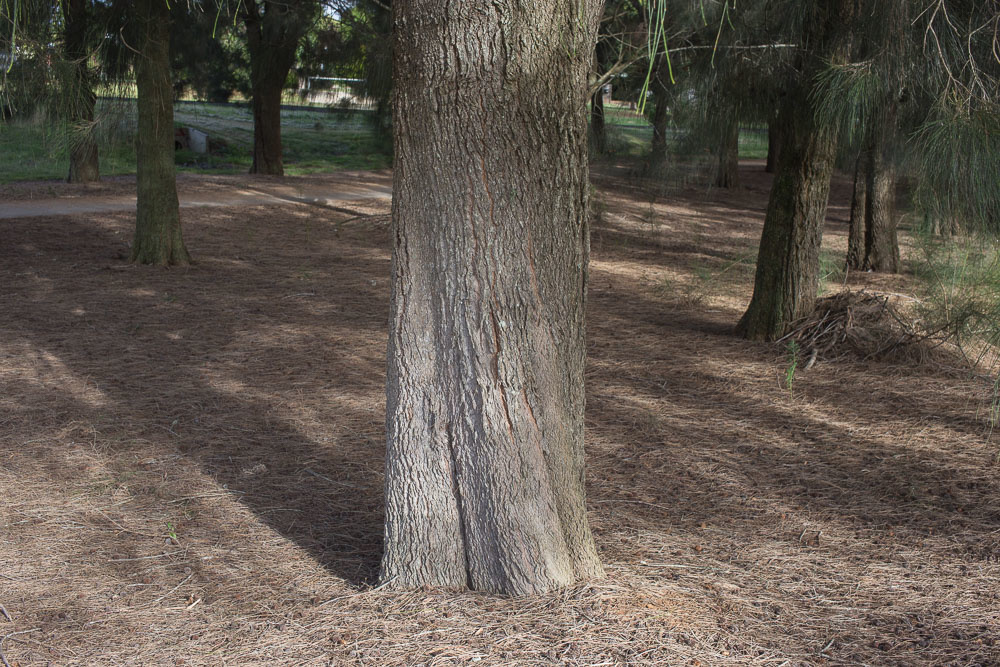
It grows at a moderate rate, reaching up to 20 m (65 ft), though it is more typically 10 to 16 m (33 to 52 ft) tall, with a single trunk that widens slightly toward the base and sometimes flutes on large trees. The bark is grey to dark brown, smooth on young trees, and becomes rough and scaly, with shallow longitudinal cracks, on mature trees.
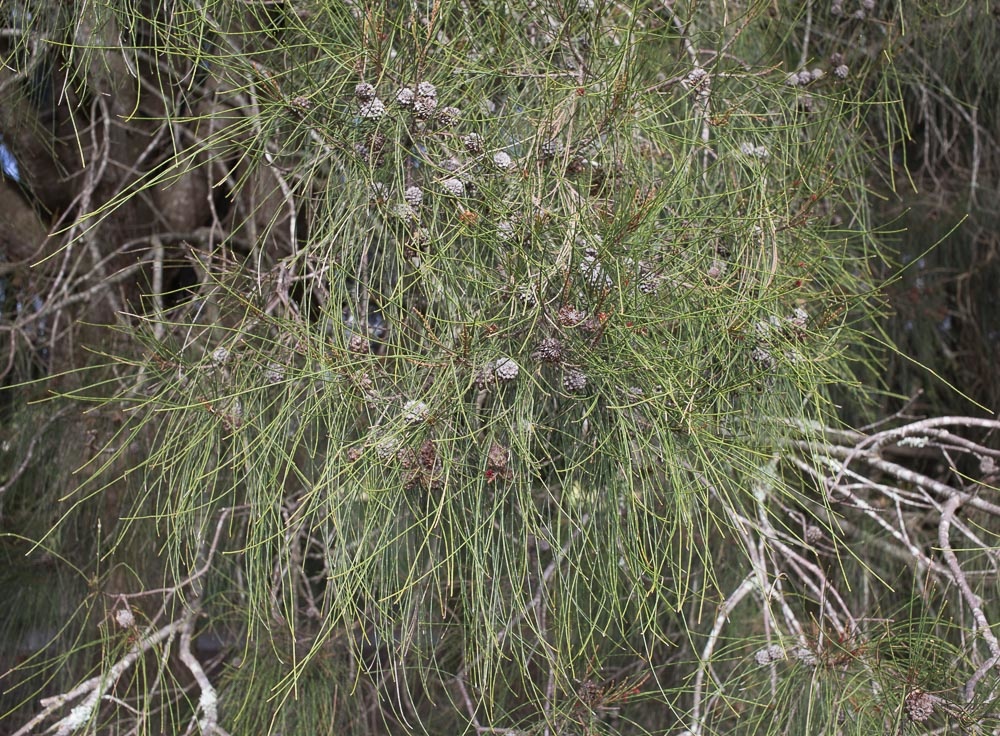
The branches start low on the trunk and are held close, forming a narrow, columnar crown with drooping, wispy, needle-thin branchlets, each up to 30 cm (1 ft) long and dull green. After two to three seasons, the tree sheds these, carpeting the ground, where they quickly become brown.
The true leaves are tooth-like, tiny and almost invisible to the naked eye, joining the segments on the thin green, needle-like branchlets.
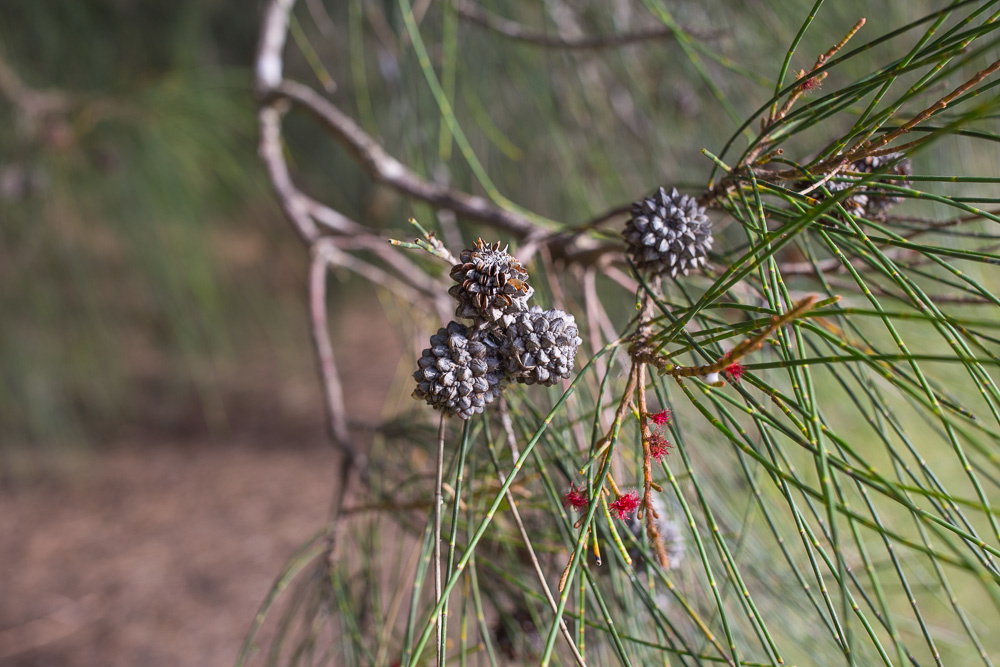
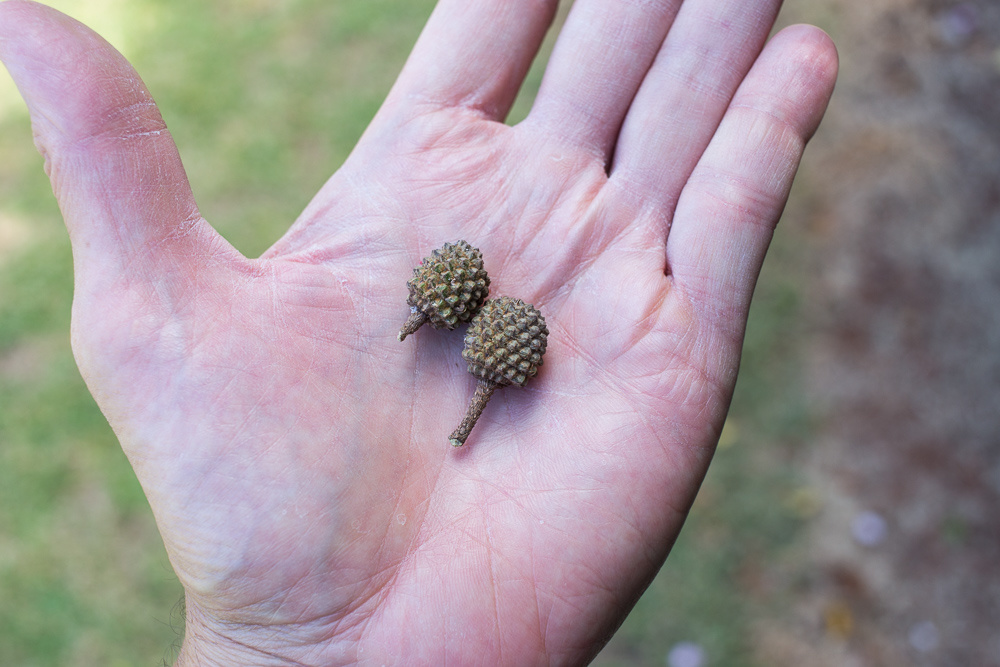
The flowers are tiny, insignificant, and light brown, with male and female flowers on separate trees. These bloom in spring and are followed on female trees by small, cylindrical grey cones with a hard, bumpy exterior and a single winged seed inside.
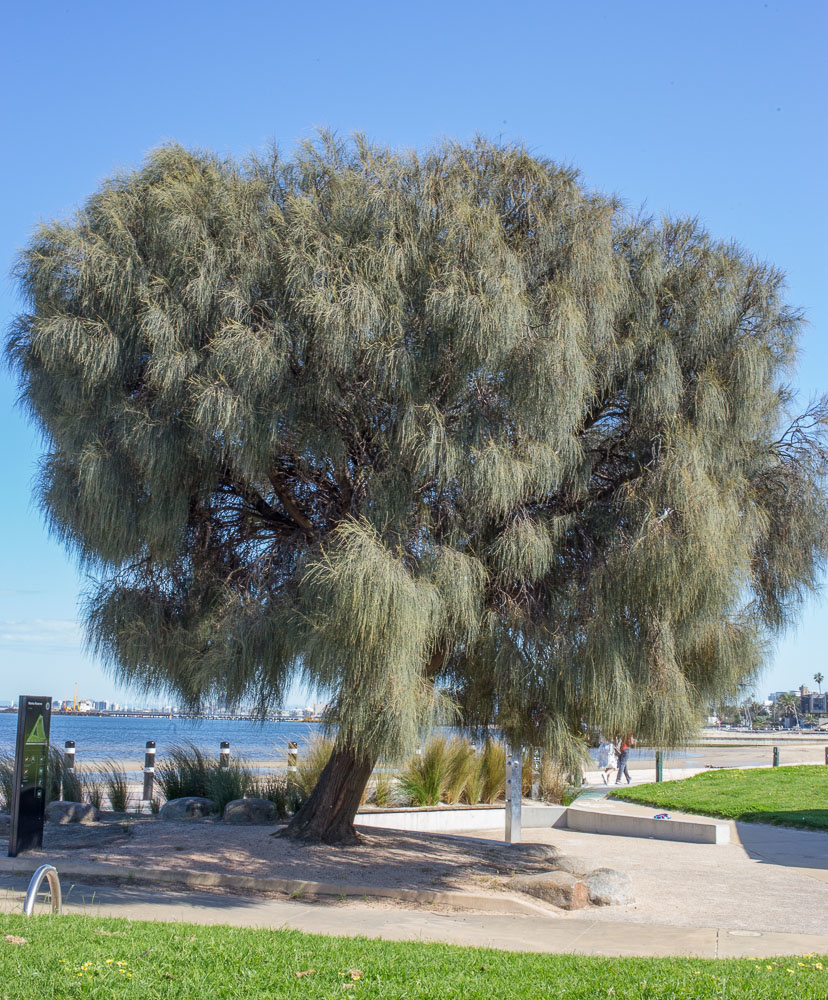
St Kilda, Australia
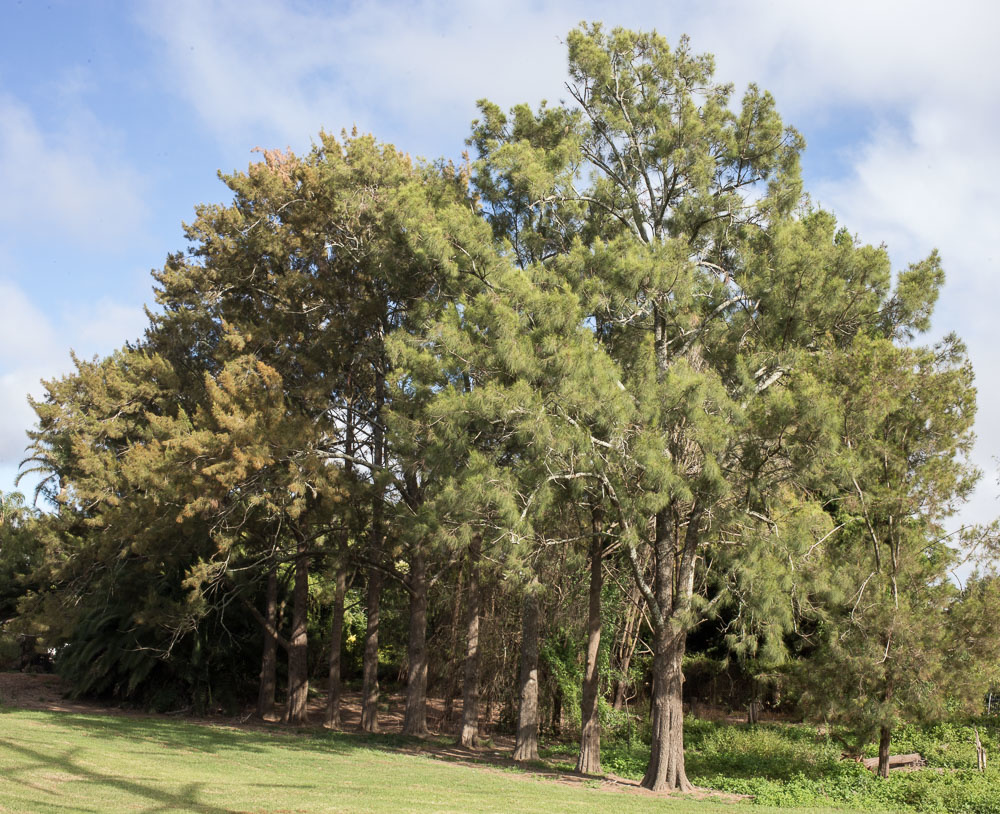
Toowoomba, Australia
Material uses
Hardwood - Averaging 960 kilograms per cubic meter (60 lbs per cubic ft), Swamp Sheoak is classed as a durable hardwood. The heartwood is a decorative chestnut brown with prominent rays.
Decay- and rot-resistant wood - It has good natural resistance to rot and decay.
Marine-resistant wood - It also resists marine-boring insects. Still, logs are rarely sawn, except for small pilings used in shallow-water marine construction.
Poles and posts - Small-diameter roundwood lengths are cut for poles and posts...
Wood turning - ...and turnery...
Tool handles - ...particularly for shaping into durable tool handles.
Firewood - It also makes excellent fuelwood for firewood...
Charcoal - ...and charcoal.
Environmental uses
Seaside garden plant - The tree tolerates seasonal flooding, saturated ground, and saline conditions, making it suitable for coastal plantings.
Erosion control - It also provides valuable coastal protection, including dune and soil stabilisation and general erosion prevention.
Land rehabilitation - It is also used for land reclamation...
Windbreak - ...and as a windbreak.
Groundcover - A low-growing, prostrate variety with a creeping, cascading habit is occasionally cultivated in gardens as groundcover...
Wall or fence cover - ...or wall cover.
Climate
Grows naturally in sub-humid to humid coastal subtropical and tropical mid-elevation climates, generally areas with annual lows of 10 to 21° C, annual highs of 19 to 29°C, annual rainfall of 900 to 3500 mm and a dry season of 6 months or less.
Growing
New plants are usually started from seed, which remain viable for many years. It tolerates permanently wet conditions and salt, growing satisfactorily in soil with salinity levels of 2.5 to 6.4 grams of dissolved salt per litre of water, about one-fifth that of seawater.
In its native range, it is found in coastal swamp and estuary environments, just behind the mangrove line. It performs well on almost all soil types, including slow- to free-draining clay, loam and sand of an acid to alkaline nature, generally with a pH of 5.0 to 8.0 and on sites with full to partial sun exposure.
Problem features
Its vigorous suckering habit can form dense stands, and seed, dispersed by wind and water, can colonise new ground fairly quickly.
Introduced into Hawaii, it has now naturalised at mid-elevations, typically in forest reserves situated above 500 meters. It is also naturalised in coastal environments in the Bahamas, particularly on Andros Island, the Berry Islands and Cat Cay.
The Hawaii Pacific Weed Risk Assessment (HPWRA) project and the IFAS Assessment of Non-Native Plants in Florida's Natural Areas assess it as a high weed risk species for Hawaii and South Florida, respectively.
Pollen released by male cones is carried on the wind and is known to cause hay fever in some people.
Where it grows
References
Books
-
Boland, D. & Brooker, I. & McDonald, M. W. 2006, Forest trees of Australia, 5th ed., CSIRO Publishing (Ensis), Melbourne
-
Chaplin, L. T. & Brandies M. M. 1998, The Florida Gardener's Book of Lists, Taylor Publishing Company, Dallas, Texas
-
Doran, J. C & Turnbull, J. W. 1997, Australian trees and shrubs : species for land rehabilitation and farm planting in the tropics, 2nd ed, Australian Centre for International Agricultural Research (ACIAR), Canberra, Australian Capital Territory
-
Little, E. L. & Skolmen, R. G. 1989, Common forest trees of Hawaii (native and introduced), Agricultuural Handbook No. 679, Forest Service, U.S. Department of Agriculture, Washington, D.C.
-
Little, E.L. Jr. 1983, Common fuelwood crops: a handbook for their identification, McClain Printing Company, Parsons, West Virginia
-
Marcar, N. E. 1995, Trees for saltland : a guide to selecting native species for Australia, Division of Forestry, Commonwealth Scientific and Industrial Research Organisation (CSIRO) Australia, Canberra
-
Nair, P. K. R. 1993, An introduction to agroforestry, International Centre for Research in Agroforestry (ICRAF), Kluwer Academic Publishers, Dordrecht
-
National Research Council (Board on Science and Technology for International Development) 1984, Casuarinas, nitrogen-fixing trees for adverse sitesNational Academy Press, Washington D.C.
-
Randall, R. P. 2002, A global compendium of weeds, R.G. and F.J. Richardson Press, Melbourne
-
Randall, R. P. 2007, The introduced flora of Australia and its weed status, Cooperative Research Centre for Australian Weed Management, Glen Osmond, South Australia
-
Streets, R. J. & Troup, R. S. 1962, Exotic forest trees in the British Commonwealth, Oxford University Press, Oxford, England
-
Webb, D. B. 1984, A Guide to species selection for tropical and sub-tropical plantations, 2nd ed., Unit of Tropical Silviculture, Commonwealth Forestry Institute, University of Oxford, Oxfordshire
Articles, Journals, Reports and Working Papers
-
Dagar, J. C. & Singh, G. 2007, Biodiversity of Saline and Waterlogged Environments: Documentation, Utilization and Management, NBA Scientific Bulletin, (9), 78.
-
Kairo, M., B. Ali, O. Cheesman, K. Haysom, and S. Murphy. 2003. Invasive species threats in the caribbean region. CAB International.
-
Morton, J.F. 1964, Honeybee Plants of South Florida, Proceedings of the Florida State Horticultural Society, Vol 77:415-436.
-
Smith, R. L. 2010. Invasive alien plant species of The Bahamas and biodiversity management. M.S. Thesis. Miami University, Oxford, OH. 122 pp