

Common name: Moreton Bay Chestnut
Other common names: Australian Chestnut, Black Bean
Description
Moreton Bay Chestnut is a timber and landscape tree originating in the Australian-Melanesian region, occurring primarily in subtropical forests on Australia's east coast and similar forest types in Papua New Guinea and Vanuatu.
It may be up to 35 m (115 ft) tall in closely spaced forests, with a straight trunk and a narrow crown, and it grows at a slow to moderate rate, depending on the growing conditions. On open sites, it is typically 10 to 20 m (30 to 60 ft) tall with a low-branching habit and a densely branched, rounded crown. The bark is grey or brown, smooth, and, with age, becomes somewhat rough.
Leaves are large, up to 45 cm (1.5 ft) long and consist of up to eight pairs of dark glossy green, oval leaflets in a feathery arrangement. They remain on the tree throughout the year.
Flowers are up to 4 cm (1.5 in) long, first yellow, become orange-red, and are borne in clusters directly on the mature branches and to a lesser extent on the trunk. However, they are hardly visible through the dense foliage. They bloom in spring and are followed by stout, lime-green seedpods 15 to 20 cm (6 to 8 in) long. Maturing in late summer to autumn, they become brown, with two to four brown-shelled, round, ping-pong-ball-sized seeds inside.
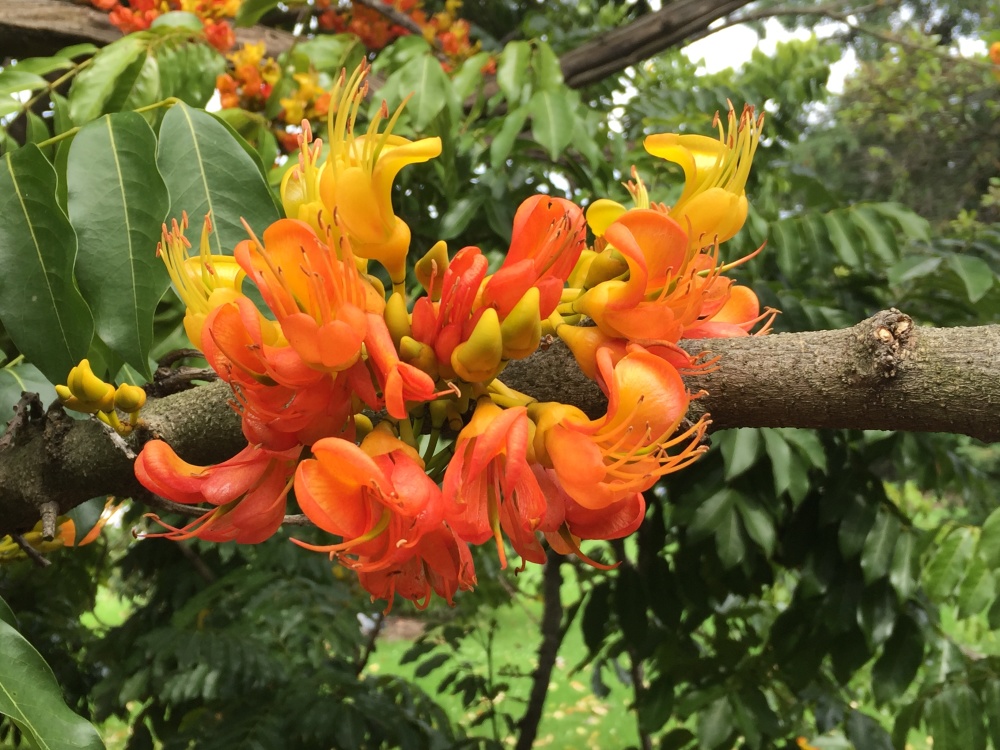
Flowers (Royal Botanic Gardens Melbourne, Australia)
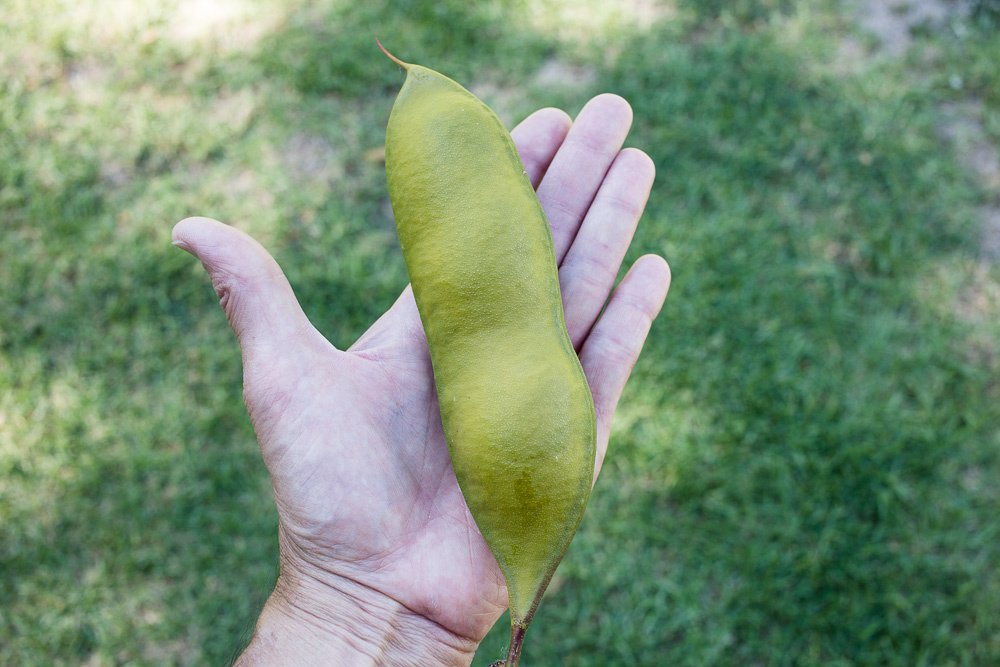
Seedpod
Environmental uses
Street tree - Moreton Bay Chestnut is cultivated as a street tree in parts of Australia for its shapely form.
Foliage ornamental - Its showy foliage enhances its ornamental appeal.
Flowering ornamental - As do its showy flowers and distinctive seedpods.
Shade tree - It is also valued for the shade it provides.
Wildlife support - The nectar-rich flowers sustain nectar-eating parrots and other wildlife in its native range.
Material uses
Hardwood - The wood is medium-weight, averaging around 750 kg per cubic metre (47 lb per cubic ft). The sapwood is cream-white, and the heartwood is attractively figured with dark chocolate-brown to nearly black streaks.
Decay- and rot-resistant wood - It has good natural resistance to rot and decay, though not to wood-boring insects.
Furniture and cabinets - Well-formed logs are sawn into boards and planks used for making fine furniture and cabinets.
Decorative veneer - Some logs are also sliced thinly for decorative veneer.
Wood turning - The smaller roundwood lengths are used for turnery.
Wood craft - And for woodcraft, including carvings.
Boxes and crates - As well as for making fancy wooden boxes.
However, it is now seldom found in carpenters' workshops due to sawdust being a strong irritant to the nasal passages.
Climate
Grows naturally in moderately humid subtropical and tropical climates, generally areas with annual lows of 10 to 23°C, annual highs of 19 to 35°C, annual rainfall of 800 to 4000 mm and a dry season of 6 months or less. However, it develops best as a timber tree in tropical lowland areas with annual rainfall of 1600 mm or more.
Growing
New plants are usually started from seed. The seedlings perform best on deep, rich, free-draining clay and loam soils of a moderately acid to neutral nature, generally with a pH 5.0 to 7.0 and on sites with full to partial sun exposure.
Problem features
Moreton Bay Chestnut is listed as a weed in at least one reference publication. However, there does not appear to be any record of it as a serious weed anywhere, despite its widespread introduction and cultivation outside its natural range, including in countries in Asia, Africa and the Pacific.
The seeds have a high saponin content, making them toxic if ingested raw. They reportedly cause death in horses, cattle and pigs and vomiting, diarrhoea and dizziness in humans. Wood sawdust is a strong irritant to the nasal passages.
Where it grows
References
Books
-
Allen, O. N. & Allen, E. K. 1981, The Leguminosae : a source book of characteristics, uses, and nodulation, University of Wisconsin Press, Madison, Wisconsin
-
Barwick, M., et al. 2004, Tropical & subtropical trees : a worldwide encyclopaedic guide, Thames and Hudson, London
-
Boland, D. & Brooker, I. & McDonald, M. W. 2006, Forest trees of Australia, 5th ed., CSIRO Publishing (Ensis), Melbourne
-
Bristow, M. & Bragg, A. & Annandale. M. 2005, Growing rainforest timber trees: a farm forestry manual for north Queensland, Research and Development Corporation (RIRDC), Barton, A.C.T, Australia
-
Francis, J. K. 1998, Tree species for planting in forest, rural, and urban areas of Puerto Rico, U.S. Department of Agriculture, Forest Service, International Institute of Tropical Forestry, Río Piedras, Puerto Rico
-
Holliday, I. 2002, A field guide to Australian trees, 3rd revised editon, New Holland Publishers, Frenchs Forest, New South Wales
-
Janick, J., & Paull, R. E. 2008, The encyclopedia of fruit & nuts, CABI Publishing, Wallingford, Oxfordshire
-
Jex-Blake, A. J. 1957, Gardening in East Africa : a practical handbook, 4th ed., Royal Kenya Horticultural Society, Longmans, Green and Company, London
-
Krishen, P. 2006, Trees of Delhi : a field guide, Dorling Kindersley Publishers, Delhi
-
Lake, M. 2015, Australian rainforest woods : characteristics, uses and identification, CSIRO Publishing, Collingwood, Victoria
-
Macmillan, H. F. 1943, Tropical planting and gardening : with special reference to Ceylon, 5th ed, Macmillan Publishing, London
-
Macoboy, Stirling 1982, Trees for flower and fragrance, Lansdowne Press, Sydney
-
Martin, F. M., et al. 1987, Perennial edible fruits of the tropics : an inventory, U.S. Dept. of Agriculture (USDA), Agricultural Research Service, U.S. Government Printing Office (GPO), Washington, D.C.
-
Morton, J. F. 1971, Exotic plants, Golden Press, New York
-
Peate, N. & Macdonald, G. & Talbot, A. 2006, Grow what where : over 3,000 Australian native plants for every situation, special use and problem area, 3rd ed., Bloomings Books, Richmond, Victoria, Australia
-
Porter, T. 2012, Wood : identification & use, Compact edition, Guild of Master Craftsman Publications, Lewes, East Sussex
-
Randall, R. P. 2002, A global compendium of weeds, R.G. and F.J. Richardson Press, Melbourne
-
Randall, R. P. 2007, The introduced flora of Australia and its weed status, Cooperative Research Centre for Australian Weed Management, Glen Osmond, South Australia
-
Wickens, G. E 1995, Edible nuts, Food and Agriculture Organization of the United Nations (FAO), Rome
Articles, Journals, Reports and Working Papers
-
Johnson, A. & Johnson, S. 2006, Garden plants poisonous to people, New South Wales Department of Primary Industries (NSW DPI), Orange, New South Wales