

Common name: Cananga
Other common names: Matches Stick Tree, Ylang ylang
Description
Cananga, or Ylang-ylang, is a flowering, essential-oil-yielding tree originating from Southeast Asia and the Pacific, with its natural range extending from the Philippines, through Indonesia and Papua New Guinea, to northern Australia, and from Vietnam through Cambodia to Thailand and Malaysia. It is now introduced in nearly all, if not all, tropical countries and is cultivated in Indonesia, the Comoros, Reunion, and Nosy Be (Madagascar) for its flowers, which are distilled to produce essential oil.
It is a fast-growing tree and in parts of its range may reach up to 40 m (130 ft) tall with a trunk diameter of 75 cm (2.5 ft). In cultivation, it is more typically 3 to 10 m (10 to 33 ft) tall with an irregular crown of long, slender, wide-spreading branches, some of which extend out so far they droop. The bark is light brown or greyish, smooth in young trees, and fissured and rough in mature trees.
The leaves are elongated-oval with a pointed tip, up to 20 cm (8 in) long, dark, glossy green on top and pale, dull green underneath, and prominently ribbed on top. They remain on the tree in all seasons and are alternately arranged along slender branches that extend up to 6 m (20 ft), causing them to droop under their own weight.
The flowers are large, composed of six slender petals up to 13 cm (5 in) long, green and twisted when young, becoming yellow, limp, and drooping when mature. They are borne in profusion, in clusters of four to twelve arising at the leaf bases and come into bloom in the rainy season but may bloom continuously in areas without a distinct dry season. When mature, they are overpoweringly sweetly fragrant, reminding one of Arabian jasmine (Jasminum sambac) and Royal jasmine (Jasminum grandiflorum).
The fruits are oval, up to 2.5 cm (1 in) long, green when young, becoming blackish when ripe and are berry-like, with up to twelve small seeds embedded in yellow pulp.
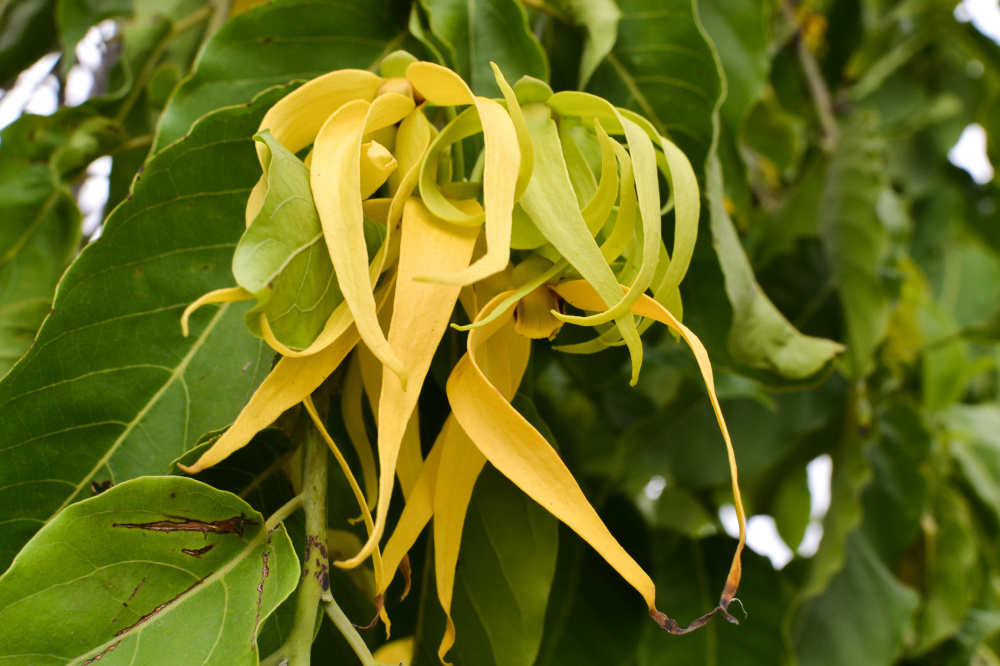
Flower
Material uses
Essential oil - The flowers yield a sweetly fragrant essential oil traded as 'Ylang ylang oil' or 'Cananga oil', extracted by steam distillation or solvent extraction.
Steam distillation is the most common method, yielding 1 to 2% free-flowing, yellow-to-orange-yellow oil with an intensely sweet, floral, slightly woody aroma.
Solvent extraction is much less common and involves using a volatile solvent such as hexane. This produces a fragrant, wax-like substance known as an essence concrète, which is then washed with alcohol and concentrated into essential oil. Solvent extraction is more technical and expensive than steam distillation but yields a purer oil known as an absolute.
Natural fragrance - The essential oil and absolute are used extensively as a fragrance component in high-end perfumes, particularly of the floral type, such as 'Red Door' by Elizabeth Arden, 'Ysatis' by Givenchy and 'Chanel No. 5' by Chanel, as well as in men's fragrances, toiletry goods and cosmetics, including soaps, creams and lotions, and to some extent detergents.
Softwood - The wood is soft and lightweight, averaging about 290 kg per cubic meter (18 lb per cubic ft), and has low natural resistance to rot and decay, making it unsuitable for most uses.
Plant fibre pulp - However, it can be pulped for paper.
Manufactured wood - It can also be pulped for fibreboard.
Edible uses
Natural flavouring - Both the essential oil and absolute are also widely used as flavourings in alcoholic and non-alcoholic beverages, including colas and other fizzy drinks, as well as dairy desserts, soft confectionery, chewing gum, and baked goods.
Health uses
Aromatherapy oil - The essential oil has a sedative or calming effect and is used in aromatherapy to reduce heart rate and blood pressure.
Climate
Grows naturally in moderately humid to very humid subtropical and tropical lowland to mid-elevation climates, generally in areas with annual lows of 16 to 25°C, annual highs of 26 to 35°C, annual rainfall of 1200 to 6000 mm and a dry season of 5 months or less, extending to 7 months with irrigation or groundwater.
Essential oil production is concentrated in humid tropical areas with a dry season of 2 months or less, as trees there tend to flower heavily year-round, enabling continuous essential oil extraction.
Growing
New plants are usually started from seed, which germinate erratically. Germination is improved by first storing the seed under dry conditions for six to twelve months, then soaking them in hot water before sowing. Because the seeds are tiny, they are collected by washing the pulp of mature fruit through a sieve under running water, then air-drying and storing them.
The treated seeds are then sown in deep containers with a free-draining potting mix and tended in a nursery until they are about 50 cm (1.6 ft) tall, after which they are planted out. Care is taken when transplanting to avoid damaging the long taproot.
Performs best on deep, rich, free-draining clay, loam and sand soils of a moderately acid to moderately alkaline nature, generally with a pH of 5.0 to 8.0, and on sites with full to partial sun exposure.
Cananga trees tolerate seasonal flooding well but are intolerant of strong winds because their wood is brittle.
Under ideal conditions, a mature tree produces about 20 kg (44 lbs) of fresh flowers per year and, with an average oil content of 1.5%, yields 300 grams (10.6 ounces) of essential oil.
Problem features
Birds, bats and small animals are known to eat the fruit and disperse the seed. It is recorded as naturalised and as a weed in more than one country, but there does not appear to be any record of it anywhere as a serious weed. The Hawaii Pacific Weed Risk Assessment (HPWRA) project assesses it as a low weed-risk species for Hawaii.
The wood is brittle, causing branches to break off in strong winds and fall to the ground, potentially causing personal injury or property damage.
Where it grows
References
Books
-
Adams, C. D. 1972, Flowering plants of Jamaica, University of the West Indies, Mona, Greater Kingston
-
Arctander, S. 1960, Perfume and flavor materials of natural origin, Elizabeth, New Jersey
-
Ashton, M.S. 1997, A field guide to the common trees and shrubs of Sri Lanka, Wildlife Heritage Trust of Sri Lanka, WHT Publications (Pvt.) Ltd., Colombo
-
Barwick, M., et al. 2004, Tropical & subtropical trees : a worldwide encyclopaedic guide, Thames and Hudson, London
-
Brady, G. S. & Clauser, H. R & Vaccari, J. A. 2002, Materials handbook : an encyclopedia for managers, technical professionals, purchasing and production managers, technicians and supervisors, 15th ed., McGraw-Hill, New York
-
Chaplin, L. T. & Brandies M. M. 1998, The Florida Gardener's Book of Lists, Taylor Publishing Company, Dallas, Texas
-
Chevallier, A. 2000, Encyclopedia of herbal medicine, 2nd American ed., Dorling Kindersley, New York
-
Dastur, J. F. 1964, Useful plants of India and Pakistan : a popular handbook of trees and plants of industrial, economic, and commercial utility, 2nd ed., D. B. Taraporevala Sons, Bombay
-
Elevitch, C. R. 2006, Traditional trees of Pacific Islands: their culture, environment and use, 1st edition, Permanent Agriculture Resources, Holualoa, Hawaii
-
Francis, J. K. and Liogier, H. A. 1991, Naturalized exotic tree species in Puerto Rico, General technical report SO-82, USDA Forest Service, Southern Forest Experiment Station, New Orleans
-
Genders, R. 1978, Scented flora of the world, Robert Hale Publishing, London & St. Martin's Press, New York
-
Groom, N. 1997, The new perfume handbook, 2nd ed., Blackie Academic & Professional, London
-
Hill, A. F. 1952, Economic botany : a textbook of useful plants and plant products, 2nd ed, McGraw-Hill, New York
-
Holttum, R. E. & Enoch, I. C. 2010, Gardening in the tropics : the definitive guide for gardeners, Marshall Cavendish Editions, Singapore
-
Jones, M. 2011, The complete guide to creating oils, soaps, creams, and herbal gels for your mind and body : 101 natural body care recipes, Atlantic Publishing Group, Ocala, Florida
-
Khan, I. A. & Abourashed, E. A. 2010, Leung's encyclopedia of common natural ingredients : used in food, drugs and cosmetics, 3rd edition, Wiley Publishing, Hoboken, New Jersey
-
Kraemer, J. H. 1945, Native woods for construction purposes in the South China Sea region, Bureau of Yards and Docks, United States Navy Department, Washington D.C.
-
Little, E. L. et al. 1964 and 1974, Common trees of Puerto Rico and the Virgin Islands (2 volumes), Forest Service, U.S. Department of Agriculture (USDA), Washington D.C.
-
Macmillan, H. F. 1943, Tropical planting and gardening : with special reference to Ceylon, 5th ed, Macmillan Publishing, London
-
Morton, J. F. 1971, Exotic plants, Golden Press, New York
-
Oyen, L. P. A. & Nguyen X. D. 1999, Plant Resources of South-East Asia (PROSEA) 19 : Essential-oil plants, Backhuys Publishers, Leiden
-
Parrotta, J. A. 2001, Healing plants of peninsular India, CABI Publishing, Wallingford, Oxfordshire
-
Randall, R. P. 2002, A global compendium of weeds, R.G. and F.J. Richardson Press, Melbourne
-
Reyes, G. 1992, Wood densities of tropical tree species, U.S. Department of Agriculture, Forest Service, Southern Forest Experiment Station, New Orleans, Louisiana
-
Roecklein, J. C & Leung, P.S. 1987, A Profile of economic plants, Transaction Books, New Brunswick, New Jersey
-
Seidemann, J. 2005, World spice plants: economic usage botany taxonomy, Springer-Verlag, Berlin
-
Weiss, E. A. 1997, Essential oil crops, CABI Publishing, Wallingford, Oxfordshire
-
Winter, R. 2009, A consumer's dictionary of cosmetic ingredients : complete information about the harmful and desirable ingredients found in cosmetics and cosmeceuticals, 7th ed, Three Rivers Press, New York