

Common name: Red Birch
Other common names: Turpentine Tree, Tourist Tree, West Indian Birch
Description
Red Birch is a fast-growing, resin-yielding landscape tree native to tropical America, with a natural range extending from South Florida through Central America and the Caribbean to northern South America.
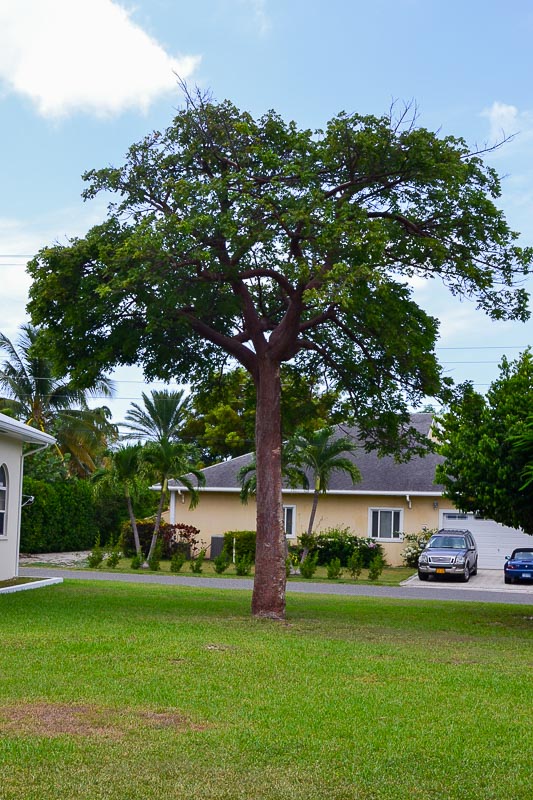
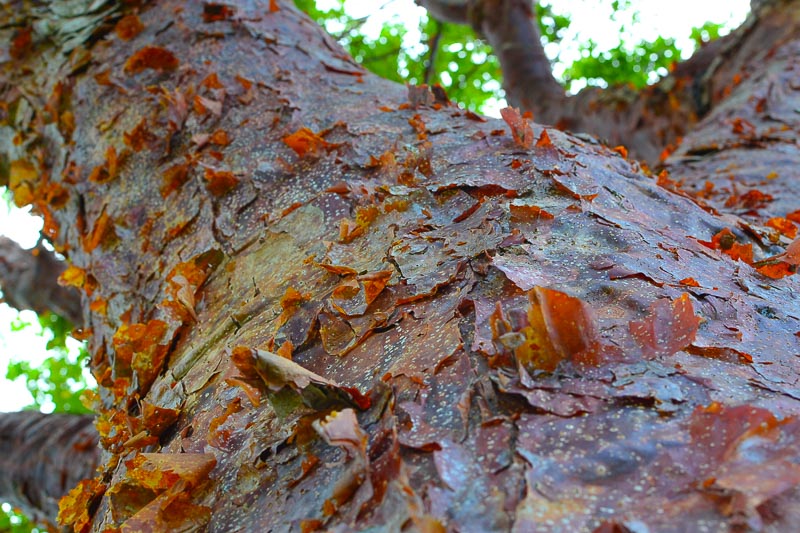
It is typically a medium-sized tree 10 to 15 m (30 to 50 ft) tall, though it may reach up to 30 m (100 ft) in natural forests. On open sites, it develops a straight, uniform trunk supporting a rounded crown, sometimes with wildly curving and twisting branches. Its most distinguishing feature is lustrous copper-coloured bark that cracks and peels off in thin, near-translucent flakes.
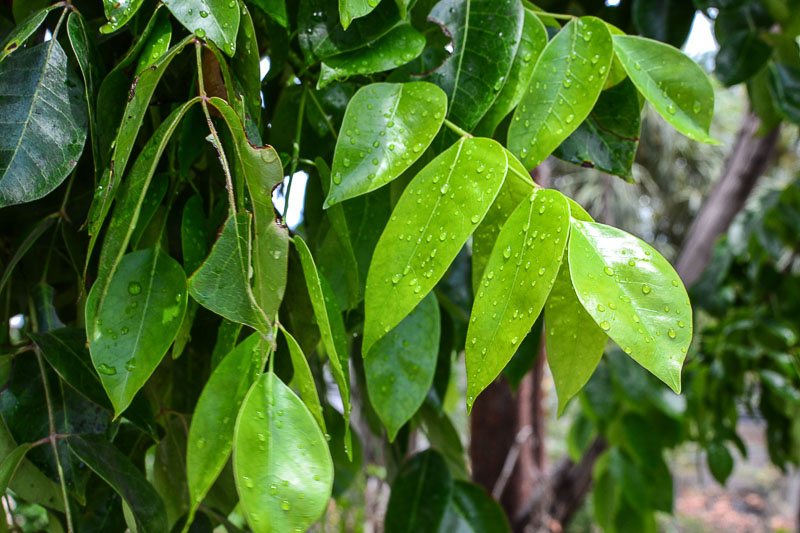
The leaves are compound, with three to nine oval leaflets up to 7.5 cm (3 in) long, arranged in pairs along the leaf, with an extra leaflet at the tip. In the dry season, they fall off the tree to conserve water, leaving the branches bare and exposed. New leaflets emerge glossy lime-green, then gradually age to dark green. A stem-succulent tree, Red birch also conserves water by storing it in its stems.
Flowers are small, pale green-white and bloom in loose clusters around the same time as the new leaves develop. They also bloom on and off throughout the year in irrigated landscapes. It is dioecious, with female and male flowers borne on separate trees.
The fruit is a small, three-sided green berry that becomes pink-red when ripe, usually eight to ten months after flowering ends.
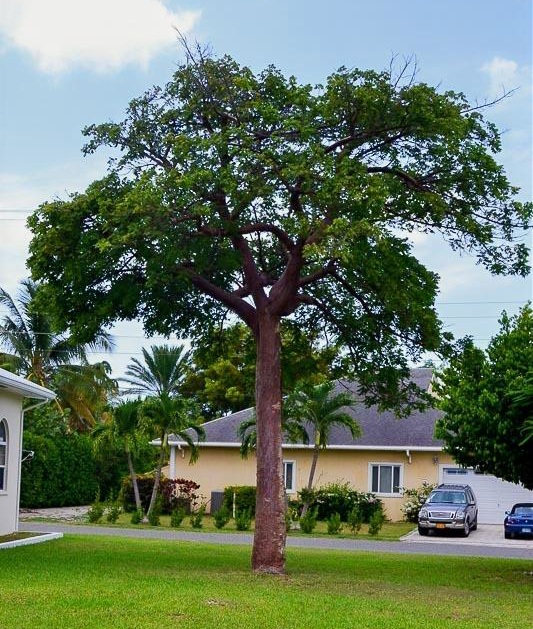
Grand Cayman (Cayman Islands)
Material uses
The wood is lightweight, in the 300 to 400 kg per cubic meter (19 to 25 lbs per cubic ft) range and has low natural resistance to decay and termites. This places it in the non-durable softwood category, with limited suitability for building and construction. It also has a high moisture content.
Manufactured wood - Its main uses include making plywood,
Boxes, crates and pallets - ...boxes, crates, and pallets,
Wood craft and wares - ...as well as matchsticks and toothpicks.
Firewood - When properly dried, it can be cut into firewood, though it is not an ideal wood for this purpose.
Charcoal - It can also be used to make charcoal, though again it is not an ideal wood for this purpose.
Natural resin - The bark, on wounding, yields a balsam resin that, if left to ooze, hardens on the trunk over time and can be collected. Both the resin and crushed leaves have a strong turpentine odour.
Natural varnish - In its unhardened form, used as a crude varnish.
Natural adhesive - Also used as glue for mending broken pottery.
Health uses
Natural incense - In its hardened form, the resin has long been used as incense in rituals.
General interest
Red Birch is closely related to the Linaloe tree (Bursera linanoe), a commercially important tree native to Mexico.
Climate
Grows naturally in seasonally dry, sub-humid to moderately humid subtropical and tropical climates, generally frost-free areas with annual lows of 17 to 25°C, annual highs of 27 to 36°C, annual rainfall of 500 to 1600 mm and a dry season of 3 to 8 months.
In Jamaica, Red birch trees occur mainly in coastal areas, with the occasional tree at higher elevations up to 700 m (2300 ft)—areas where the average low in the warmest month is 19°C (66°F) or above.
Growing
New plants are started from seed or cuttings, which are quick to take root.
Performs well on free-draining clay-loam, loam, sandy loam, loamy sand, and limestone or high-calcareous soils of a moderately acid to alkaline nature, generally with a pH of 5.5 to 8.5, and on sites with full to partial sun exposure. Being a stem succulent species, it has good tolerance of drought conditions and is moderately tolerant of salt spray.
Problem features
Birds and small animals eat the fruit and disperse the seed. However, there does not appear to be any record of its escape and naturalisation anywhere, despite its widespread cultivation as an ornamental.
Mature trees produce surface roots, which can be a problem if planted near paved structures, such as paved walkways.
Reports of its wind tolerance are conflicting, ranging from high to low breakage resistance, possibly due to seasonal changes in wood moisture content.
Where it grows
References
Books
-
Adams, C. D. 1972, Flowering plants of Jamaica, University of the West Indies, Mona, Greater Kingston
-
Barwick, M., et al. 2004, Tropical & subtropical trees : a worldwide encyclopaedic guide, Thames and Hudson, London
-
Berni, C. A & Bolza, E. & Christensen, F. J. 1979, South American timbers - the characteristics, properties and uses of 190 species, Commonwealth Scientific and Industrial Research Organization (CSIRO), Division of Building Research, Highett, Victoria, Australia
-
Burns R.M., Mosquera M.S. & Whitmone J.L. 1998, Useful trees of the tropical region of North America, North American Forestry Commission Publication (Number 3), Washington D.C.
-
Chudnoff, M. 1984, Tropical timbers of the world, Forest Service, U.S. Department of Agriculture (USDA), Washington, D.C.
-
Fawcett, W. 1891, Economic plants, An index to economic products of the vegetable kingdom in Jamaica, Jamaica Government Printing Establishment, Kingston
-
Florida Department of Environmental Protection 2010, The Florida-Friendly Landscaping Guide to Plant Selection & Landscape Design, 1st ed., University of Florida
-
Francis, J. K. et al. 2000, Silvics of Native and Exotic Trees of Puerto Rico and the Caribbean Islands, Technical Report IITF-15, USDA Forest Service, Rio Piedras, Puerto Rico
-
Gilman, E. F. 1997, Trees for urban and suburban landscapes, Delmar Publishers, Albany, New York
-
Howes, F. N. 1949, Vegetable gums and resins, Chronica Botanica Company, Waltham, Massachusetts
-
Longwood, F. R. 1962, Present and potential commercial timbers of the Caribbean: with special reference to the West Indies, the Guianas, and British Honduras, U.S. Dept. of Agriculture Forest Service, Washington, D.C.
-
Macmillan, H. F. 1943, Tropical planting and gardening : with special reference to Ceylon, 5th ed, Macmillan Publishing, London
-
National Research Council (Board on Science and Technology for International Development) 1983, Firewood crops : shrub and tree species for energy production (Volume 2), The National Academies Press, Washington D. C.
-
Randall, R. P. 2007, The introduced flora of Australia and its weed status, Cooperative Research Centre for Australian Weed Management, Glen Osmond, South Australia
-
Record, S. J. & Hess, R. W., 1972, Timbers of the New World, Yale University Press, New Haven, Connecticut & Arno Press, New York
-
Reyes, G. 1992, Wood densities of tropical tree species, U.S. Department of Agriculture, Forest Service, Southern Forest Experiment Station, New Orleans, Louisiana
-
Scheffer, T. C & Morrell, J. J. 1998, Natural durability of wood : a worldwide checklist of species, Forest Research Laboratory, Oregon State University, Corvallis, Oregon
-
Schubert, T. H. 1979, Trees for urban use in Puerto Rico and the Virgin Islands. U.S. Department of Agriculture, Forest Service, Southern Forest Experiment Station, New Orleans
-
Vázquez, Y. C. 1999, Potentially valuable Mexican trees for ecological restoration and reforestation, Institute of Ecology, Database SNIB-REMIB-CONABIO, Project J084, Mexico
-
Vozzo, J. A 2002, Tropical tree seed manual, U.S. Department of Agriculture (USDA), Forest Service, Washington D.C.
Articles, Journals, Reports and Working Papers
-
Borchert, R., & Rivera, G. 2001, Photoperiodic control of seasonal development and dormancy in tropical stem-succulent trees, Tree Physiology 21.4 (2001): 213-221.
-
Meerow, A.W. 1996, Native Trees for South Florida, University of Florida-IFAS Publication EES-57, Gainesville
-
Morton, J.F. 1964, Honeybee Plants of South Florida, Proceedings of the Florida State Horticultural Society, Vol 77:415-436.