

Common name: Palmyra Palm
Other common names: Doub Palm, Great Fan Palm, Lontar Palm, Tala Palm, Tal Palm, Toddy Palm, Wine Palm
Description
Originating across India, Southeast Asia, and the Pacific, the Palmyra Palm is cultivated for its sweet sap and coconut-like fruit.
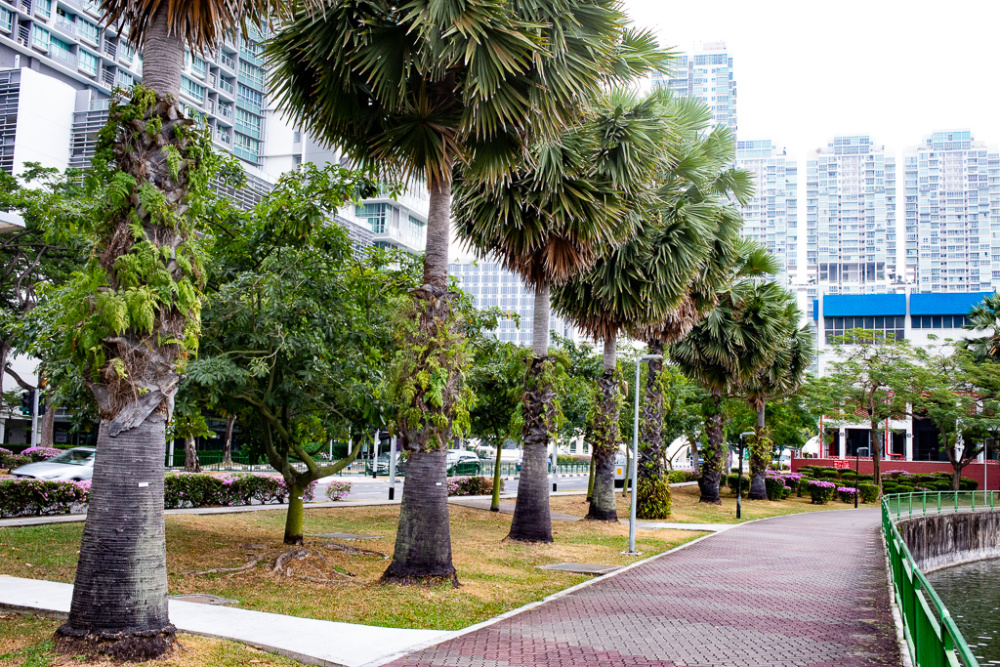
Individual palms may be up to 30 m (100 ft) tall. However, they are typically 15-20 m (50-65 ft) tall and have a tall-palm shape, with a long, slim trunk of ringed grey bark and a compact, rounded crown of green, fan-shaped leaves.
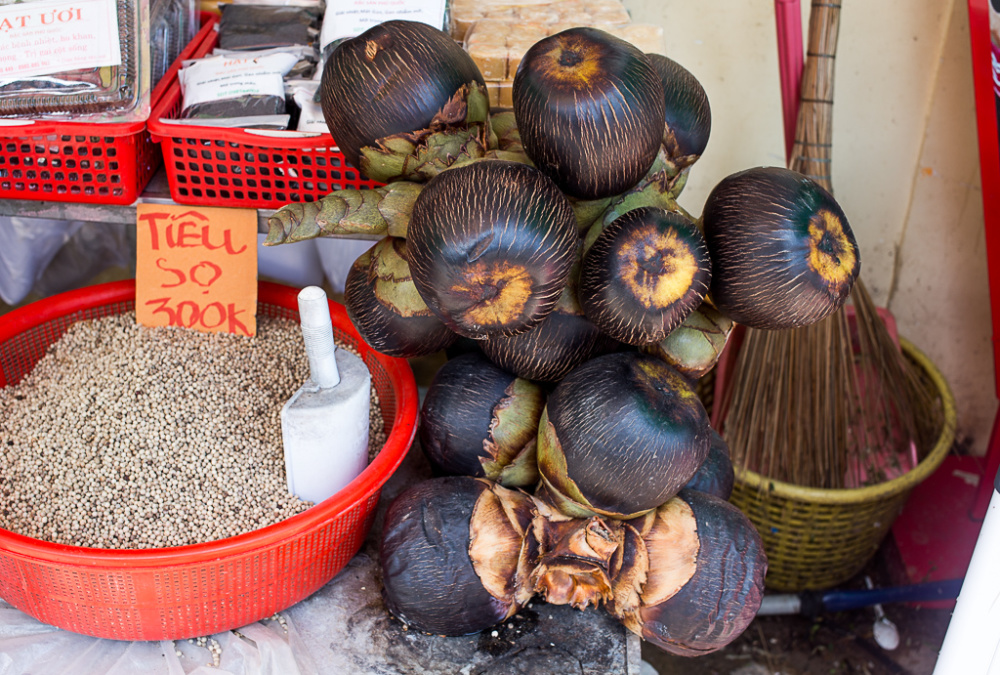
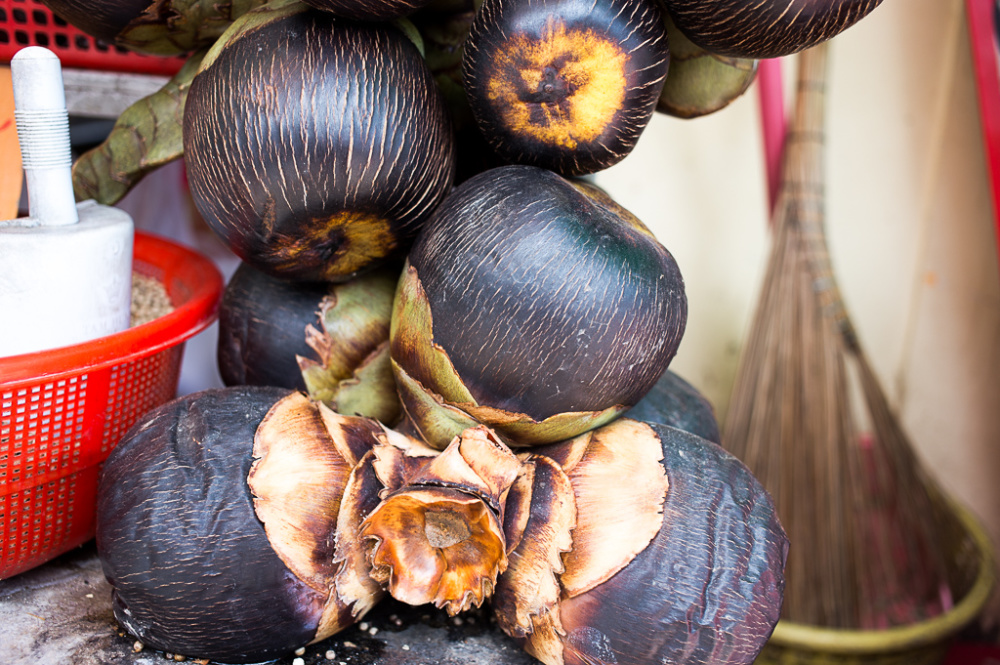
The flowers are small or insignificant, greenish-yellow and borne in pendant clusters with female and male flowers on separate individuals. They are followed on female palms by coconut-like fruit that mature to the size of a small coconut (Cocos nucifera). More rounded than a coconut, they also have different colouration: two-toned, with a small green cap on the part closest to the stem and the rest grey-brown to dark black-brown.

Edible uses
Sap tapped from the inflorescence at the top of the palm is used to produce several products. Tapping begins when the palm starts to flower, at around fifteen years of age, and continues for four to five months each year until the end of its useful life. Individual palms yield between five and ten litres of sap per day, with female palms typically yielding about fifty per cent more sap than male palms.
Natural sweetener - The sap is boiled and reduced to produce palm sugar, a crystallised sugar commonly used as a sweetener in India, Sri Lanka and Southeast Asia.
Plant-based vinegar - The sap is also fermented to make palm vinegar.
Alcoholic drink - Also fermented to make toddy, a widely consumed alcoholic beverage.
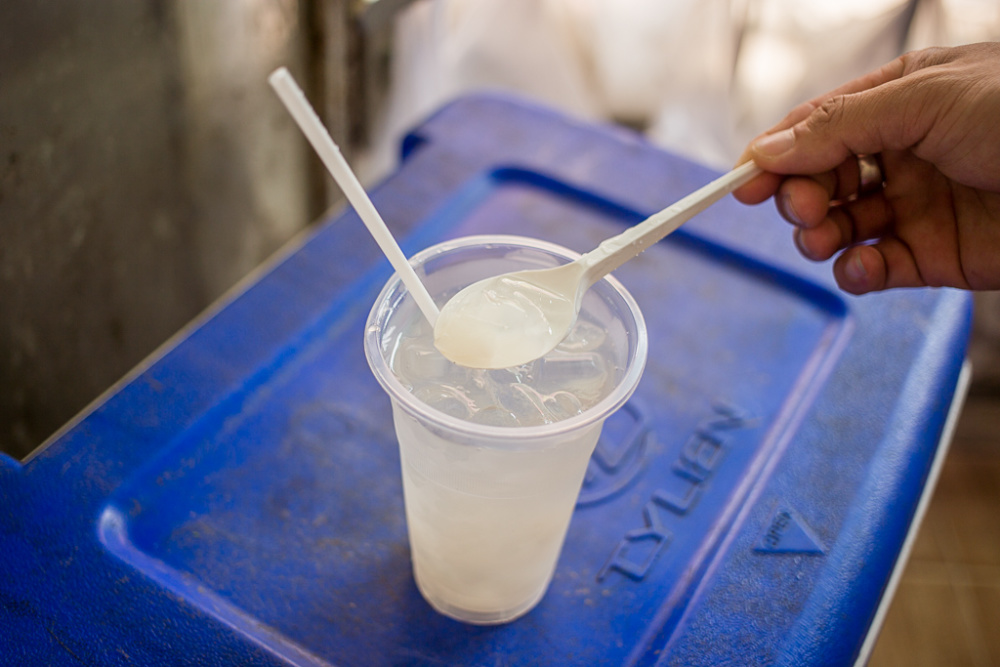
Fresh fruit - The immature fruit contains up to three translucent, jelly-like kernels that contain sweetish water. These are mostly eaten fresh, usually in a drink with ice, and are typical street food fare in Southeast Asia.
Material uses
Timber and lumber - Wood sawn from the trunk is known as 'Black Palm wood', a heavy wood averaging about 900 kg per cubic meter (56 lbs per cubic ft), with attractive light and dark brown streaking. Its durability varies considerably, depending on the part of the trunk from which it is taken, ranging from low to high natural resistance to rot and decay.
Furniture and cabinets - Used for making furniture.
Flooring and decking - Also used for flooring.
Wood turning - Also used for turnery, especially for making walking sticks.
Tool handles - Also used for knife and tool handles.
Woven craft - The leaves are used in crafts, usually woven ones, especially baskets, bags, and hats.
Broom or brush - Fibre stripped from the leaf base makes good bristles and is used to manufacture brooms and brushes.
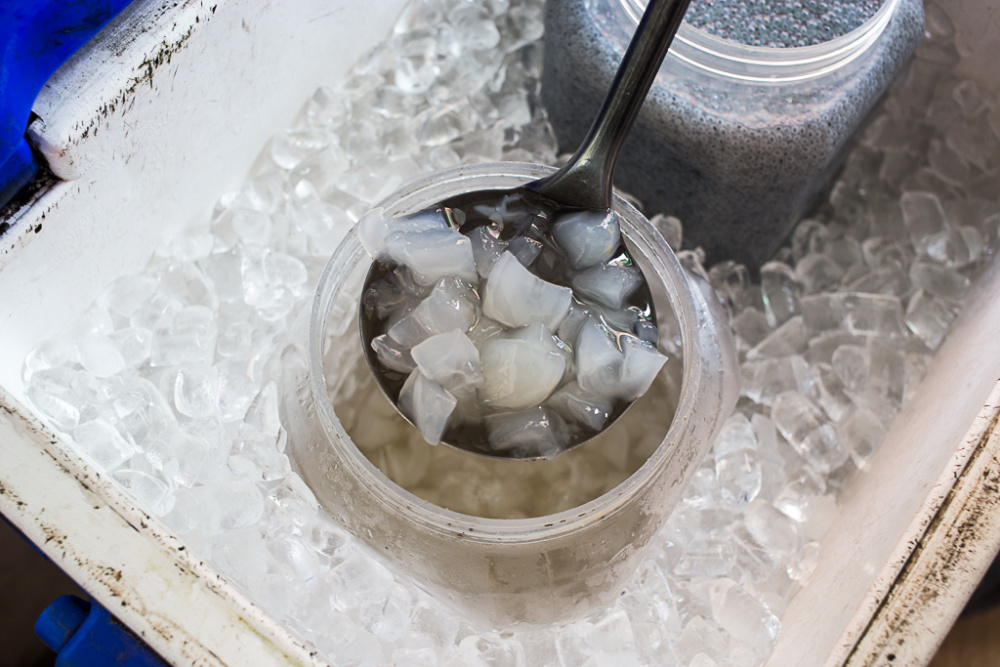
Cubes of Plamyra fruit jelly kept chilled on ice (Vietnam)
Climate
Plamyra palm grows naturally and is productive in moderately humid subtropical and tropical climates, generally areas with annual lows of 18 to 25°C, annual highs of 27 to 36°C, annual rainfall of 700 to 4000 mm and a dry season of 3 to 8 months.
Growing
New plants are usually started from seed, with both male and female plants needed to produce fruit and set seed. It performs best in free-draining clay, loam, and sand soils that are slightly acid to slightly alkaline, generally with a pH of 6.5 to 7.5, and in sites with full sun exposure. Once established, it tolerates drought, seasonal flooding, salinity, and generally poor soils, but is intolerant of permanently wet or waterlogged soils.
Problem features
There do not appear to be any records of it escaping cultivation and naturalising anywhere, despite its cultivation outside its native range. The Hawaii Pacific Weed Risk Assessment (HPWRA) project assesses it as a low weed risk species for Hawaii.
Male plants release wind-blown pollen that can cause severe hay fever in some people.
Where it grows
References
Books
-
Dastur, J. F. 1964, Useful plants of India and Pakistan : a popular handbook of trees and plants of industrial, economic, and commercial utility, 2nd ed., D. B. Taraporevala Sons, Bombay
-
Food and Agriculture Organization of the United Nations (FAO) 1988, Traditional food plants : a resource book for promoting the exploitation and consumption of food plants in arid, semi-arid and sub-humid lands of eastern Africa, Food and Nutrition Paper No. 42, Rome
-
Gohl, B. 1981, Tropical Feeds : feed information summaries and nutritive values (Revised edition), Food and Agriculture Organization of the United Nations (FAO), Rome
-
Hocking, D. 1993, Trees for drylands, International Science Publisher, New York
-
Howes, F. N. 1949, Vegetable gums and resins, Chronica Botanica Company, Waltham, Massachusetts
-
Jacquat, C. & Bertossa, G. 1990, Plants from the markets of Thailand : descriptions and uses of 241 wild and cultivated plants, with 341 colour photographs, Editions Duang Kamol, Bangkok
-
Janick, J., & Paull, R. E. 2008, The encyclopedia of fruit & nuts, CABI Publishing, Wallingford, Oxfordshire
-
Jensen, M. 1999, Trees commonly cultivated in Southeast Asia : an illustrated field guide, 2nd ed., Food and Agricultural Organisation of the United Nations (FAO) Regional Office for Asia and the Pacific (RAP), Bangkok
-
Johnson, D.V. & Food and Agriculture Organization of the United Nations (FAO) 2011, Tropical palms (2010 revision), FAO, United Nations, Rome
-
Krishen, P. 2006, Trees of Delhi : a field guide, Dorling Kindersley Publishers, Delhi
-
Macmillan, H. F. 1943, Tropical planting and gardening : with special reference to Ceylon, 5th ed, Macmillan Publishing, London
-
Martin, F. M., et al. 1987, Perennial edible fruits of the tropics : an inventory, U.S. Dept. of Agriculture (USDA), Agricultural Research Service, U.S. Government Printing Office (GPO), Washington, D.C.
-
Purseglove, J. W. 1981, Tropical crops: Monocotyledons, Longman, Harlow, London
-
Randall, R. P. 2002, A global compendium of weeds, R.G. and F.J. Richardson Press, Melbourne
-
Scheffer, T. C & Morrell, J. J. 1998, Natural durability of wood : a worldwide checklist of species, Forest Research Laboratory, Oregon State University, Corvallis, Oregon
-
Withington, D. 1988, Multipurpose tree species for small-farm use: proceedings of an international workshop held November 2-5, 1987, in Pattaya, Thailand. Arlington, Va, Winrock International Institute for Agricultural Development, USA
Articles, Journals, Reports and Working Papers
-
Cunningham, A. B & Australian Centre for International Agricultural Research 2011, Hidden economies, future options trade in non-timber forest products in eastern Indonesia, Australian Centre for International Agricultural Research, Canberra
-
Dagar, J. C. & Singh, G. 2007, Biodiversity of Saline and Waterlogged Environments: Documentation, Utilization and Management, NBA Scientific Bulletin, (9), 78.
-
Seth, M.K 2003-10-01, 'Trees and their economic importance' The Botanical Review, vol. 69, no. 4, pp. 321(56).
-
Wong M. 2006. Palms for Hawaii landscapes, (Landscape; L-19), University of Hawaii, Honolulu