

Description
Tallowwood is a eucalyptus tree and timber resource originating in Australia, where it occurs in the continent's east, in subtropical coastal forests extending from near Newcastle in New South Wales to Maryborough in Queensland.
In natural forests, it may grow into a large tree, reaching heights of up to 70 meters (230 ft) and a trunk diameter approaching 3 meters (10 ft). On open sites, it is typically about a third that size and is a handsome tree, usually with a straight, round trunk clear of branches for up to half the tree's height, supporting a large, rounded crown of gently weeping foliage. The bark is dark brown, smooth on young trees, and thick, furrowed, rough, and strappy on mature trees, exposing orange underbark where it has stripped off.
The leaves and flowers are typical of Eucalyptus species. The leaves are up to 13 cm (5 in) long, narrow, slightly curved or straight, tapering to a fine point and dull green. They persist on the tree in all seasons, in a dense arrangement that casts a deep shade.
The flowers are small, with erect creamy-white filaments, blooming from late winter to early summer. Fertilised flowers are followed by small goblet-shaped seed capsules containing tiny brown, oval seeds.
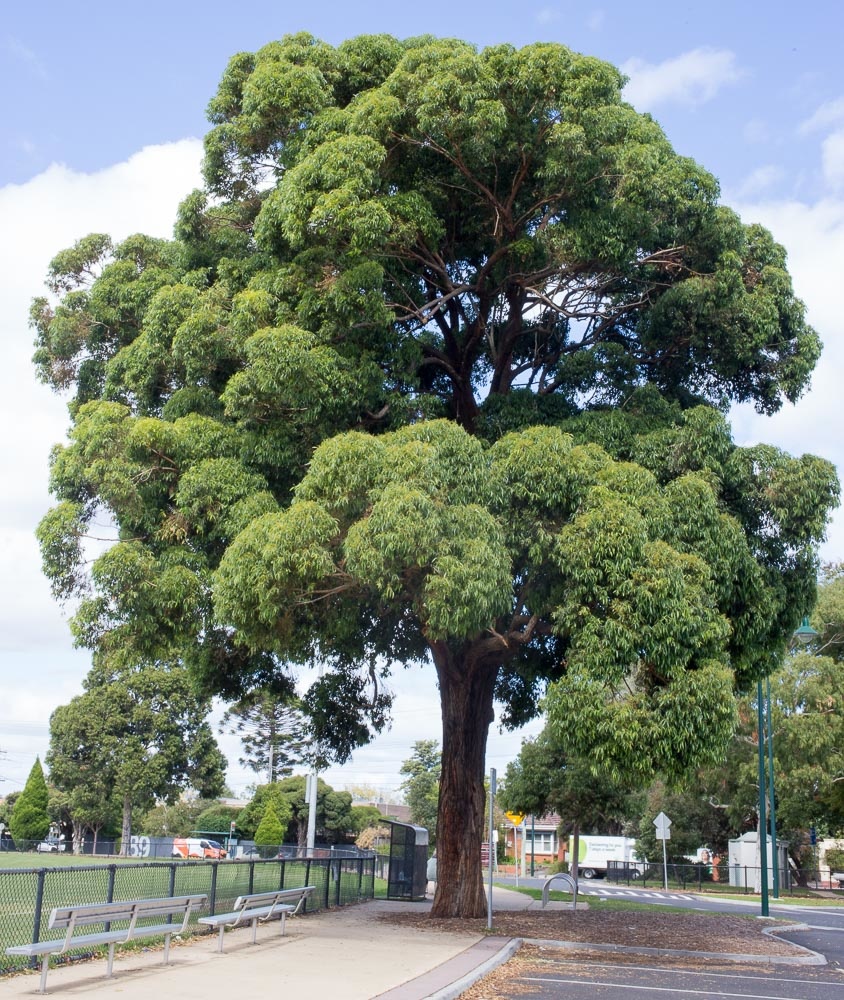
Carnegie, Victoria, Australia
Material uses
Hardwood - Tallowwood is one of Australia's premier timber trees. It produces a hard, heavy wood, averaging 1000 kilograms per cubic metre (62 lb per cubic ft)...
Decay- and rot-resistant wood - ...with high natural resistance to rot and decay, making it suitable for indoor and outdoor construction use.
Termite-resistant wood - It also has high natural resistance to wood-boring insects.
Timber and lumber - The heartwood is pale to dark yellow-brown, attractively streaked and lustrous due to naturally occurring oily or waxy compounds in the wood. It is an easy wood to work and polish.
Heavy construction - Well-formed logs are sawn into beams and planks used for heavy construction, including house frames and bridges,
Light construction - ...light construction, such as fencing,
Flooring and decking - ...outdoor decking and interior flooring,
Furniture and cabinets - ...outdoor furniture,
Joinery and millwork - ...and joinery work.
Poles and posts - Small-diameter roundwood is cut into lengths for poles and posts.
Firewood - It also makes excellent firewood, along with branchwood and wood offcuts.
Edible uses
Honey - The flowers are a minor nectar and medium pollen source for foraging honeybees, and the unadulterated honey is dark amber.
Environmental uses
Shade tree - Tallowwood is recommended in Australia as an amenity and shade tree.
Windbreak - It has also been successfully tested as a tall, closely spaced windbreak in tropical highland areas.
Climate
Grows naturally in humid subtropical climates, generally areas with annual lows of 9 to 17°C, annual highs of 19 to 30°C, annual rainfall of 1000 to 2200 mm and a winter dry season of 5 months or less, extending to 8 months with irrigation or groundwater.
Growing
New plants are usually started from seed, which remains viable for several years under dry, cold, and airtight conditions. Seeds sown in a free-draining potting mix start to germinate after the second week. The seedlings are then tended in a nursery until ready for planting out when about six months old or suitably sized.
Performs best on moist, free-draining clay-loam, loam, sandy-loam and loamy-sand soils of a moderately acid to neutral nature, generally a pH of 5.0 to 7.0, and on sites with full to partial sun exposure.
Problem features
The Hawaii Pacific Weed Risk Assessment (HPWRA) project and the IFAS Assessment of Non-Native Plants in Florida's Natural Areas assess tallowwood as a low weed-risk species for Hawaii and Florida, respectively.
Where it grows
References
Books
-
Blake, S. T. & Roff, C. 1987, The honey flora of Queensland, 3rd ed., Queensland Department of Primary Industries (QLD DPI), Brisbane
-
Boland, D. & Brooker, I. & McDonald, M. W. 2006, Forest trees of Australia, 5th ed., CSIRO Publishing (Ensis), Melbourne
-
Cribb, A. B. & Cribb, J. W. 1982, Useful wild plants in Australia, William Collins, Sydney
-
Holliday, I. 2002, A field guide to Australian trees, 3rd revised editon, New Holland Publishers, Frenchs Forest, New South Wales
-
National Research Council (Board on Science and Technology for International Development) 1980, Firewood crops : shrub and tree species for energy production (Volume 1), The National Academies Press, Washington D. C.
-
Nicolle, D. (2016). Taller Eucalypts for Planting in Australia: Their Selection, Cultivation and Management. Dr Dean Nicolle, Adelaide.
-
Porter, T. 2012, Wood : identification & use, Compact edition, Guild of Master Craftsman Publications, Lewes, East Sussex
-
Randall, R. P. 2007, The introduced flora of Australia and its weed status, Cooperative Research Centre for Australian Weed Management, Glen Osmond, South Australia
-
Scheffer, T. C & Morrell, J. J. 1998, Natural durability of wood : a worldwide checklist of species, Forest Research Laboratory, Oregon State University, Corvallis, Oregon
-
Streets, R. J. & Troup, R. S. 1962, Exotic forest trees in the British Commonwealth, Oxford University Press, Oxford, England
-
Troup, R.S. & Joshi, H. B. 1975 to 1981, Silviculture of Indian Trees (3 volumes), Government of India Publications, New Delhi
-
Webb, D. B. 1984, A Guide to species selection for tropical and sub-tropical plantations, 2nd ed., Unit of Tropical Silviculture, Commonwealth Forestry Institute, University of Oxford, Oxfordshire