


Common name: Yellow Box
Other common names: Honey Box, Honey-Scented Gum, Yellow Ironbark, Yellow Ironbox
Description
Honey Box (aka Yellow Box) is a valuable honey-producing eucalyptus from Australia and one of the major honey trees of the world.
Its natural range extends across warm-temperate and subtropical areas in southern and southeastern Australia, from the Grampian Ranges in western Victoria, north through central and eastern New South Wales, to southeast Queensland.
A moderate to slow-growing eucalyptus, it may reach heights of up to 30 m (100 ft) in its natural habitat, though it is more commonly 15 to 20 m (50 to 65 ft) tall.
The trunk is usually straight, up to 1 m (3ft) in diameter and clear of branches for about half the tree height. It is covered with grey to yellow-brown bark that persists on the lower part but peels and sheds from the upper and main branches, exposing smooth creamy-white underbark. The branches are few and ascending, forming an open, rounded, moderately leafy crown.
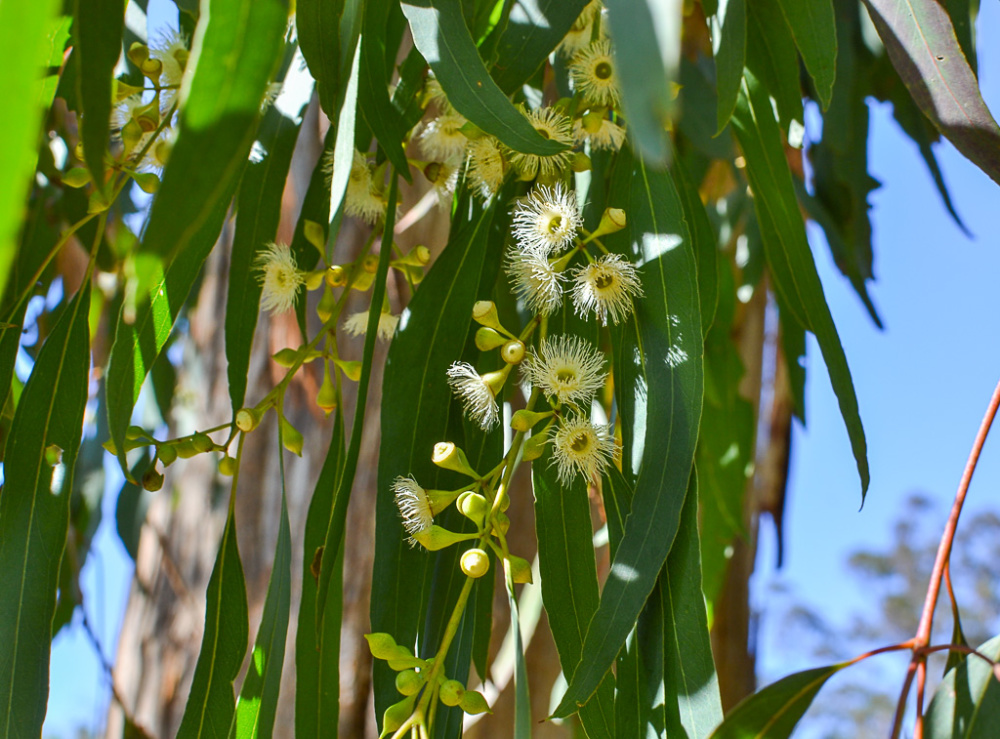
As with many eucalypts, the leaves change shape as the tree matures; the leaves on seedlings and juveniles are near oval and short, while those on full-grown trees are narrowly lance-shaped, up to 13 cm (5 in) long. They are dark, dull green on top, underneath slightly paler and remain on the tree throughout the year.
The flowers are typical of eucalypts, with long white filaments arising from a small goblet-shaped base. They bloom from spring through summer, in clusters of only a few arising at the sides and ends of the branches.
Fertilised flowers are followed by small, green, bowl-shaped seed capsules up to 1 cm (0.4 in) long that become brown and woody when mature, with many small brown, reddish-brown or grey seeds inside.
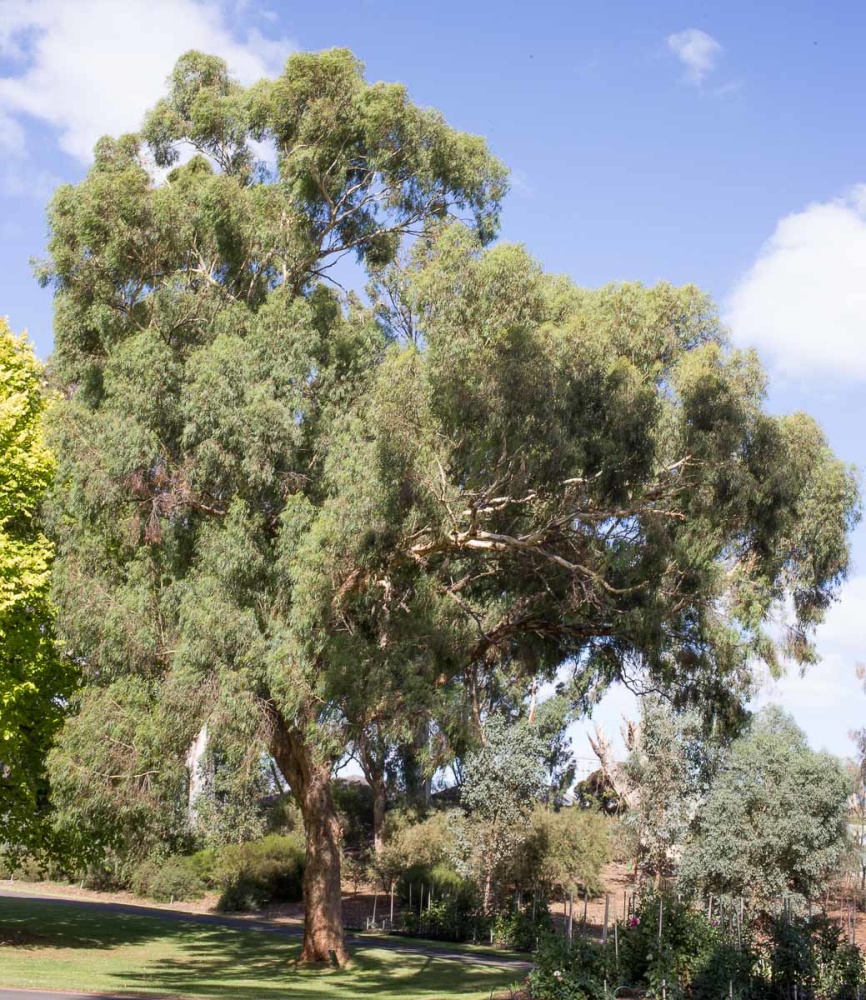
Bendigo Botanic Gardens, Victoria, Australia
Material uses
Hardwood - The timber is hard and heavy, ranging from 900 to 1,200 kg per cubic metre (56 to 75 lb per cubic foot). The heartwood is pale pink or yellow-brown.
Decay- and rot-resistant wood - It has good natural resistance to rot, decay, and wood-boring insects, making it suitable for indoor and outdoor use.
Heavy construction - It is used in heavy construction,
Flooring and decking - ...for flooring and decking,
Poles and posts - ...poles, posts, and fencing.
Wood turning - ...and for turnery.
Firewood - It also makes an excellent fuelwood, including firewood,
Charcoal - ...and for making charcoal.
Environmental uses
Bee forage - The flowers produce abundant nectar, with the peak period lasting around six weeks before the flow slowly declines. This sustains honeybee colonies, which can be observed actively working the flowers.
Wildlife support- The nectar also nourishes and sustains nectar-eating birds and bats, making it a vital wildlife tree in its native range.
Edible uses
Honey - It is reported as a major honey tree in Australia and in countries where it has been introduced, including Kenya, South Africa, and Zimbabwe. Yellow Box honey is a premier grade, light amber honey with a superior flavour and slow granulation. It only starts to crystallise after about five years, or never in its purest, unadulterated form. Yields of up to 75 kg (165 lb) of honey per colony per season have been recorded in Australia.
General interest
When translated from Latin, the second part of the botanical name, melliodora, means 'the scent of honey', referring to the sweet, honey-like scent coming from the flowers.
Climate
Grows naturally and is productive in sub-humid to moderately humid warm-temperate and subtropical climates, generally areas with annual lows of 5 to 17°C, annual highs of 19 to 31°C, annual rainfall of 500 to 1200 mm and a summer or winter dry season of 3 to 8 months.
Growing
New plants are usually started from seed, which benefit from pre-soaking in water before sowing. Germination occurs within five to seven days under warm conditions.
Performs best in free-draining clay-loam, loam, sandy-loam, and loamy-sand soils that are moderately acid to neutral, generally with a pH of 5.0 to 7.5, and in sites with full sun exposure.
Once established, Honey Box trees tolerate drought and salty soils well.
Problem features
There appears to be no record of it as a weed or invasive species, despite its introduction in many regions outside its native range.
Where it grows
References
Books
-
Blake, S. T. & Roff, C. 1987, The honey flora of Queensland, 3rd ed., Queensland Department of Primary Industries (QLD DPI), Brisbane
-
Boland, D. & Brooker, I. & McDonald, M. W. 2006, Forest trees of Australia, 5th ed., CSIRO Publishing (Ensis), Melbourne
-
Clemson, A. 1985, Honey and pollen flora, New South Wales Department of Agriculture, Inkata Press, Melbourne
-
Crane, E., Walker, P. & Day, R. 1984, Directory of important world honey sources, International Bee Research Association, London, United Kingdom
-
F. R. Beuhne 1922, Honey flora of Victoria, Melbourne Albert J. Mullett, Govt. printer
-
Hall, N. 1972, The use of trees and shrubs in the dry country of Australia, Australian Government Publishing Service, Canberra, Australian Capital Territory
-
Holliday, I. 2002, A field guide to Australian trees, 3rd revised editon, New Holland Publishers, Frenchs Forest, New South Wales
-
Marcar, N. E. 1995, Trees for saltland : a guide to selecting native species for Australia, Division of Forestry, Commonwealth Scientific and Industrial Research Organisation (CSIRO) Australia, Canberra
-
Nicolle, D. (2016). Taller Eucalypts for Planting in Australia: Their Selection, Cultivation and Management. Dr Dean Nicolle, Adelaide.
-
Randall, R. P. 2002, A global compendium of weeds, R.G. and F.J. Richardson Press, Melbourne
-
Roecklein, J. C & Leung, P.S. 1987, A Profile of economic plants, Transaction Books, New Brunswick, New Jersey
-
Scheffer, T. C & Morrell, J. J. 1998, Natural durability of wood : a worldwide checklist of species, Forest Research Laboratory, Oregon State University, Corvallis, Oregon
-
Webb, D. B. 1984, A Guide to species selection for tropical and sub-tropical plantations, 2nd ed., Unit of Tropical Silviculture, Commonwealth Forestry Institute, University of Oxford, Oxfordshire