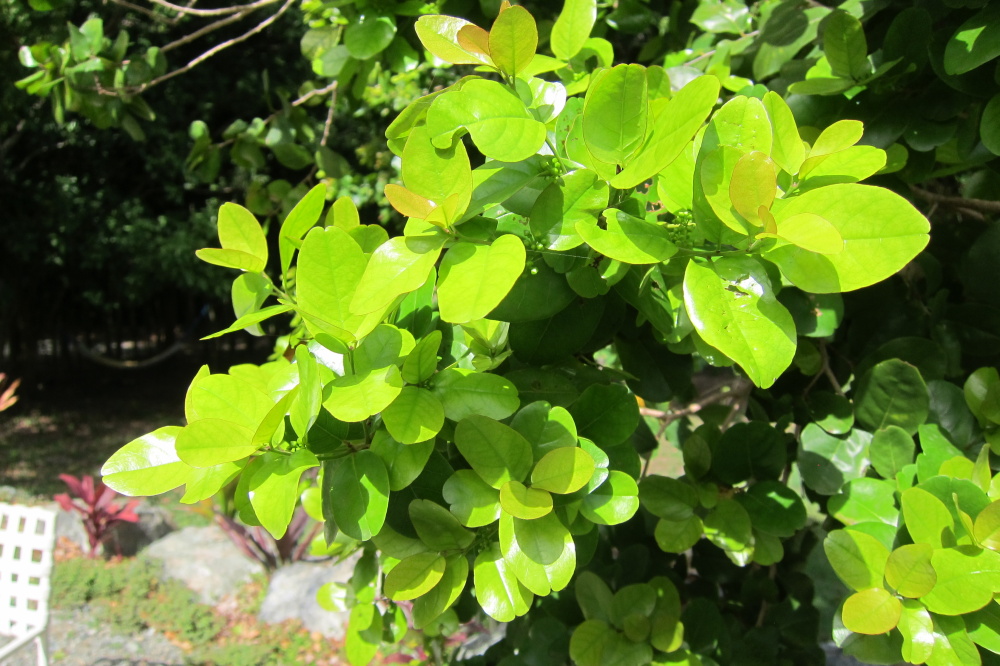


Common name: Black Ironwood
Other common names: Axe Master, Ironwood, Leadwood
Description
Black Ironwood is a small landscape and minor fruit tree native to the Caribbean and found in coastal and hilly areas. Its natural range extends from Melbourne, Central Florida, through the Florida Keys to Mexico and Honduras, and through the Eastern Caribbean, to as far south as Bonaire and Curaçao.
It is typically a small tree, 3 to 5 m (10 to 15 ft) tall in coastal areas, with a slender trunk up to 15 cm (6 in) in diameter and a densely leafy, rounded crown. Inland and in the moist, hilly parts of its range, it may reach heights of up to 17 m (56 ft) with a 50 cm (20 in) diameter trunk. The bark is grey, smooth or lightly fissured, becoming scaly on mature trees.
Leaves are oval, up to 6 cm (2.5 in) long and slightly notched at the tip. They are copper-red and soft when they emerge, becoming dark glossy green on top, dull green underneath, and leathery. Arranged near opposite along the ends of the branches, they remain on the tree throughout the year.
Flowers are small, greenish-yellow and borne in clusters of only a few, arising at the sides of the branches. They bloom on and off throughout the year, but are at their fullest from spring to summer and emit an almond-like aroma.
Fertilised flowers are followed by small roundish fruit up to 1 cm (0.4 in) long. When young, they are green, turning dark purple to almost black when ripe, with thin, juicy pulp surrounding a single seed.
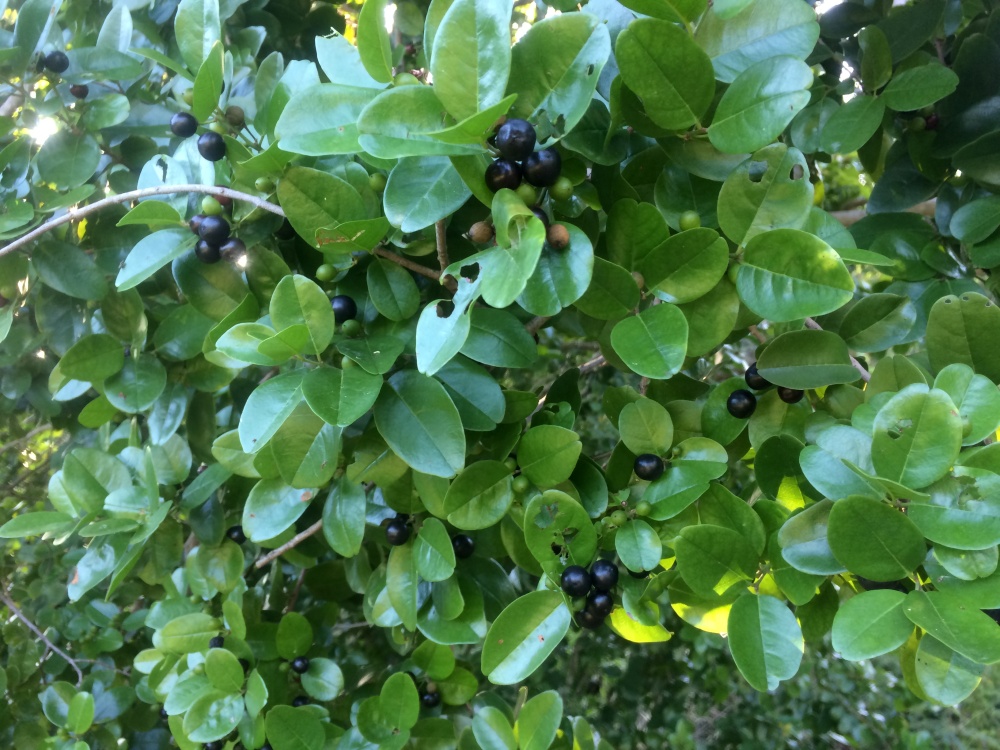
Fruiting tree (US Virgin Islands)
Environmental uses
Home garden tree - The tree's small size, shapely form, and lush green foliage make it an excellent candidate for a specimen or landscape tree,
Seaside garden plant - ...especially in tropical coastal areas, because it tolerates salt spray, drought, and limestone soils.
Bird attractant - As a bonus, the fruit attracts and sustains native birds,
Bee forage - ...and honeybees actively work the flowers.
Edible uses
Fresh fruit - The fruit is edible, and the pulp, although scant, is juicy with a sweet grape-and-blackberry flavour, made more appealing by its dark purple colour. They are mostly eaten fresh out of hand,
Fruit spread - ...or made into jam or jelly.
Alcoholic drink - In parts of its native range, they're soaked in alcohol, mainly white rum (from Saccharum officinarum), with spices such as clove and cinnamon to make a potent and spicy local liquor.
Material uses
Hardwood - One of the hardest and heaviest known woods, it weighs 1340 to 1420 kgs per cubic meter (84 to 89 lbs per cubic ft),
Decay- and rot-resistant wood - ...and has good natural resistance to rot and decay. However, it is brittle, and the logs are too small in diameter to make sawing them into lumber practical.
Poles and posts - Instead, they are mostly cut for posts and poles.
General interest
The second part of the botanical name, 'Ferreum', comes from the Latin for iron, Ferrum, referring to the wood's hardness.
Climate
Grows naturally in sub-humid to moderately humid subtropical and tropical climates, generally in areas with annual lows of 17 to 25°C, annual highs of 26 to 35°C, annual rainfall of 500 to 2000 mm and a dry season of 2 to 8 months.
In Jamaica, Black Ironwood occurs at elevations from near sea level to 900 meters (3000 feet), where the average low of the warmest month is at or above 17°C (63°F).
Growing
New plants are usually started from seed.
Performs best on free-draining loam, sandy loam, loamy sand, and limestone soils of a slightly acid to alkaline nature, generally with a pH of 6.0 to 8.0, and on sites with full to partial sun exposure.
Problem features
Birds eat the fruit and disperse the seed, which germinates readily. However, there appears to be no record of it as a problem weed or invasive species.
The dark juice can permanently stain clothes, other fabrics, and concrete surfaces such as driveways or sidewalks.
Where it grows
References
Books
-
Adams, C. D. 1972, Flowering plants of Jamaica, University of the West Indies, Mona, Greater Kingston
-
Little, E. L. et al. 1964 and 1974, Common trees of Puerto Rico and the Virgin Islands (2 volumes), Forest Service, U.S. Department of Agriculture (USDA), Washington D.C.
-
Record, S. J. & Hess, R. W., 1972, Timbers of the New World, Yale University Press, New Haven, Connecticut & Arno Press, New York
-
Thompson, R.S. et al. 2015, Atlas of relations between climatic parameters and distributions of important trees and shrubs in North America - Revisions for all taxa from the United States and Canada and new taxa from the western United States: U.S. Geological Survey Professional Paper 1650–G
Articles, Journals, Reports and Working Papers
-
Meerow, A.W. 1996, Native Trees for South Florida, University of Florida-IFAS Publication EES-57, Gainesville