

Common name: Snow in Summer
Other common names: Flaxleaf Paperbark, Honey Myrtle, Narrowleaf Paperbark, Narrowleaf Teatree
Description
Snow in Summer is a flowering, essential-oil-yielding tree native to Australia, with a range extending across warm-temperate and subtropical areas in the east of the continent, where it occurs in pockets of coastal forests. It prefers swampy, poorly drained sites, or sites subject to flooding or that become watercourses during the rainy season.
On favourable sites, it is moderately fast-growing and reaches heights of up to 15 m (50 ft). However, it is more commonly 5 to 10 m (16 to 32 ft) tall and develops a stout, occasionally forked trunk that supports a densely branched, rounded crown. The bark is off-white to cream coloured and sheds in papery sheets that persist on the trunk, forming layers of dry, dead bark that can be peeled off by hand.
The leaves are very small, lance-shaped, dull blue-green, and closely arranged along thin branchlets; the crown is tightly packed and casts deep shade on the ground below. They remain on the tree year-round and, when crushed, release a camphorous aroma.
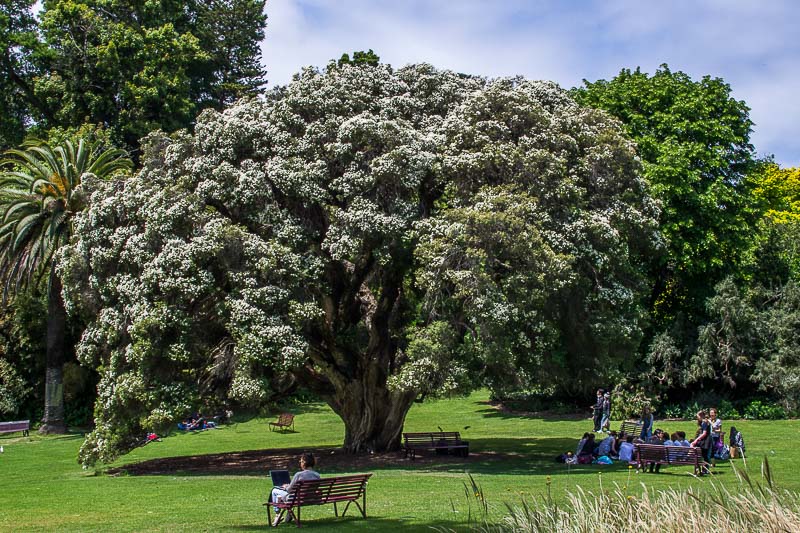
In spring, fluffy white flower spikes resembling snowflakes cover the crown, almost completely hiding the foliage. Small, woody, cup-shaped seed capsules follow, closely spaced along the branchlets, and become dry and light brown when mature, with many tiny seeds inside.

Trees in full bloom (Melbourne, Australia)

The flowers are reminiscent of snowflakes.
Environmental uses
Home garden tree - Snow in summer is cultivated in gardens
Public garden tree - ...and parks,
Street tree - ...and as a street tree, for its shapely form, unusual and interesting bark,
Flowering ornamental - ...showy flowering,
Shade tree - ...and the shade it provides.
Bee forage - Honeybees actively visit flowers for nectar and pollen. Still, they produce only moderate amounts. The small amount of honey produced is dark amber and strongly flavoured.
Material uses
Essential oil - When steam-distilled, the leaves yield commercial quantities of 'Tea tree oil'. However, they are not as widely exploited as the leaves of Melaleuca alternifolia, the oil's principal source. Tea tree oil is a colourless to pale yellow oil extracted mainly for medicinal use as an antiseptic, antibacterial and antifungal agent. Oil yields range from 1 to 2% of the leaves by weight, depending on the proportion of old- to new-growth in the distilled material. Snow in summer oil is similar to Tea tree oil from Melaleuca alternifolia, but has a more Eucalyptus-like aroma and flavour.
Timber and lumber - The sapwood is yellowish and resistant to borers, while the heartwood is pinkish grey, generally fine in texture, and of moderate strength. The wood is high in silica, which quickly blunts saws and similar tools.
Marine-resistant wood - The wood is hard and particularly durable in water, making it suitable for submerged pilings in swampy ground or water.
Decay- and rot-resistant wood - The wood is also durable in the ground.
Termite-resistant wood - Melaleuca wood is also highly termite-resistant.
Poles and posts - Melaleuca timber has historically been used for house stumps, fence posts, poles,
Boat building - ...knee joints for floating vessels,
Light construction - ...framing and rough construction,
Flooring and decking - ...and flooring.
Firewood - If properly dried, the wood makes reasonable firewood. The peeled bark makes excellent kindling or fire-starting material, and Indigenous Australians have long used it for this purpose.
Health uses
Tea tree oil has natural antiseptic, antibacterial and antifungal properties. People apply it topically to insect bites and stings, wounds, burns, acne, warts, athlete's foot and vaginal yeast infections. People also use it in inhalation treatments for coughs, colds, and flu. The thin, papery layers that make up the bark sandwich a fine powder reportedly containing a natural antibiotic, and Aboriginal Australians have used it for centuries as a bandage for wound healing.
Natural dental care - People also apply tea tree oil topically to oral infections, including gum ailments.
Climate
Grows naturally in moderately humid warm-temperate to subtropical climates, generally areas with annual lows of 6 to 17°C, annual highs of 18 to 30°C, annual rainfall of 500 to 2000 mm and a dry season of 6 months or less, extending to 12 months with irrigation or groundwater.
Growing
New plants are usually started from seed. It performs best in slow- to free-draining clay loam, loam, sandy loam, and loamy sand soils that are moderately acidic to neutral, generally with a pH of 5.0 to 7.5, and in sites with full to partial sun exposure.
Snow in summer is moderately salt tolerant, with its growth reportedly unaffected by soil-salt conditions up to 3.0 grams of dissolved salt per litre of water, about one-twelfth of seawater concentration.
Problem features
It is listed as a weed in at least one publication. Still, no record exists of it becoming naturalised or a serious weed anywhere outside Australia, despite its introduction and cultivation in Florida, Louisiana, California, and other non-native regions.
The roots are moderately invasive, and we recommend planting at least 4 m (13 ft) from any underground pipes.
Where it grows
References
Books
-
Barwick, M., et al. 2004, Tropical & subtropical trees : a worldwide encyclopaedic guide, Thames and Hudson, London
-
Blake, S. T. & Roff, C. 1987, The honey flora of Queensland, 3rd ed., Queensland Department of Primary Industries (QLD DPI), Brisbane
-
Brophy, J. J., Craven, L. A. & Doran, J. C. 2013, Melaleucas: their botany, essential oils and uses, Australian Centre for International Agricultural Research (ACIAR), Canberra
-
Chevallier, A. 2000, Encyclopedia of herbal medicine, 2nd American ed., Dorling Kindersley, New York
-
Clemson, A. 1985, Honey and pollen flora, New South Wales Department of Agriculture, Inkata Press, Melbourne
-
Guenther, E. & Althausen, D. 1948 to 1952, The essential oils (6 volumes), Van Nostrand Publishing, New York
-
Holliday, I. 2002, A field guide to Australian trees, 3rd revised editon, New Holland Publishers, Frenchs Forest, New South Wales
-
Lake, M. 2019, Australian forest woods: Characteristics, Uses and Identification, CSIRO Publishing, Clayton South, Victoria, Australia
-
Leech, M. 2013, Bee Friendly: A planting guide for European honeybees and Australian native pollinators, Rural Industries Research and Development Corporation (RIRDC), Canberra, Australian Capital Territory
-
Marcar, N. E. 1995, Trees for saltland : a guide to selecting native species for Australia, Division of Forestry, Commonwealth Scientific and Industrial Research Organisation (CSIRO) Australia, Canberra
-
Menninger, E. A. 1962, Flowering trees of the world for tropics and warm climates, 1st ed., Heathside Press, New York
-
Oakman, H. 1995, Harry Oakman's what flowers when : the complete guide to flowering times in tropical and subtropical gardens, University of Queensland Press, St. Lucia, Queensland
-
Perry, B. 2010, Landscape plants for California gardens: an illustrated reference of plants for California landscapes, Land Design Publishing, Claremont, California
-
Randall, R. P. 2002, A global compendium of weeds, R.G. and F.J. Richardson Press, Melbourne
-
Randall, R. P. 2007, The introduced flora of Australia and its weed status, Cooperative Research Centre for Australian Weed Management, Glen Osmond, South Australia
-
Weiss, E. A. 1997, Essential oil crops, CABI Publishing, Wallingford, Oxfordshire