

Common name: Sunn Hemp
Other common names: Bombay Hemp, Brown Hemp, Indian Hemp, Madras Hemp, Sunn Crotalaria
Description
Sunn Hemp is an annual herb native to neighbouring areas of India and Pakistan in the northwest of the subcontinent. It is valued for its fibre, seed oil and the range of environmental services it provides.
The plant has a green, ribbed, semi-woody central stem 2 to 4 m (7 to 13 ft) tall and 2 cm (0.8 in) in diameter, from which short, thin, leaf-bearing stems branch, forming an erect, narrow plant. Fast-growing under favourable conditions, it may attain a height of up to 1.2 m (4 ft) only sixty days after sowing the seed.
The leaves are lance-shaped, 5 to 13 cm (2 to 5 in) long, medium green and in a spiral and alternate arrangement along the branching stems.
The flowers are bright yellow and pea-like, resembling the flowers of other legumes, and are large, measuring 2 to 2.5 cm (0.8 to 1 in) across. Flowering responds to shortening day length, so the plants flower only from autumn to winter.
The fertilised flowers are followed by cylindrical seedpods 3 to 5 cm (1.2 to 2 in) long, green when young, becoming creamy-brown and dry. When mature, they contain up to eight small, kidney-shaped seeds.
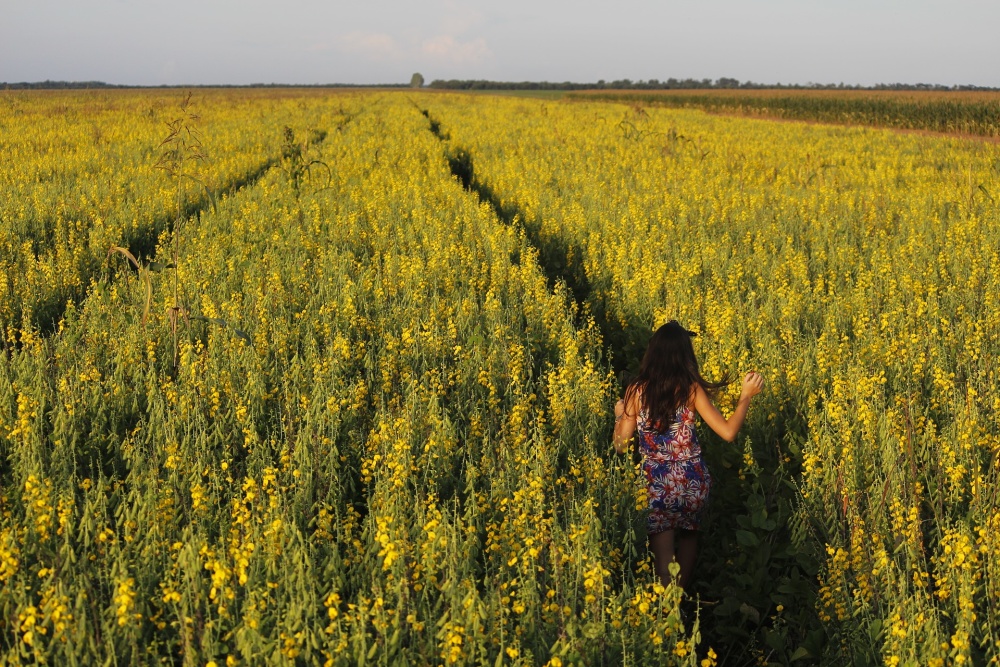
Field of Sun hemp (Photo by Karynne Grabovski from Pixabay)
Material uses
Natural fibre - Sunn Hemp is cultivated as a fibre crop for making coarse textiles such as sacking fabrics, canvas, and rug yarns.
Rope or cordage - As well as items like ropes or cordage used for articles such as fishing nets and matting.
Plant fibre pulp - The fibres are also converted into pulp for speciality papers such as drip-coffee filters, tissues, and cigarette papers.
Natural packaging - And for material used in the manufacture of biodegradable packaging.
Livestock feed - The fresh-cut leaves and soft stems have a crude protein content of up to 15% of their dry weight and are highly palatable to livestock, but should be cut before the seedpods have formed, as these can be toxic to some livestock.
Environmental uses
Erosion control - Sunn hemp is also cultivated to provide a range of environmental services, including as a cover crop to minimise soil erosion and conserve soil moisture.
Green manure - It is also grown as a green manure crop to improve soil properties.
Nitrogen-fixing - As a green manure crop, it also adds nitrogen to the soil.
Natural insecticide - It is also valuable for controlling harmful soil nematodes, reportedly producing a compound toxic to several destructive nematode species, making it a useful tool for pest management, especially in crop rotation systems.
Climate
It grows naturally in sub-humid to humid subtropical and tropical climates, generally areas with annual lows of 12 to 25°C, annual highs of 23 to 35°C and annual rainfall of 800 to 4000 mm.
It can be grown year-round in tropical regions but only as a spring, summer, or autumn crop in subtropical regions because of cool winter conditions.
Growing
New plants are raised from seed, sown close for fibre crops to discourage branching and farther apart for green manure, cover, and fodder crops.
Green manure, cover, and fodder crops should not be allowed to grow beyond the full-bloom stage and not more than 90 to 120 cm (3 to 4 ft) tall. Otherwise, they become fibrous, less palatable to livestock, and more challenging to cut, mow, or plough under. For this reason, subtropical areas usually grow green manure and cover crops only in summer to prevent flowering brought on by short day length.
For fibre production, the stems are harvested when the seedpods start to develop on the plant. The cut stems are then retted (soaked in water to soften) for approximately three days before stripping off the fibres.
It performs best on rich, free-draining clay, loam, and sand soils of a moderately acid to neutral nature, generally with a pH of 5 to 7.5, and on sites with full sun exposure. It is intolerant of poorly drained or permanently wet soils.
Problem features
It has a history of cultivation as a fibre crop in countries outside of its native range. Reports indicate it is naturalised in some countries.
Although listed as a weed in more than one reference publication, there do not appear to be any records of it anywhere as a serious weed. This may be due, in part, to it usually being harvested or ploughed under as a green manure crop before it reaches the fruiting stage. The Hawaii Pacific Weed Risk Assessment (HPWRA) project assesses it as a low weed-risk species for Hawaii.
Where it grows
References
Books
-
Adams, C. D. 1972, Flowering plants of Jamaica, University of the West Indies, Mona, Greater Kingston
-
Allen, O. N. & Allen, E. K. 1981, The Leguminosae : a source book of characteristics, uses, and nodulation, University of Wisconsin Press, Madison, Wisconsin
-
Fawcett, W. 1891, Economic plants, An index to economic products of the vegetable kingdom in Jamaica, Jamaica Government Printing Establishment, Kingston
-
Ghosh, T. 1983, Handbook on jute, Food and Agriculture Organization of the United Nations (FAO), Rome
-
Gohl, B. 1981, Tropical Feeds : feed information summaries and nutritive values (Revised edition), Food and Agriculture Organization of the United Nations (FAO), Rome
-
Jamieson, G. S. 1943, Vegetable fats and oils : their chemistry, production, and utilization for edible, medicinal and technical purposes, 2d ed, Reinhold, New York
-
National Research Council (Board on Science and Technology for International Development) 1979, Tropical legumes : resources for the future, The National Academies Press, Washington D. C.
-
Randall, R. P. 2002, A global compendium of weeds, R.G. and F.J. Richardson Press, Melbourne
-
Randall, R. P. 2007, The introduced flora of Australia and its weed status, Cooperative Research Centre for Australian Weed Management, Glen Osmond, South Australia
-
Roecklein, J. C & Leung, P.S. 1987, A Profile of economic plants, Transaction Books, New Brunswick, New Jersey
-
Wood, I. M. 1997, Fibre crops : new opportunities for Australian agriculture, Queensland Department of Primary Industries (QLD DPI), Brisbane
Articles, Journals, Reports and Working Papers
-
Valenzuela H, Smith J. 2002. 'Tropic Sun' sunnhemp. Honolulu (HI): University of Hawaii. 3 p. (Sustainable Agriculture; SA-GM-11).