

Common name: Wall okra
Other common names: Bines pear, Bynes pear, God okra, Prickle withe, Queen of the night, Strawberry pear, Siple okra
Description
Wall Okra is a flowering and fruiting cactus native to the northern Caribbean, with a natural range limited to the islands of Cuba, Jamaica, and Hispaniola.
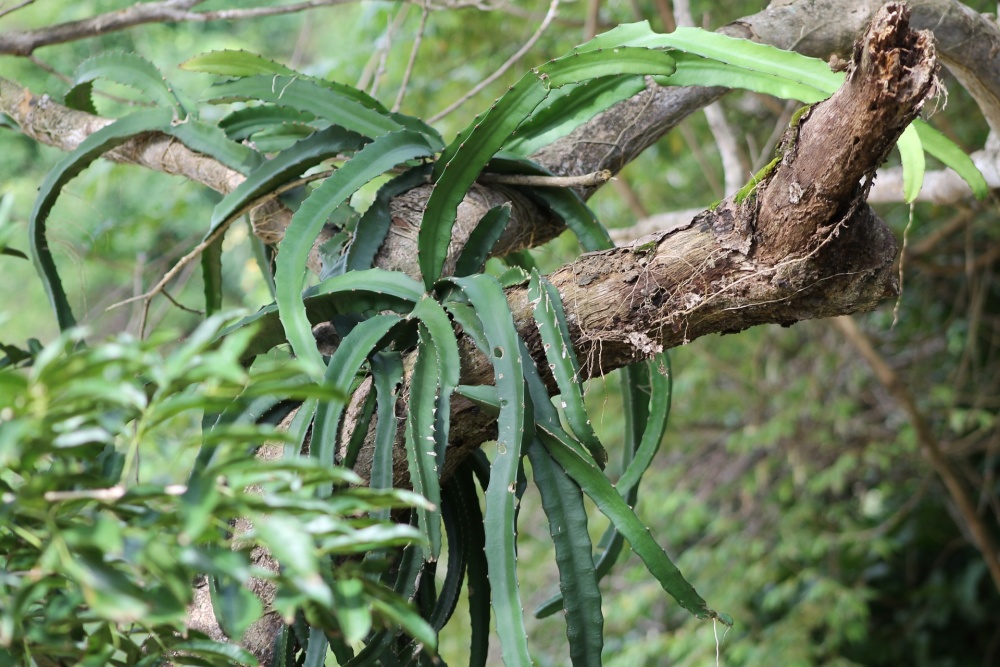
The plant has slender, succulent green stems jointed into segments up to 60 cm (2 ft) long. These are Y-shaped in cross-section with three wings, the margins of which are armed with sharp needle-like spines. Aerial roots at nodes along the underside enable it to creep and climb up on walls and even into trees as it grows.
Long days induce flowering, with flowers opening at night from summer through early autumn to be pollinated by bats and nocturnal insects, its specialist pollinators. They are solitary and large flowers, up to 20 cm (8 in) across when fully open, yellow-green on the outside, ivory-white within and strongly and sweetly fragrant.
The fertilised flowers develop into egg-shaped fruit that become crimson coloured when ripe, usually in autumn. They are about 10 cm (4 in) long and weigh about 200 gms (0.4 lbs), less than half the weight of commercially grown Dragon Fruit (Selenicereus undatus), which can weigh up to 600 gms (1.3 lbs) each.
Use
Wall Okra is appreciated for its spectacular flowers, which open only once at night, then close by morning, with new flowers opening most nights over a long blooming period.
The ripe fruit pulp is edible, mildly sweet, and usually eaten fresh out of hand. Like other types of dragon fruit, it can be added to fruit salads or blended in drinks, such as cold milk-based fruit drinks commonly served in Southeast Asia, where dragon fruit was introduced but is now widely cultivated. The pulp is soft, white and embedded with numerous tiny black seeds that are easily swallowed along with the pulp.
The unopened flower buds are cooked and eaten as a vegetable in parts of its native range and have a mucilaginous or slimy consistency, similar to Okra (Abelmoschus esculentus).
General interest
A strong, durable wire-like fibre stripped from the stems has been historically used by fishermen on the south coast of Jamaica as cordage or lashing material to construct fish traps or 'pots' set in deep water.
Climate
Grows naturally in sub-humid to moderately humid tropical lowland to mid-elevation climates, generally areas with annual lows of 14 to 25°C, annual highs of 25 to 35°C, annual rainfall of 800 to 2000 mm and a dry season of 3 to 8 months.
In Jamaica, it is common in the drier parts of the island, at elevations from near sea level up to 1200 meters (4000 feet) - areas where the average low of the warmest month is 17°C (63°F) or above.
Growing
New plants can be raised from seed but are more commonly started from cuttings. It performs best in free-draining loam and sandy soils enriched with manure and adjusted to a moderately acidic to alkaline pH, generally in the 5.5 to 8.0 range. It tolerates drought and limestone soils.
It is naturally an understory plant, with stems susceptible to sunburn if exposed to full sun for too long, especially in dry conditions, and does best with some shade from the hot midday sun. It also needs to be planted well away from any artificial lighting, which might interfere with its blooming. It is mostly planted where it can grow on a trellis or climb up a small tree.
Problem features
Fruit-eating birds break open the fruit with their beaks, eat the pulp and disperse the seed. While there appears to be no record of it as a weed anywhere in the world, its more widely distributed relative, the Dragon Fruit (Selenicereus undatus), is assessed as a high weed-risk species for Hawaii by the Hawaii Pacific Weed Risk Assessment (HPWRA) project.
Where it grows
References
Books
-
Adams, C. D. 1972, Flowering plants of Jamaica, University of the West Indies, Mona, Greater Kingston
-
Cassidy, F. G. & Le Page, R. B. 1980, Dictionary of Jamaican English, 2nd ed., Cambridge University Press, Cambridgeshire
-
Griffiths, M. & Burras, J. K. 1994, Manual of climbers and wall plants, Royal Horticultural Society (Great Britain), Timber Press, Portland, Oregon
-
Higman, B. W 2008, Jamaican food : history, biology, culture, University of the West Indies Press, Kingston, Jamaica
-
Iremonger, S. 2002, A guide to plants in the Blue Mountains of Jamaica, University of the West Indies Press, Kingston, Jamaica
-
Randall, R. P. 2007, The introduced flora of Australia and its weed status, Cooperative Research Centre for Australian Weed Management, Glen Osmond, South Australia