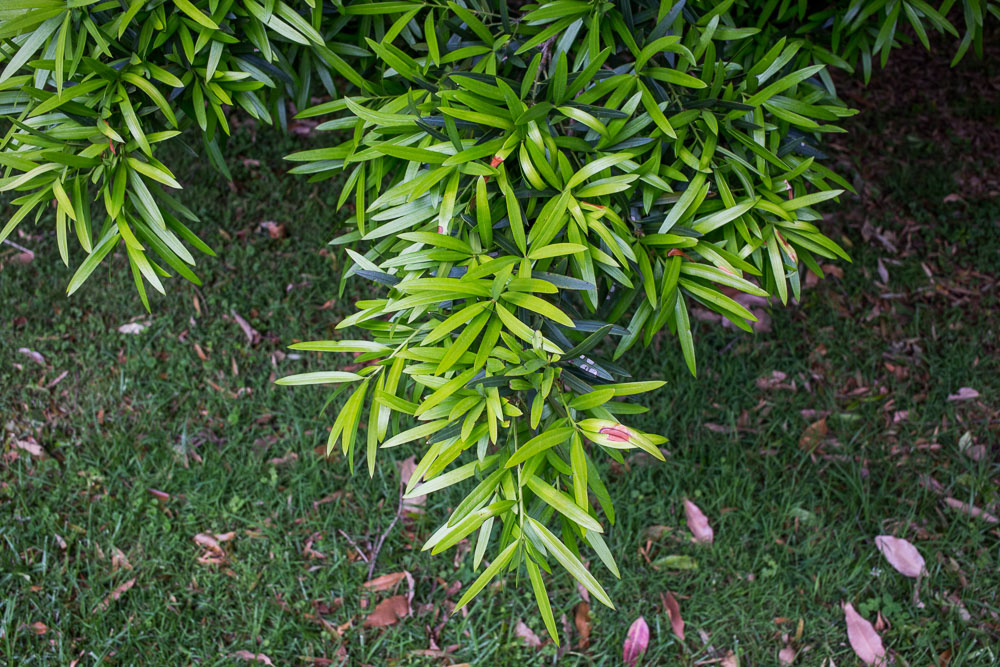


Common name: Plum Pine
Other common names: Brown Pine, Illawarra Plum, Pencil Cedar, She Pine, Yellow Pine
Description
Plum Pine is an ornamental and timber-producing conifer originating in Australia, with its natural range limited to areas of subtropical forest on the continent's east coast.
In closely spaced forests, it may reach heights of up to 40 m (130 ft), though on open sites it is more commonly 15 to 25 m (50 to 65 ft) tall and grows at a moderate to fast rate, with a straight trunk, sometimes fluted at the base. The bark is dark brown, fissured and fibrous.
Branching starts low on young trees, forming a dense pyramidal crown. As the tree ages, the lower branches are pruned off naturally, and the remaining branches become wide-spreading, resulting in a rounded crown in mature trees.
The leaves are narrowly lance-shaped, of variable lengths up to 18 cm (7 in) and alternately arranged along the branches. They emerge glossy red, soft and limp, then become lime-green and gradually mature into dark green, stiff and leathery. The light, bright colours of the young leaves starkly contrast with the darker, older leaves that predominate on the tree.
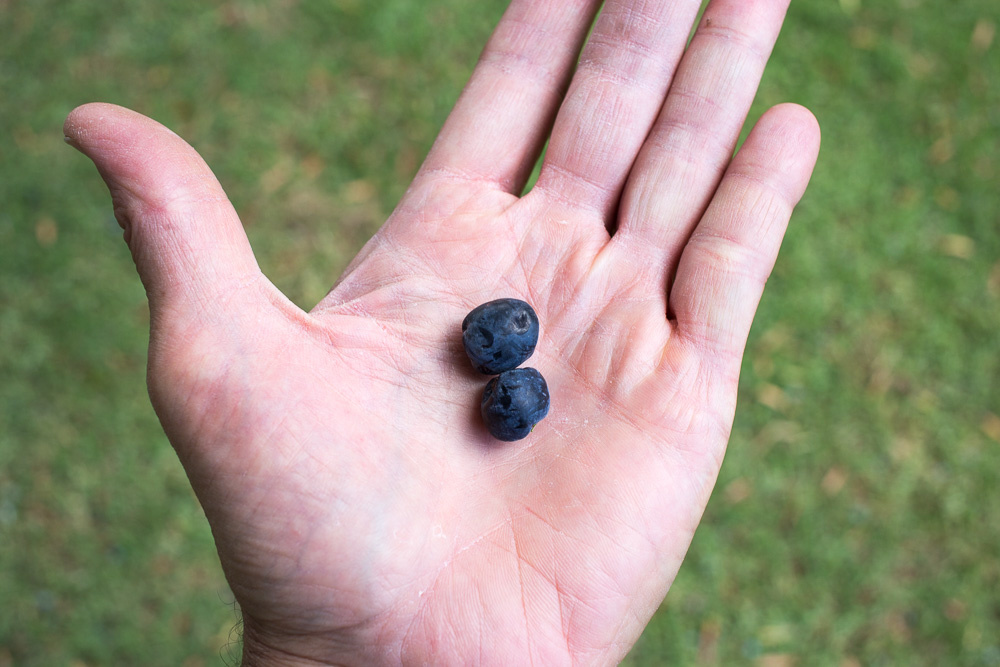
The flowers are small and insignificant, green-white, either female or male, on separate trees and held in finger-like clusters arising at the sides of the branches. They are followed on female trees by small, plum-like pseudo- or false fruit that become bluish-black when ripe, with a single round seed attached, which is the actual fruit. They usually ripen from autumn to winter.
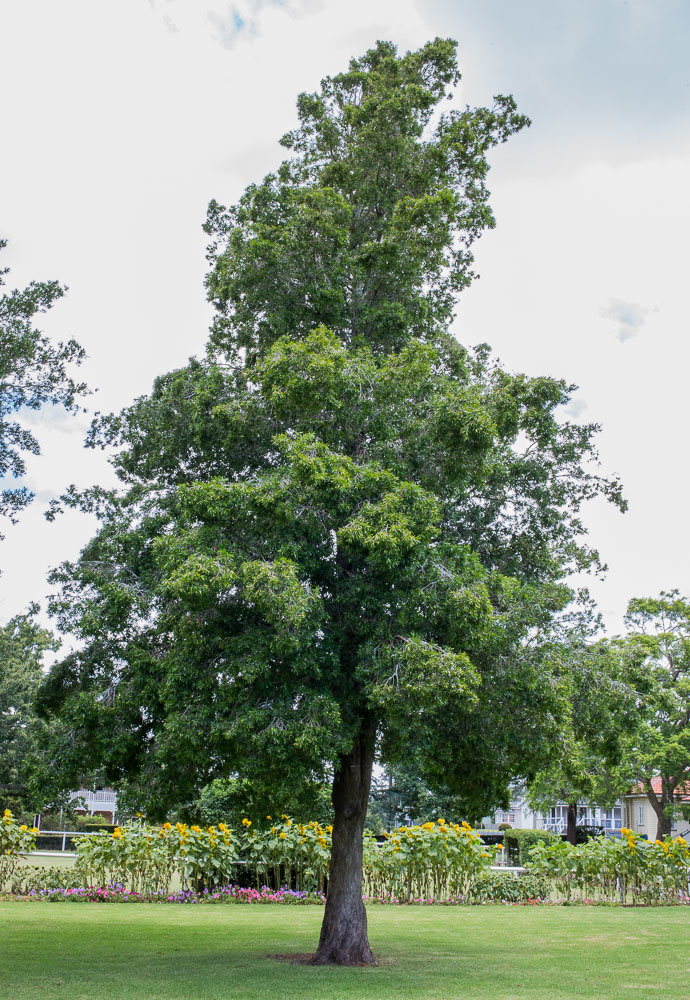
Toowoomba, Australia
Material uses
Hardwood - The wood is medium-weight, averaging 600 kilograms per cubic meter (37 pounds per cubic ft).
Decay- and rot-resistant wood - It has moderate to high natural resistance to rot and decay.
Termite-resistant wood - As well as to termites.
Marine-resistant wood - And to marine borers, making it suitable for indoor, outdoor, and in-water construction.
Boat building - Large, well-formed logs are sawn into planks for boat-building.
Furniture and cabinets - Also furniture and cabinets.
Joinery and millwork - And joinery work generally.
Heavy construction - As well as beams for wharf and bridge construction.
Poles and posts - Small-diameter logs are used chiefly for in-water pilings, poles, and posts.
Wood turning - As well as turnery.
Wood craft and wares - And wooden wares, including kitchen utensils.
Cut-foliage - The dark green, mature foliage is used as backing greenery to add contrast, texture and volume to floral arrangements. Cut stems are stripped of their bottom leaves, then placed cut-end in lukewarm water. They are reported to have a vase life of up to three weeks.
Environmental uses
Foliage ornamental - It is a popular ornamental in Australia for its shapely form, showy foliage and low-branching habit.
Hedge plant - This has led to its use as a tall hedge.
Windbreak - Or windbreak.
Edible uses
Fruit spread - The false fruits have a sweet, resinous flavour when ripe and are made into jam.
Fruit chutney - Also chutney and fruit sauce, especially to accompany rich meats, such as lamb, duck and game.
Health uses
Vitamin C - The false fruits are also high in Vitamin C.
Climate
Grows naturally in moderately humid subtropical and tropical mid- to high-elevation climates, generally areas with annual lows of 9 to 21°C, annual highs of 19 to 31°C, annual rainfall of 1000 to 1600 mm and a dry season of 6 months or less.
Growing
New plants can be started from seed or cuttings. Cuttings from male trees ensure it does not become a weed when cultivated, but this is at the expense of fruit production, which requires both male and female trees.
Performs best on free-draining clay, loam or sand soils of a moderately acid to neutral nature, generally with a pH of 5.0 to 7.0, and on sites with full to partial sun exposure.
Problem features
Birds and bats eat the fruit and help to disperse the seed. Still, there are no records of its escape and naturalisation, despite its introduction into areas outside its natural range. The Hawaii Pacific Weed Risk Assessment project (HPWRA) assessed it as a low weed risk species for Hawaii.
The roots are invasive, and in Australia, a minimum planting distance of 10 meters from underground pipes, building foundations, and other structures is recommended.
Where it grows
References
Books
-
Boland, D. & Brooker, I. & McDonald, M. W. 2006, Forest trees of Australia, 5th ed., CSIRO Publishing (Ensis), Melbourne
-
Holliday, I. 2002, A field guide to Australian trees, 3rd revised editon, New Holland Publishers, Frenchs Forest, New South Wales
-
Lake, M. 2015, Australian rainforest woods : characteristics, uses and identification, CSIRO Publishing, Collingwood, Victoria
-
Oakman, H. 1995, Harry Oakman's what flowers when : the complete guide to flowering times in tropical and subtropical gardens, University of Queensland Press, St. Lucia, Queensland
-
Rauch, F. D. & Weissich, P. R. 2000, Plants for tropical landscapes : a gardener's guide, University of Hawaii Press, Honolulu
-
Rowell, R. J. 1996, Ornamental conifers for Australian gardens, New South Wales University Press, Kensington, New South Wales
Articles, Journals, Reports and Working Papers
-
South East Water Company 1999, Tree roots : a growing problem, South East Water, Moorabbin, Victoria