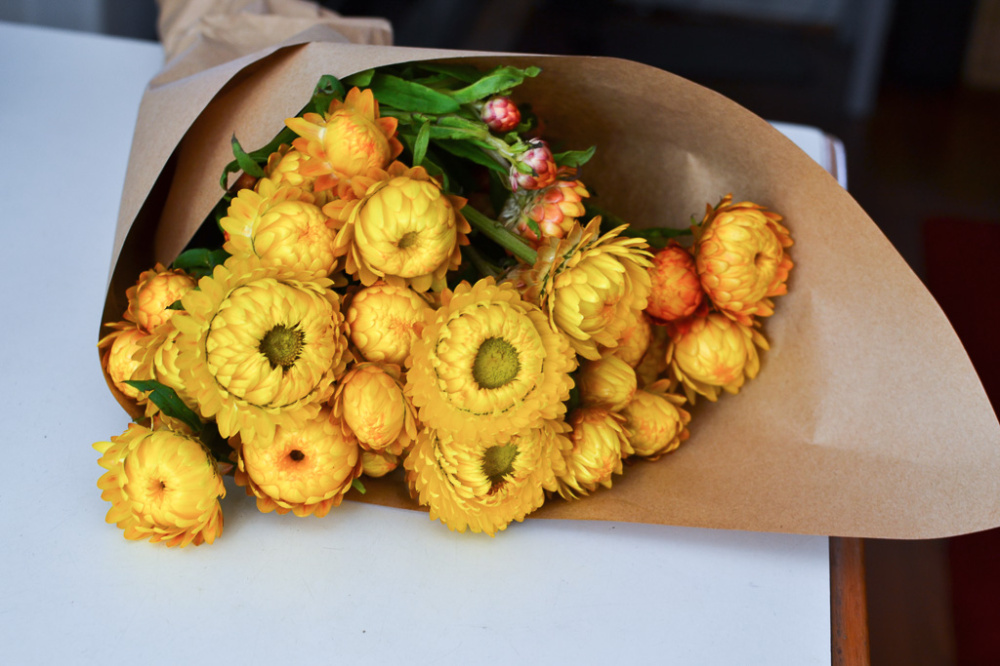
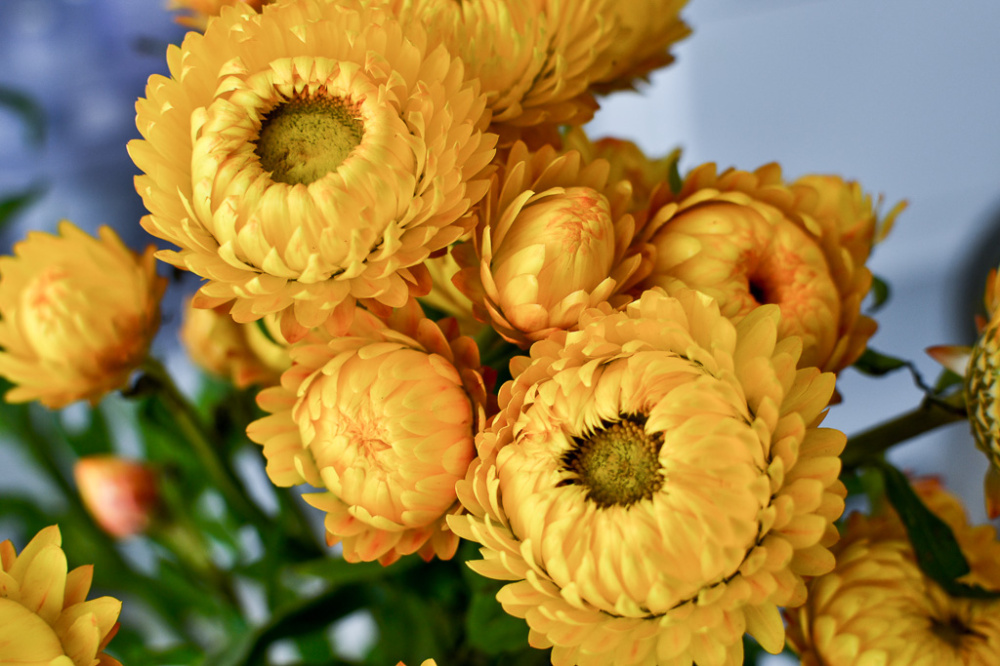


Common name: Strawflower
Other common names: Everlasting daisies, Golden everlasting, Paper daisy, Paper flower, Straw daisy, Yellow paper daisy
Description
Strawflower is a flowering shrub native to Australia and widely distributed there, its natural range extending from the warm-temperate south, through the arid centre, to the dry tropics in the north of the continent.
It is a short-lived perennial, commonly 30 to 90 cm (1 to 3 ft) tall and shrubby in appearance. The base is woody and partially hidden underneath a wide-spreading, rounded crown of foliage and flowers. There is also an annual form, but it requires long days to initiate flowering and is therefore not suited to the sub-tropics or tropics.
Leaves are lance-shaped, 5 to 10 cm (2 to 4 in) long, dull green, smooth-margined, somewhat velvety to touch and are arranged alternately along the stems.
The flowers are large, brightly coloured and held on long stems above the foliage. As a result of selective breeding, they come in various shapes and colours, including pinks, reds, purples, yellows and whites. They bloom mainly from winter to spring in subtropical and tropical climates, though also continuously under proper plant care and maintenance.
Use
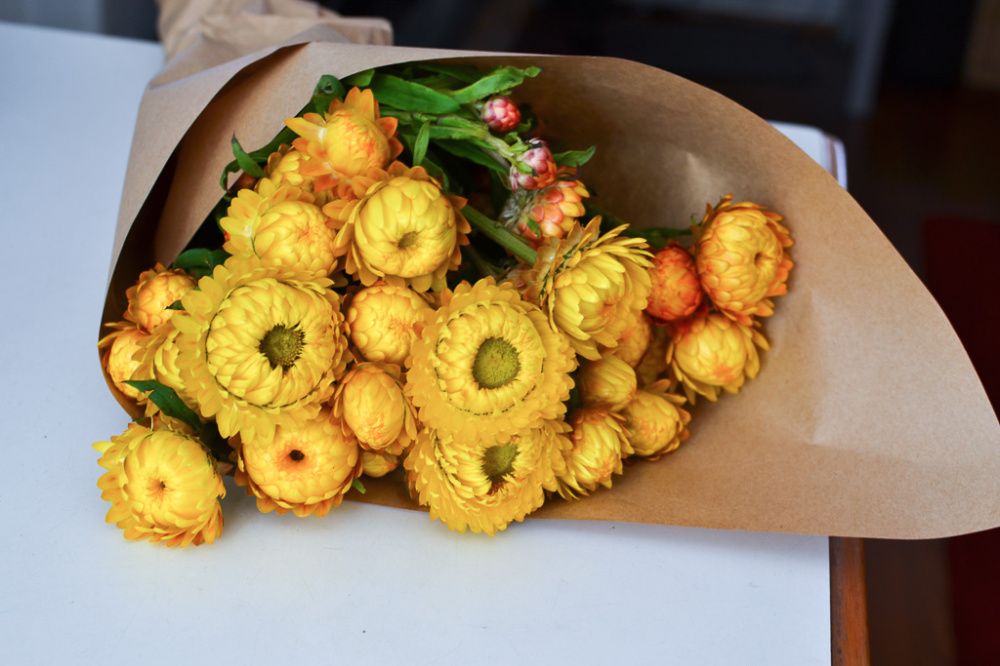
The flower stems are cut for both fresh and dried flower arrangements. Flowering stems for fresh-cut arrangements should be stripped of leaves that would be submerged and a preservative added to the vase water to keep them fresh for longer. If being stored or transported, they should be kept cool at temperatures between 4 and 8°C (39 to 46 °F).
Good quality dried flowers are produced by hanging bunches of still-budding, but not yet fully open, flower-heads upside-down in a dry, airy room for a few weeks. The flower-heads, it is said, keep their colour and shape for months, sometimes lasting up to a year. However, they need wiring for vase arrangements because the dried stems do not last as long.
Strawflower is also cultivated as a groundcover and to add colour to garden beds and containers.
Climate
The perennial form grows and flowers naturally in subtropical and sub-humid tropical climates, generally areas with annual lows of 9 to 20°C, annual highs of 21 to 32°C, annual rainfall of 500 to 1400 mm and a dry season of 4 to 7 months.
Although also grown in humid tropical highland climates with no dry season, the plants are more susceptible to fungal disease brought on by humid conditions.
Growing
New plants can be grown from seed or semi-woody cuttings, which strike or root easily. Growth and flowering performance is best on rich, manured, quick-draining sand soils of a slightly acid to slightly alkaline nature, generally with a pH of 6.5 to 7.5 and on sites with full to partial sun exposure.
Regular light pruning is recommended to keep a good shape, and cutting the flower stems encourages more flowering and prolongs the blooming period. It has a good flowering habit for around three years, then becomes woody and unproductive, requiring its replacement.
Problem features
In Australia, it is recorded as having escaped cultivation and a weed of the environment. Still, it is not classed anywhere as a serious weed. It is assessed as a low weed risk species for Florida by the IFAS Assessment of Non-Native Plants in Florida's Natural Areas.
Where it grows
References
Books
-
Jones, R. 2001, Caring for cut flowers, 2nd ed, Landlinks Press, Victoria, Australia
-
Mackey, B. & Brandies, M. M., 2001, A cutting garden for Florida : grow marvelous flowers for bouquets in your Florida home landscape, 3rd edition, revised and expanded, B.B. Mackey Books, Wayne, Pennsylvania
-
Randall, R. P. 2002, A global compendium of weeds, R.G. and F.J. Richardson Press, Melbourne
-
Randall, R. P. 2007, The introduced flora of Australia and its weed status, Cooperative Research Centre for Australian Weed Management, Glen Osmond, South Australia
Articles, Journals, Reports and Working Papers
-
Gollnow, B. 2013, Getting Started in Wildflower Growing : How to grow native Australian and South African species for the cut flower market, Rural Industries Research and Development Corporation (RIRDC), Canberra, Australian Capital Territory