

Common name: New Zealand Spinach
Other common names: Warrigal Greens, Warrigal Cabbage, Warrigal Spinach
Description
New Zealand Spinach, or Warrigal Greens, is a spinach-like plant native to the Southern Hemisphere, found on New Zealand's North Island and the east coast of Australia, extending from the southeast coast to the town of Rockhampton.
It is a short-lived perennial up to 50 cm (1.6 ft) tall, with a low-lying, sprawling, creeping habit of soft stems radiating up to 2 meters (6.6 ft) outward from the centre.
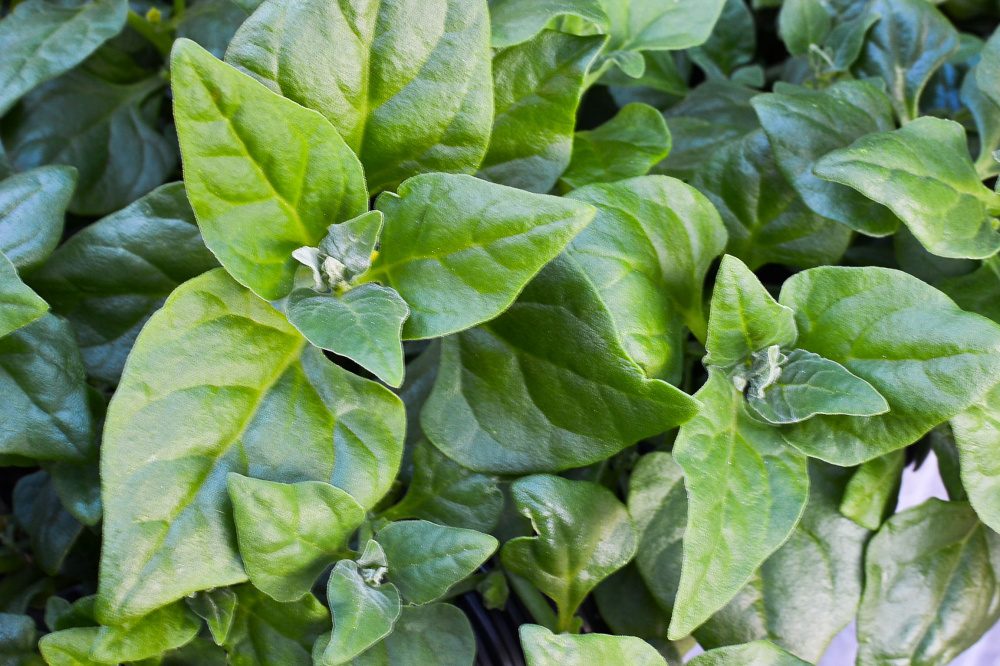
The leaves are arrowhead-shaped, 7 to 10 cm (2.8 to 4 in) long, soft, succulent and medium green. Fine hairs on the leaves and stems give the plant a fuzzy, glistening appearance.
The flowers are small, yellow and arise from the leaf bases throughout the year. They are bisexual, with both male and female parts, but require bees or other insects for pollination. After pollination, the flowers develop into angular, bell-shaped fruit up to 1.25 cm (0.5 in) long, with pointed horns; they turn dark brown when mature and contain three or more small seeds.
Edible uses
Cooked vegetable - The young leaves and stems were an important vegetable in the diet of Australia's and New Zealand's native people long before Europeans arrived. Although it is still eaten today, its use is overshadowed by non-native species such as English Spinach (Spinacia oleracea). It is now cultivated on a limited scale in home gardens and is sometimes available as a niche vegetable at farmers' markets.
Unlike English Spinach, it suits warm climates with high summer temperatures and bolts slowly (a reduced tendency to flower), which helped encourage its introduction and cultivation as a spinach crop in upland areas in the Philippines and some Central and South American countries. Though not related to English Spinach, the young leaves have a similar texture and flavour, albeit milder and slightly bitter. However, like English Spinach, it is high in oxalic acid, so it needs cooking.
Only the young leaves and stem tips are eaten, and are usually blanched for a couple of minutes, with the blanching water discarded as a precaution. After blanching, it can be stored frozen like spinach or used straight away in vegetable dishes, pestos, quiches and stuffings,
Salad vegetable - ...or in salads.
Environmental uses
Seaside garden plant - It grows naturally in seashore environments,
Erosion control - ...and is used extensively in coastal dune plantings in its native range to control erosion and sand drift.
Health uses
Iron - Cooked leaves and stems are reportedly a good source of iron,
Calcium - ...calcium,
Phosphorus - ...and phosphorus.
Climate
Grows naturally in sub-humid to moderately humid subtropical and tropical mid- to high-elevation climates, generally areas with annual lows of 8 to 19°C, annual highs of 17 to 30°C, annual rainfall of 600 to 3500 mm and a dry season of 7 months or less.
Growing
New plants are usually started from seed and benefit from pre-soaking in water for 24 hours before sowing. Performs best in rich or well-manured, free-draining loam and sand soils of a moderately acid to slightly alkaline nature, generally with a pH of 5.8 to 8.0, and sites with full to partial sun exposure.
The seeds are best sown in spring to early summer in subtropical areas and near the end of the rainy season in tropical areas, when soil moisture is sufficient for good germination and growth and humidity has started to fall.
Problem features
It has a creeping habit and produces viable seeds that water easily disperses. In some regions, it is recorded as an invasive species, a term applied to serious weeds. The Hawaii Pacific Weed Risk Assessment (HPWRA) project assessed it as a high weed risk species for Hawaii.
Uncooked leaves and stems have high oxalic acid content, which may adversely affect kidney function.
Where it grows
References
Books
-
Grubben, G.J.H. & Denton, O.A. (Editors) 2004, Plant Resources of Tropical Africa, Volume 2 : Vegetables, PROTA Foundation, Backhuys Publishers, Leiden
-
Macmillan, H. F. 1943, Tropical planting and gardening : with special reference to Ceylon, 5th ed, Macmillan Publishing, London
-
Rubatzky, V. E. & Yamaguchi, M. 1997, World vegetables : principles, production, and nutritive values, 2nd ed., Chapman & Hall, New York
-
Tindall, H. D 1983, Vegetables in the Tropics, Macmillan Press, London
-
Toensmeier, E. 2007, Perennial Vegetables : From Artichokes to Zuiki Taro, A Gardener's Guide to Over 100 Delicious and Easy to Grow Edibles, White River Junction, Chelsea Green Publishing, Vermont
-
Winters, H. F & Miskimen, G. W. 1967, Vegetable gardening in the Caribbean area, U.S. Dept of Agriculture, Washington D.C.