

Common name: Kakadu Plum
Other common names: Billy Goat Plum, Bush Plum, Gubinge, Salty Plum
Description
Kakadu Plum is an Australian native tree producing fruit with the highest known vitamin C content of any fruit, reportedly more than sixty times that of oranges.
The tree's natural range is limited to tropical northern Australia, where it occurs in open woodlands along the coastal plain from Broome, east through Kununurra, Darwin, and Katherine, to the Cape York Peninsula.
It is a small to medium-sized tree, reaching up to 12 m (40 ft), though it is more commonly 5 to 10 m (16 to 32 ft) tall, with a single, slender, straight trunk that is occasionally low-branching on poor sites and supports a wide-spreading crown. The bark is light grey, mottled and slightly rough.
Leaves are large, oval, up to 25 cm (10 in) long; they emerge bronze-red, mature to green with yellow ribs, then turn yellow in the dry season and fall to the ground to conserve water. They are arranged spirally along the stems, toward the ends of the branches.
Flowers are creamy-white, small and insignificant, borne on long flower spikes at the tips of the branches. They come into bloom at the transition from the dry to the rainy season, which coincides with spring to summer in its native range.
Fertilised flowers are followed by nipple-shaped oval fruit, 2 to 3 cm (0.8 to 1.2 in) long, green when young and becoming yellow-green, and less commonly purple, when ripe, with fleshy pulp surrounding a large seed.
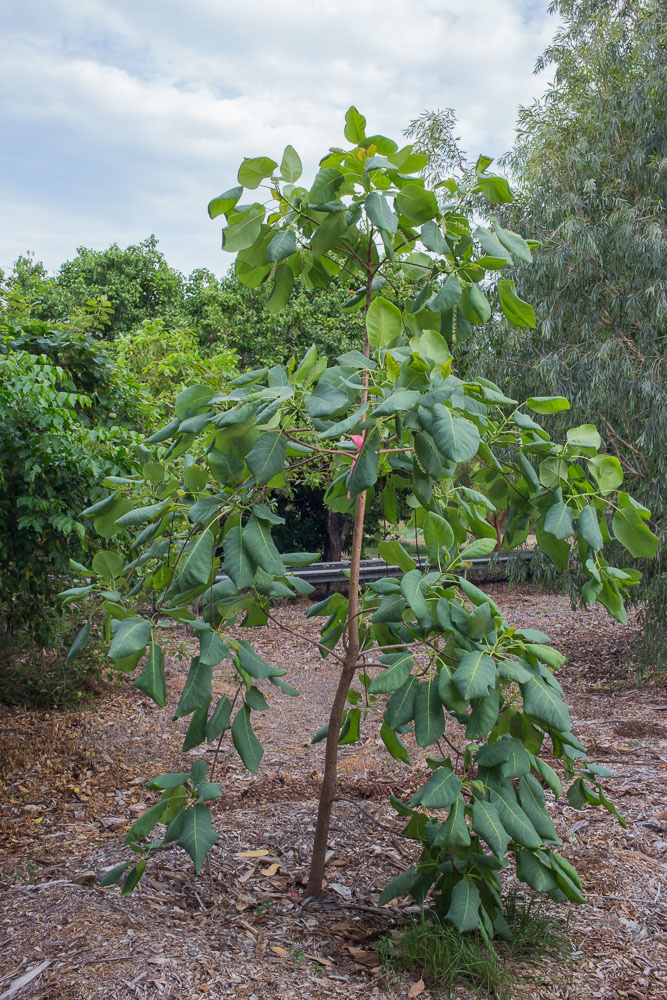
Young tree (Darwin, Australia)
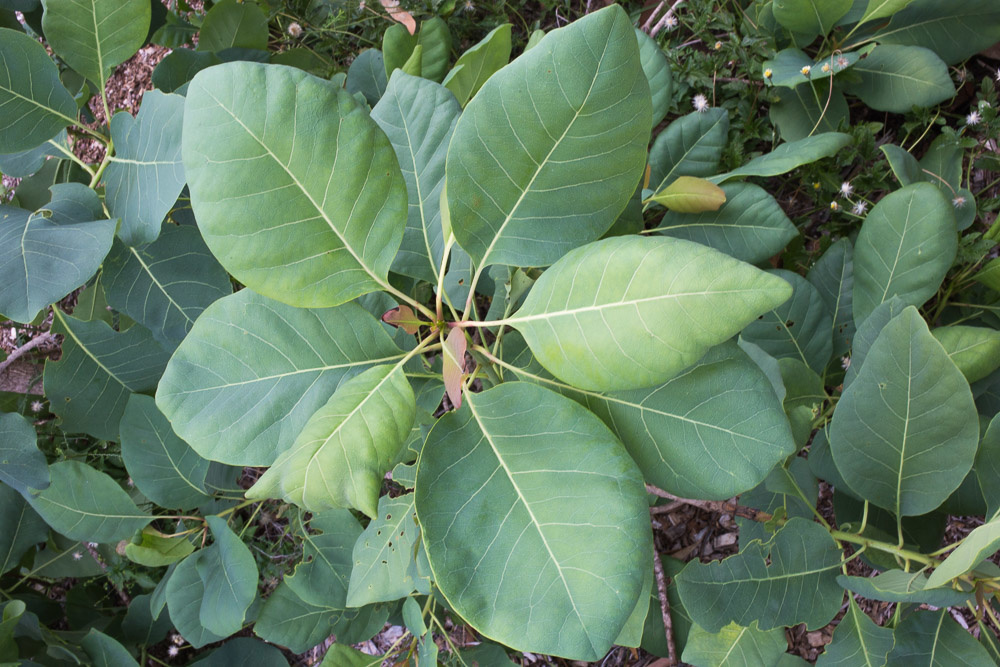
Leaves
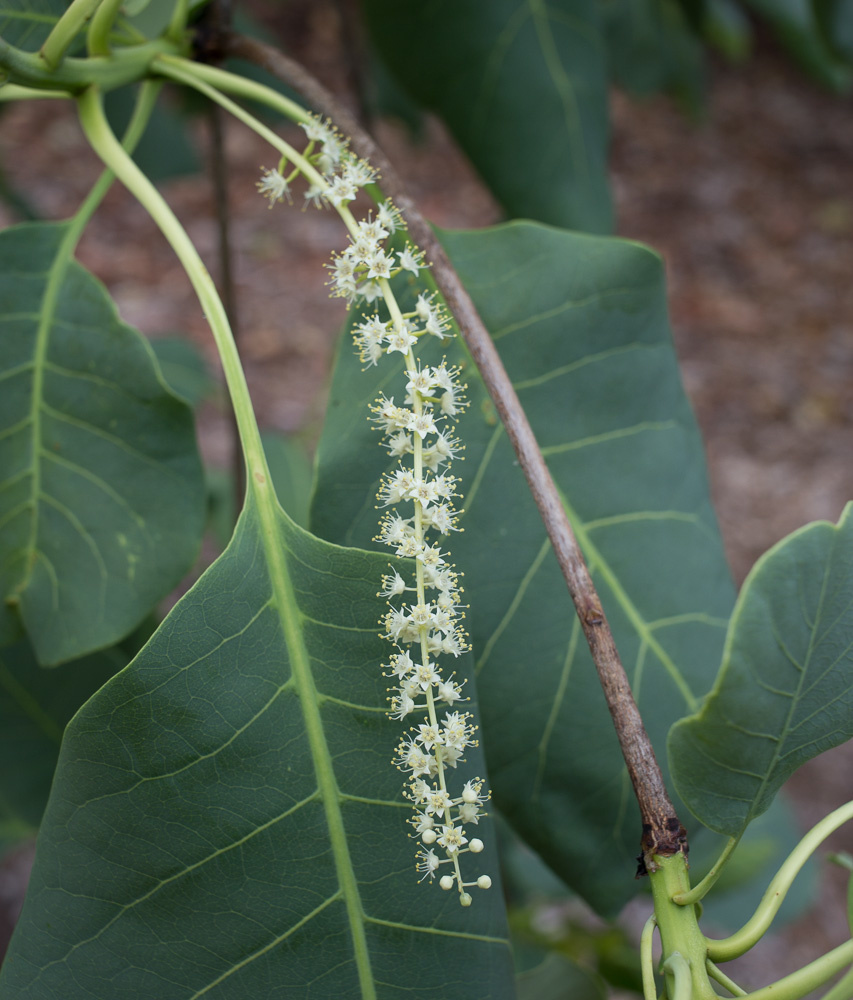
Flowers
Edible uses
Fresh fruit - The ripe fruit is a popular wild-harvested snack food in its native range. The fruit is eaten fresh out of hand by biting into the pulp, which, though scant, is juicy, fibrous, and pleasingly sour with a somewhat astringent flavour, described as reminding one of gooseberries. Because of its sourness, it has limited value as a fresh fruit.
Fruit spread - The pulp has long been used to make jam.
Fruit puree - In recent years, as its high vitamin C and antioxidant content has been recognised, demand for the pulp has increased in pharmaceutical, health-food, and cosmetic products. Commercial operations have been set up in remote communities in northern Australia to freeze wild-harvested fruit (within twenty-four hours), then transport it to processing facilities where the pulp is removed, pureed, and freeze-dried into a powder. The powder has found its way into a range of products as a health and beauty-promoting ingredient, including health foods, dietary supplements and skincare cosmetics.
Natural food preservative - Researchers have also found the freeze-dried pulp to have strong antimicrobial properties, and the Australian seafood industry has successfully tested it as a natural preservative, showing good results in extending shelf life and maintaining the appearance of fresh shellfish, particularly prawns and shrimp.
Material uses
Natural cosmetic - The freeze-dried fruit pulp powder is used as a beauty-promoting ingredient in skincare cosmetics.
Health uses
Vitamin C - The pulp has a high vitamin C and antioxidant content.
Climate
Grows naturally in sub-humid to moderately humid tropical coastal climates, generally in areas with annual lows of 20 to 25°C, annual highs of 30 to 35°C, annual rainfall of 600 to 2000 mm and a dry season of 4 to 8 months.
Growing
Although most fruit comes from wild-growing trees, reports suggest small-scale commercial cultivation has begun in remote northern regions of Western Australia. Growers extract seeds from fruit that has ripened and fallen to the ground, then sow them in containers with a free-draining potting mix. Seedling trees start to flower and bear fruit when about five to six years old.
It adapts to a wide variety of well-drained clay, loam, and sand soils that are moderately acidic to slightly alkaline, generally pH 5.0 to 7.5, and performs best in full to partial sun. It tolerates drought and seasonal flooding well but tolerates slow-draining or waterlogged soils poorly.
Problem features
There appears to be no record of it as a weed or invasive species, and the likelihood of it becoming a problem weed is low because its relatively large fruit and seed are not easily dispersed.
Where it grows
References
Books
-
Barwick, M., et al. 2004, Tropical & subtropical trees : a worldwide encyclopaedic guide, Thames and Hudson, London
-
Norrington, L. & Campbell, C. 2001, Tropical food gardens : a guide to growing fruit, herbs and vegetables in tropical and sub-tropical climates, Bloomings Books, Hawthorn, Victoria
-
Sultanbawa, Y. & Sultanbawa, F. 2016, Australian native plants : cultivation and uses in alternative medicine and the food industry, CRC Press, Boca Raton, Florida