

Common name: Arjun
Other common names: White Marudah, White Murdh
Description
Arjun is a multipurpose tree native to the Indian subcontinent, with a range extending from the Himalayan foothills to Sri Lanka.
In native forests, it may reach up to 25 meters (80 ft), with a straight, slender, buttressed trunk that is branch-free for more than half the tree's height and supports a compact, rounded crown. On open sites, it is typically low-branching, with a short trunk supporting a large, rounded crown. The bark is grey-brown, smooth on young trees, and flaking off in thin sheets on mature trees.
Leaves are elongated-oval and large, up to 25 cm (10 in) long and blunt or slightly pointed at the tip. They emerge bronze-red, become dark green and are arranged opposite to near opposite along the ends of the branches. At the start of the dry season, they gradually change colour from green to red, then fall to the ground.
The flowers are small to insignificant, creamy-white, and sweetly fragrant. They are borne on showy, finger-like clusters and bloom from spring to summer, coinciding with the onset of the rainy season in its native range. These are followed by five-winged oval fruit about 3 to 6 cm (1 to 2 in) long, yellow-green when young, becoming dark brown and dry when mature, and persist on the tree for a long time.
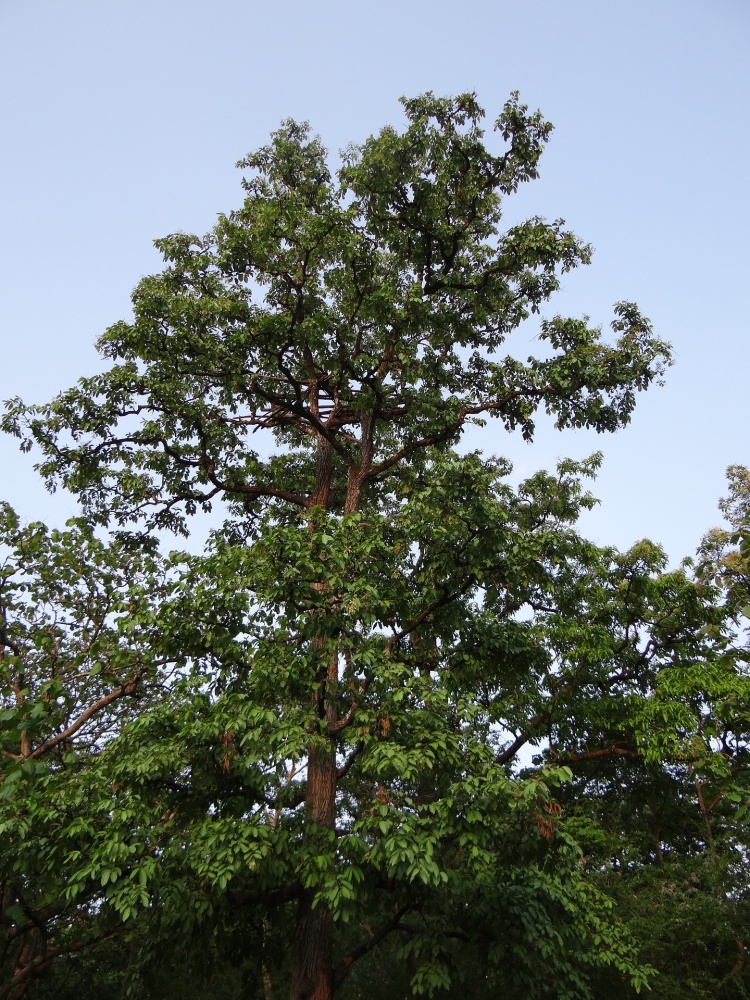
Image by Bishnu Sarangi from Pixabay
Environmental uses
Public garden tree - Arjun is sometimes cultivated in urban areas as a landscape tree for its attractive form,
Fragrant plant - ...sweetly fragrant flowers,
Foliage ornamental - ...interesting foliage,
Shade tree - ...and shade.
Seaside garden plant - Its good tolerance to saline and waterlogged soils also makes it a good candidate for seaside plantings,
Land rehabilitation - ...and coastal land reclamation and rehabilitation services.
Bee forage - The flowers produce good quantities of nectar that attract foraging honeybees, reportedly making it a major nectar source for honey production in Kerala and Karnataka states in southern India, though no reliable information appears to be published on the honey itself or its yield.
Material uses
Tanning agent - To a lesser extent, the bark and fruit are important sources of tanning material for the leather industry.
Livestock feed - The young leaves have a crude protein content of around 11% of their dry weight. They are harvested for livestock feed, and are also traditionally used as silkworm food in their native range.
Hardwood - The wood is medium-weight to heavy, ranging from 680 to 840 kg per cubic metre (42 to 52 lb per cubic ft). It has low natural resistance to decay and tends to warp and split on seasoning, and the trade considers it a minor timber.
Light construction - It is used mostly locally for general carpentry, and for making farm implements.
Firewood - The roundwood is valued as firewood,
Charcoal - ...and as a source-wood for charcoal production.
Health uses
Natural heart tonic - In Ayurvedic and traditional Indian medicine, bark extracts have been used as a heart tonic for at least 3,000 years, with a long history of treating heart failure and oedema. Modern research, ongoing in India since the 1930s, suggests the herb is best suited to conditions where blood supply to the heart is poor, such as ischaemic heart disease and angina, and that it helps maintain a regular heartbeat.
Research has also shown it to lower blood pressure and reduce cholesterol levels, supporting overall heart and circulatory health, though results on blood pressure have historically been conflicting, with some studies finding the reverse effect.
Ayurvedic physicians also use it to help restore balance among the three bodily humours (kapha, pitta, and vata) - including as a decoction to treat diarrhoea and dysentery, in powdered form as part of a traditional treatment for asthma, and for bile duct problems, poisoning, and scorpion stings. In Indian folk medicine, juice extracted from the leaves is also a traditional remedy for earache, and the herb is traditionally believed to be an aphrodisiac.
Climate
Grows naturally in sub-humid to humid subtropical and tropical climates, generally areas with annual lows of 17 to 25°C, annual highs of 26 to 35°C, annual rainfall of 700 to 3800 mm and a dry season of 4 to 8 months.
Growing
New plants are started from seed and transplanted from root suckers. It performs best on free- to slow-draining clay and loam soils of a moderately acid to neutral nature, generally with a pH of 5.5 to 7.0, and on sites with full sun exposure. It has good tolerance to soil salt, seasonal flooding and waterlogged soil conditions.
Problem features
It is listed as a weed in at least one reference publication. Still, it does not appear to be recorded as a serious weed anywhere. The fruits are large, persist on the tree for a long time, and are unlikely to be dispersed in large numbers or over any great distance from the parent tree. It is assessed as a low weed risk species for Florida by the IFAS Assessment of Non-Native Plants in Florida's Natural Areas.
Where it grows
References
Books
-
Asouti, E. & Fuller, D. Q. 2008, Trees and woodlands of South India : archaeological perspective, Left Coast Press, Walnut Creek, California
-
Bradbear, N. 2009, Bees and their role in forest livelihoods : a guide to the services provided by bees and the sustainable harvesting, processing and marketing of their products, Food and Agriculture Organization of the United Nations (FAO), Rome
-
Chevallier, A. 2000, Encyclopedia of herbal medicine, 2nd American ed., Dorling Kindersley, New York
-
Cowen, D. V. 2012, Flowering Trees and Shrubs in India, 6th edition, Thacker Press, Bombay, India
-
Crane, E., Walker, P. & Day, R. 1984, Directory of important world honey sources, International Bee Research Association, London, United Kingdom
-
Hocking, D. 1993, Trees for drylands, International Science Publisher, New York
-
Krishen, P. 2006, Trees of Delhi : a field guide, Dorling Kindersley Publishers, Delhi
-
Luna, R. K 1996, Plantation trees, International Book Distributors, Dehradun, Uttarakhand
-
Macmillan, H. F. 1943, Tropical planting and gardening : with special reference to Ceylon, 5th ed, Macmillan Publishing, London
-
Parrotta, J. A. 2001, Healing plants of peninsular India, CABI Publishing, Wallingford, Oxfordshire
-
Reyes, G. 1992, Wood densities of tropical tree species, U.S. Department of Agriculture, Forest Service, Southern Forest Experiment Station, New Orleans, Louisiana
-
Scheffer, T. C & Morrell, J. J. 1998, Natural durability of wood : a worldwide checklist of species, Forest Research Laboratory, Oregon State University, Corvallis, Oregon
-
Schmelzer, G.H., Gurub-Fakim, A. & Arroo, R.R.J. (eds) 2013, Plant Resources of Tropical Africa, Volume 11(2) : Medicinal Plants 2, PROTA Foundation, Backhuys Publishers, Leiden
-
Sheikh M. I. 1993, Trees of Pakistan, USAID Forestry Planning and Development Project, Pictorial Printers, Islamabad
-
Singh, R. V. 1982, Fodder trees of India, Oxford & IBH Publishing Company, New Delhi
-
Streets, R. J. & Troup, R. S. 1962, Exotic forest trees in the British Commonwealth, Oxford University Press, Oxford, England
-
Thomson, G. 2007, The health benefits of traditional Chinese plant medicines : weighing the scientific evidence, Rural Industries Research and Development Corporation (RIRDC), Barton, Australian Capital Territory
Articles, Journals, Reports and Working Papers
-
Dagar, J. C. & Singh, G. 2007, Biodiversity of Saline and Waterlogged Environments: Documentation, Utilization and Management, NBA Scientific Bulletin, (9), 78.
-
Morton, J.F. 1964, Honeybee Plants of South Florida, Proceedings of the Florida State Horticultural Society, Vol 77:415-436.
-
Seth, M.K 2003-10-01, 'Trees and their economic importance' The Botanical Review, vol. 69, no. 4, pp. 321(56).
-
Singh, K. P. & Kushwaha, C. P. 2006, Diversity of flowering and fruiting phenology of trees in a tropical deciduous forest in India, Oxford University Press
-
Somashekhar, B. S. and M. Sharma. 2002. Training manual on propagation techniques of commercially important medicinal plants. Foundation for Revitalisation of Local Health Traditions, Bangalore, India.