

Description
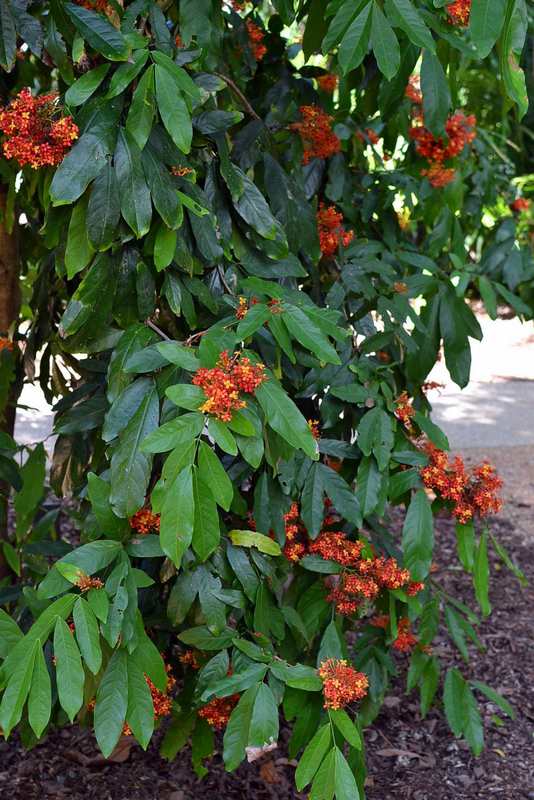
Originating in humid tropical areas of Southeast Asia, with a natural range across Vietnam, Thailand, Malaysia, and Indonesia, this flowering tree typically reaches 5 to 10 m (16 to 33 ft) tall, occasionally up to 20 m (66 ft).
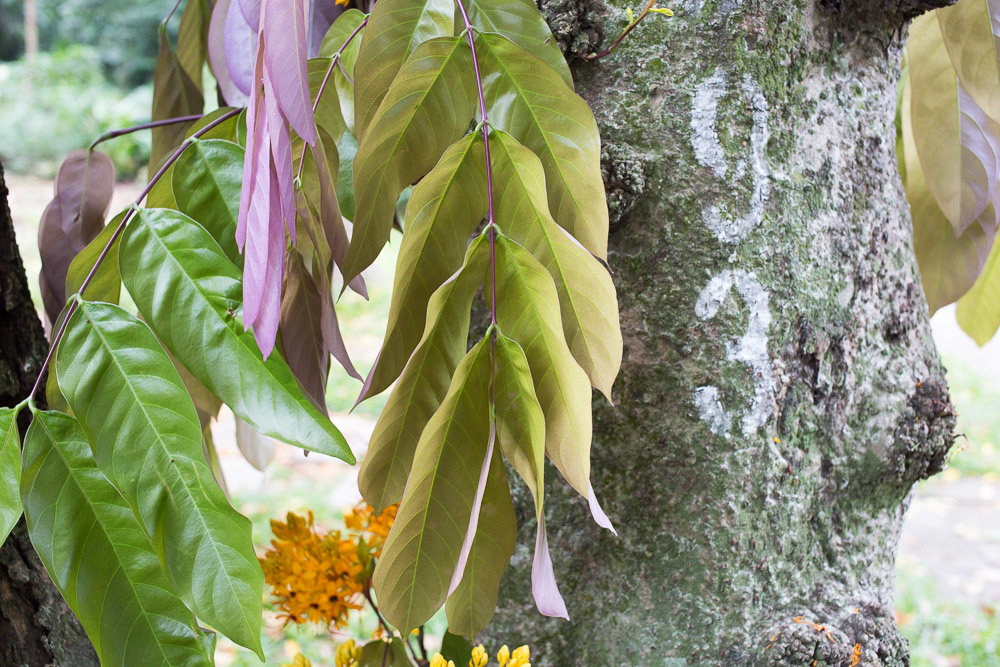
It develops a short, stout trunk and, on open sites, a wide-spreading crown of steeply arching branches, creating a weeping appearance. The bark is grey-brown and dotted with raised, wart-like pores known as lenticels.
Leaves are large, up to 25 cm (10 in) long, and feathery, consisting of six to twelve dark green oblong leaflets arranged in pairs along the length. New leaflets emerge pale purple-pink and hang limply, like those of Pride of Burma (Amherstia nobilis), contrasting with the stiff, dark green older leaves.
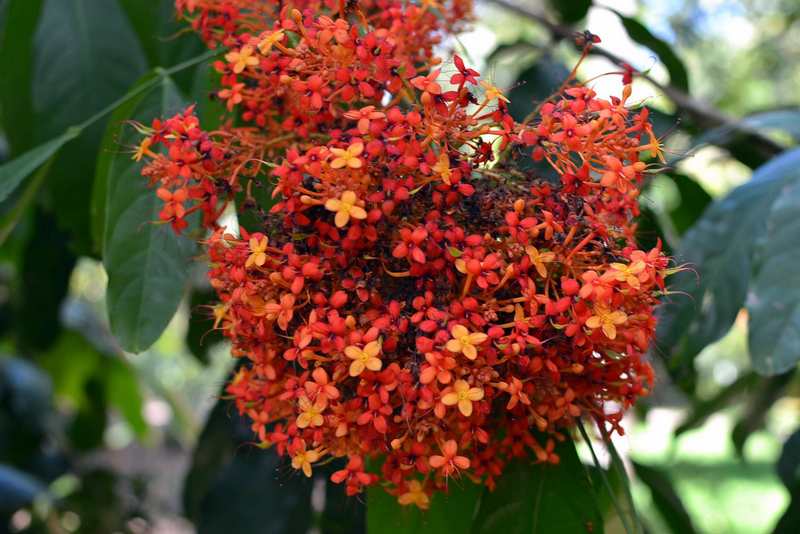
The flowers bloom from late winter to spring in large, densely packed rounded clusters borne directly on the trunk and main branches. They emerge yellow and then age to dark orange-red, though dense foliage partly obscures them. They emit a sweet fragrance, especially at night and are followed in autumn by large, flat, wine-coloured seedpods up to 25 cm (10 in) long.

Flowers (Ho Chi Minh City, Vietnam)

Seedpods (Darwin Botanic Gardens)
Environmental uses
Flowering ornamental - Asoka trees are commonly cultivated in the humid tropics for their eye-catching flower clusters and colourful seedpods,
Foliage ornamental - ....as well as for the tree's shapely form and attractive foliage.
Material uses
Hardwood - It produces heavy wood, averaging more than 800 kg per cubic meter (50 lbs per cubic ft), but with low natural resistance to rot, decay, and wood-boring insects.
Firewood - It may be useful as firewood when adequately dried.
Health uses
The bark reportedly stimulates ovarian and uterine tissue. It is used in traditional Indian medicine to treat menstrual pain, menorrhoea due to uterine fibroids, leucorrhoea, haemorrhoids and internal bleeding.
Climate
Grows naturally in humid tropical climates, generally frost-free areas with annual lows of 19 to 25°C, annual highs of 27 to 35°C, annual rainfall of 1500 to 4000 mm and a dry season of 5 months or less.
Growing
New plants are usually started from seed. Performs best on rich, free-draining clay-loam, loam and loamy-sand soils of a moderately acid to neutral nature, generally with a pH of 5.0 to 7.5, and on sites with partial sun to light shade exposure. It requires some shade and near-constant humidity for good growth and flowering performance. It is intolerant of harsh conditions and performs poorly in areas with a pronounced dry season.
Problem features
There do not appear to be any records of escape and naturalisation anywhere, despite its widespread cultivation outside of its native range. The Hawaii Pacific Weed Risk Assessment (HPWRA) project assessed it as a low weed risk species for Hawaii.
Where it grows
References
Books
-
Allen, O. N. & Allen, E. K. 1981, The Leguminosae : a source book of characteristics, uses, and nodulation, University of Wisconsin Press, Madison, Wisconsin
-
Barwick, M., et al. 2004, Tropical & subtropical trees : a worldwide encyclopaedic guide, Thames and Hudson, London
-
Macmillan, H. F. 1943, Tropical planting and gardening : with special reference to Ceylon, 5th ed, Macmillan Publishing, London
-
National Research Council (Board on Science and Technology for International Development) 1979, Tropical legumes : resources for the future, The National Academies Press, Washington D. C.
-
Parrotta, J. A. 2001, Healing plants of peninsular India, CABI Publishing, Wallingford, Oxfordshire
-
Randall, R. P. 2007, The introduced flora of Australia and its weed status, Cooperative Research Centre for Australian Weed Management, Glen Osmond, South Australia